Chrysanthemums in Golden Bloom: The Reversal at the Extremity of Decline and the Hermit's Integrity in the Cold Dew Solar Term
This article offers a deeply layered reading of Cold Dew (Hanlu) from the perspectives of pre-Qin Confucian and Daoist philosophy, the original meanings of Chinese characters, astronomy and phenology, and the Double Ninth chrysanthemum festival. It examines the gradual shift of dew from 'white' to 'cold,' the principle of reversal at the extremity of decline embodied in the Bo hexagram's five yin lines stripping away yang yet preserving the 'great fruit uneaten,' the gentleman's integrity symbolized by chrysanthemums defying autumn frost, and the ritual propriety of wild geese arriving as guests — revealing the hidden seed of renewal concealed within the stripping away of yang.
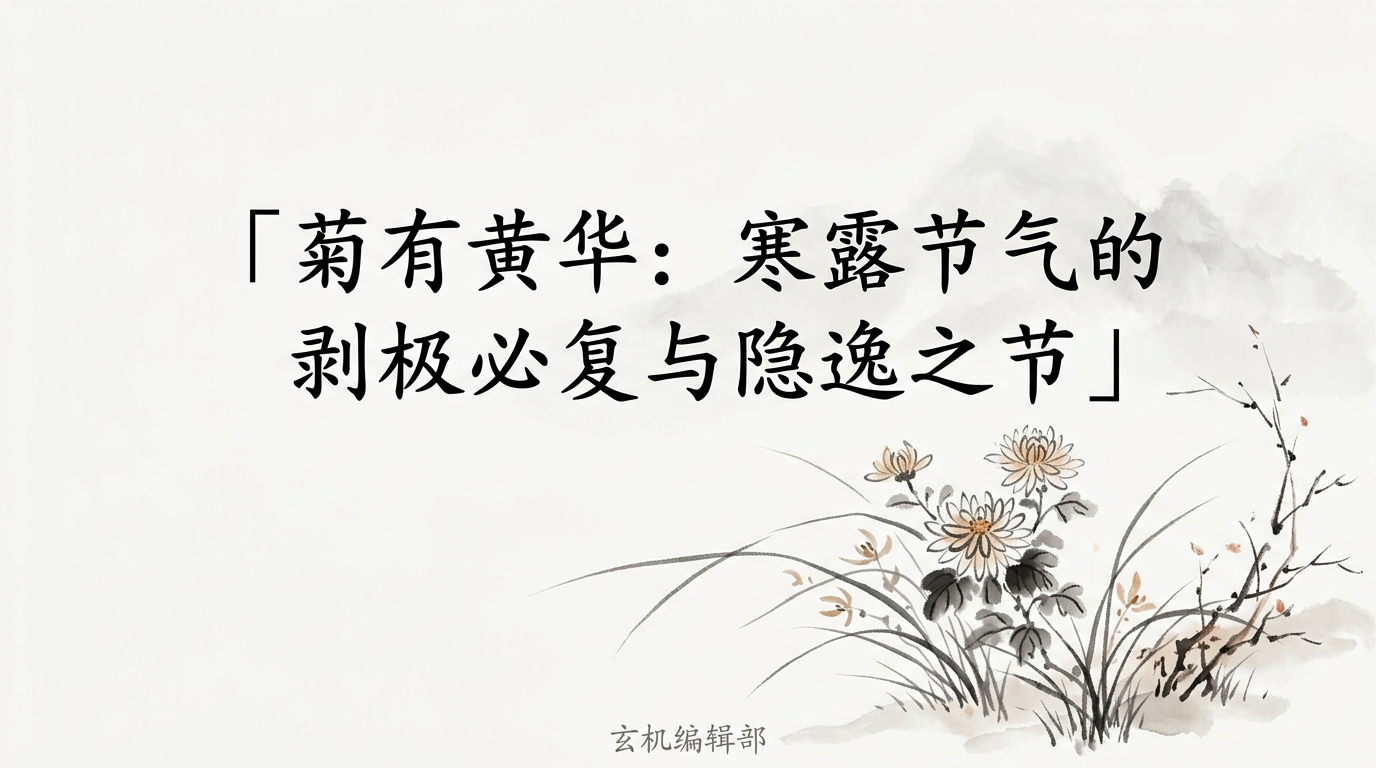
Chapter Thirteen: Cold Dew in Literature -- Dining on Chrysanthemums, Autumnal Melancholy, and the Flowing Fire
I. The Chuci's Dining on Chrysanthemum and Drinking Dew: The Archetype of Purity
Cold Dew's spiritual archetype in literature crystallized earliest and most profoundly in the Chuci (Songs of Chu). The two immortal lines from Master Qu Yuan's Lisao -- "At dawn I drink the dew that drops from magnolia; at dusk I dine on fallen petals of autumn chrysanthemum" -- created an imagery of unmatched purity. This "drinking dew and dining on chrysanthemum," an almost otherworldly mode of sustenance, shaped the image of a poet standing alone in the world, clear as ice and pure as jade. In an age of universal turbidity and universal drunkenness, the poet nourished himself on heaven and earth's purest substances, symbolizing his utter refusal to be sullied by the corrupt world. This spiritual posture became one of the most important archetypes for Chinese literati across two millennia.
The Chuci also offered the foundational image of autumn melancholy. The "Nine Songs: Lady of the Xiang" opens: "Gently, gently blows the autumn wind; Dongting's waves rise, and the tree-leaves fall." What a bleak yet beautiful autumn scene! "The tree-leaves fall" is the very image of Cold Dew's late autumn, when all things wither and grasses and trees turn yellow and drop their leaves.
II. Autumn's Images in the Book of Songs: The Flowing Fire, Winter Garments, and White Dew Becoming Frost
If the Chuci infused Cold Dew with purity and pathos, the Book of Songs (Shijing) provided the most unadorned, most heartfelt autumn tableaux.
The poem most powerfully evoking Cold Dew's "dew congealing into frost" is Jiangjia ("Reeds") from the "Airs of Qin":
"The reeds grow thick and gray; white dew has turned to frost. The one I long for stands beyond the water's other shore."
These words -- "white dew has turned to frost" (bailu wei shuang) -- precisely depict the transition from White Dew through Cold Dew to Frost's Descent, when dew gradually congeals into frost. Jiangjia sets this bleak, chilling late-autumn scene as the backdrop for a longing that is misty, elusive, and unattainable -- a figure "beyond the water's other shore," separated by vast autumn waters and cold frost. The result is one of the most hauntingly beautiful passages in all Chinese literature -- a perfect fusion of the season's unique phenology with an eternal human emotion.
III. The Tradition of Autumnal Melancholy: From Song Yu to the Heart of Letters through the Ages
The bleakness and severity of late autumn at Cold Dew gave rise to one of Chinese literature's most enduring traditions -- "autumnal melancholy" (beiqiu). Its foundational work is Master Song Yu's Jiubian (Nine Arguments):
"Alas, the aspect of autumn! Bleakly, bleakly the grasses and trees shake and shed, declining and decaying. Chill and somber, as if on a distant journey -- climbing mountains, facing waters, seeing off one who departs."
These lines captured the mood of autumn with such penetrating force that they established the keynote for the entire tradition of autumnal melancholy.
But how should we view this "autumnal melancholy" from the standpoint of Cold Dew's philosophy$6 Melancholy in autumn is natural human feeling, but it is not the totality of Cold Dew's spirit, nor its highest register. The true spirit of Cold Dew lies not in "sorrow" but in "insight" -- in seeing through the appearance of universal withering to discern the cosmic secret of "reversal at the extremity of decline"; in perceiving within yang's stripping the "great fruit uneaten"; in admiring the chrysanthemum's "golden bloom defying frost" amid late autumn's severity.
From "autumnal melancholy" to "autumnal insight," from grief to equanimity -- this is the path of spiritual elevation that Cold Dew's literature offers us. Master Song Yu's "Alas, the aspect of autumn" is the starting point; Tao Yuanming's "Picking chrysanthemums by the eastern hedge" and Su Dongpo's "With a rain-cloak amid mist and rain, I go where I will" are the luminous destination to which this path leads.