Blog
Exploring the mysteries of Yi studies and sharing ancient wisdom
The Return of First Yang: The Heart of Heaven and Earth at the Winter Solstice and the Origin of the New Year
This article offers a profoundly detailed interpretation of the Winter Solstice among the Twenty-Four Solar Terms, drawing upon pre-Qin Confucian and Daoist philosophy, etymological analysis, and astronomical calendrics. It reveals the cosmic pivot of 'yin at its extreme giving birth to yang, the return of first yang, and the beholding of heaven and earth's heart,' examines the rites of the Round Mound sacrifice to Heaven, the origin of the calendar epoch at the month of Zi, and the foundational note of the Yellow Bell pitch-pipe, guiding you through the ancient wisdom by which our forebears discerned the generative heart of heaven and earth amid the deepest darkness.
Auspicious Snow Sealing the Earth: The Nascent Yang within Supreme Yin at the Major Snow Solar Term
This article offers a deep reading of Major Snow (Daxue) among the twenty-four solar terms, drawing upon pre-Qin Confucian and Daoist philosophy, etymological origins, astronomy, and phenology. It analyzes the etymology of 'da means flourishing — at this point snow flourishes,' examines the Hexagram of Return (Fu) with its 'single yang returning' in the zi month, and reveals the virtue of auspicious snow sealing and protecting nascent yang, along with the profound cosmology of 'supreme yin birthing yang — the heart of Heaven and Earth.'
Chrysanthemums in Golden Bloom: The Reversal at the Extremity of Decline and the Hermit's Integrity in the Cold Dew Solar Term
This article offers a deeply layered reading of Cold Dew (Hanlu) from the perspectives of pre-Qin Confucian and Daoist philosophy, the original meanings of Chinese characters, astronomy and phenology, and the Double Ninth chrysanthemum festival. It examines the gradual shift of dew from 'white' to 'cold,' the principle of reversal at the extremity of decline embodied in the Bo hexagram's five yin lines stripping away yang yet preserving the 'great fruit uneaten,' the gentleman's integrity symbolized by chrysanthemums defying autumn frost, and the ritual propriety of wild geese arriving as guests — revealing the hidden seed of renewal concealed within the stripping away of yang.
White Dew Turns to Frost: The Autumn Beauty of Bailu — The Figure Beyond the Water and the Splendor of Yin's Condensation
This essay offers an in-depth exploration of the Bailu (White Dew) solar term from the perspectives of pre-Qin Confucian and Daoist philosophy, etymological analysis, astronomy and phenology, and the Classic of Poetry's 'Reeds and Rushes' (Jianjia). It examines how dew forms through the interplay of yin and yang qi, the philosophy of concealment and manifestation, the metaphor of morning dew, the celestial shift as yin grows heavy and dew turns white, the eternal longing of 'reeds so grey, white dew turns to frost' — the unattainable figure beyond the autumn waters — and the wisdom of contemplation found in the Guan hexagram's 'great observation above' and 'teaching through the numinous way.'
Name and Mind: A Study of Xunzi's "Rectification of Names"
A complete study of the *Zhengming* (Rectification of Names) chapter of the *Xunzi*. It takes up the Master's chain—"if names are not rectified, speech does not flow"—and opens onto the distinction between names having no fixed appropriateness and names having a fixed goodness; it traces in detail the boundary of convention-becoming-custom, the Heavenly Faculties' sorting of categories and the mind's verifying cognition, the three delusions and the inevitability of disputation, the three grades of speech, how order and disorder lie in what the mind approves, the Way as the true balance across past and present, and ends with "the self enslaved to things" and "valuing the self and putting things to service." It takes Confucian and Daoist principle as its foundation, drawing on the *Analects*, *Mencius*, *Doctrine of the Mean*, *Laozi*, *Zhuangzi*, *Zuo Tradition*, and the *Book of Songs*.
Dwelling, One Observes the Images; Acting, One Observes the Changes -- Reading the Chapter "The Sage Established the Hexagrams and Observed the Images" from the Upper Xici
A line-by-line reading of the second chapter of the Upper Xici. The sage's four acts -- establishing the hexagrams, observing the images, appending the statements, clarifying fortune and misfortune -- run in exact reverse order to the noble person's four acts -- observing the images, savoring the statements, observing the changes, savoring the divination. The four clauses "is the image of..." form a chain tracing effect back to cause; "the repose in which he dwells" echoes the Doctrine of the Mean's "dwelling in ease, awaiting the Mandate"; and the chapter closes by quoting the top line of hexagram Da You, "From Heaven comes its aid," gathering the whole into the two words compliance and good faith. Grounded in Confucian and Daoist thought, and drawing on the Analects, Mencius, Laozi, Zhuangzi, Xunzi, and the Zuo Tradition, it explores how the noble person finds repose between Heaven and Earth and acts amid change.
When Heat Ceases and Coolness Arises: The Wisdom of Knowing When to Stop and the Rites of Returning to the Root at Chushu
This article explores Chushu (End of Heat) from the perspectives of pre-Qin Confucian and Daoist philosophy, etymological origins, and astronomical phenology, revealing the wisdom shared between 'heat ceases at this point' and 'knowing where to stop, one finds stability.' Through analysis of the character chu (to stop), the hawk's ritual offering of birds, the onset of heaven and earth's solemnity, and the grain's ascent as a return to origins, the article illuminates the ancient way of measured restraint and reverent remembrance.
A Modest Discourse on "Li" (Ritual Propriety) — Part 1
Approaching the subject from the standpoint of pre-Qin Confucianism, this article examines the origin, essence, and civilizational foundations of ritual propriety (li), seeking to understand the profound meaning it carries between human ethical order and the Way of Heaven.
Aided by Heaven, Fortune Without Bound — Why the Top Nine of Dayou Is the Foremost Auspicious Line Among the Zhouyi's 384 Lines
Argued across four dimensions — the judgment text, the line's position, cross-verification between the Classic and its Commentary, and philosophical meaning — this essay shows why the top nine of Hexagram Dayou (Great Possession) stands first among the 384 lines of the Book of Changes: 'Aided by Heaven, fortune — nothing unfavorable' is the only unconditional, supreme judgment in the entire classic, while the Great Treatise, speaking in the Master's own voice, supplies the operative mechanism for attaining such fortune — 'treading on trust, cherishing compliance, and honoring the worthy.'
Nurturing Aspiration, Modeled on the Sacred Tortoise: A Reading of the *Guiguzi*'s Seven Techniques of the Basic Scripture
A line-by-line exegesis of the second of the Seven Techniques in the *Basic Scripture of the Hidden Tally* section of the *Guiguzi* — 'Nurturing Aspiration, Modeled on the Sacred Tortoise.' Taking 'aspiration is the envoy of desire' as its diagnosis of pathology and 'when heart-qi is unified, desire no longer wanders' as its chain of cure, the essay draws on the *Book of Changes*, *Book of Documents*, *Book of Songs*, *Zuo Tradition*, *Analects*, *Laozi*, *Zhuangzi*, *Mencius*, *Guanzi*, and *Xunzi* to restore, within its Pre-Qin context, the original meaning of nurturing aspiration, understanding others, and the threefold virtue of the sacred tortoise.

Substantiating Intent, Modeled on the Flying Serpent: A Reading of the Third of the Seven Techniques in the *Guiguzi*'s 'Original Canon on the Yin Tally'
A line-by-line exegesis of 'Substantiating Intent, Modeled on the Flying Serpent,' the third technique of the Seven Techniques of the Yin Tally in the Original Canon of the *Guiguzi*. Beginning from the definition 'substantiated intent is the deliberation of qi,' it traces the pathology of a hollow intent, the cultivation sequence from calming the five viscera to contemplating the Great Void, the cognitive attainment of 'knowing all under Heaven without leaving one's door,' and clarifies the image of the flying serpent through three pieces of pre-Qin evidence drawn from the *Xunzi*, *Shenzi*, and the *Great Treatise*.
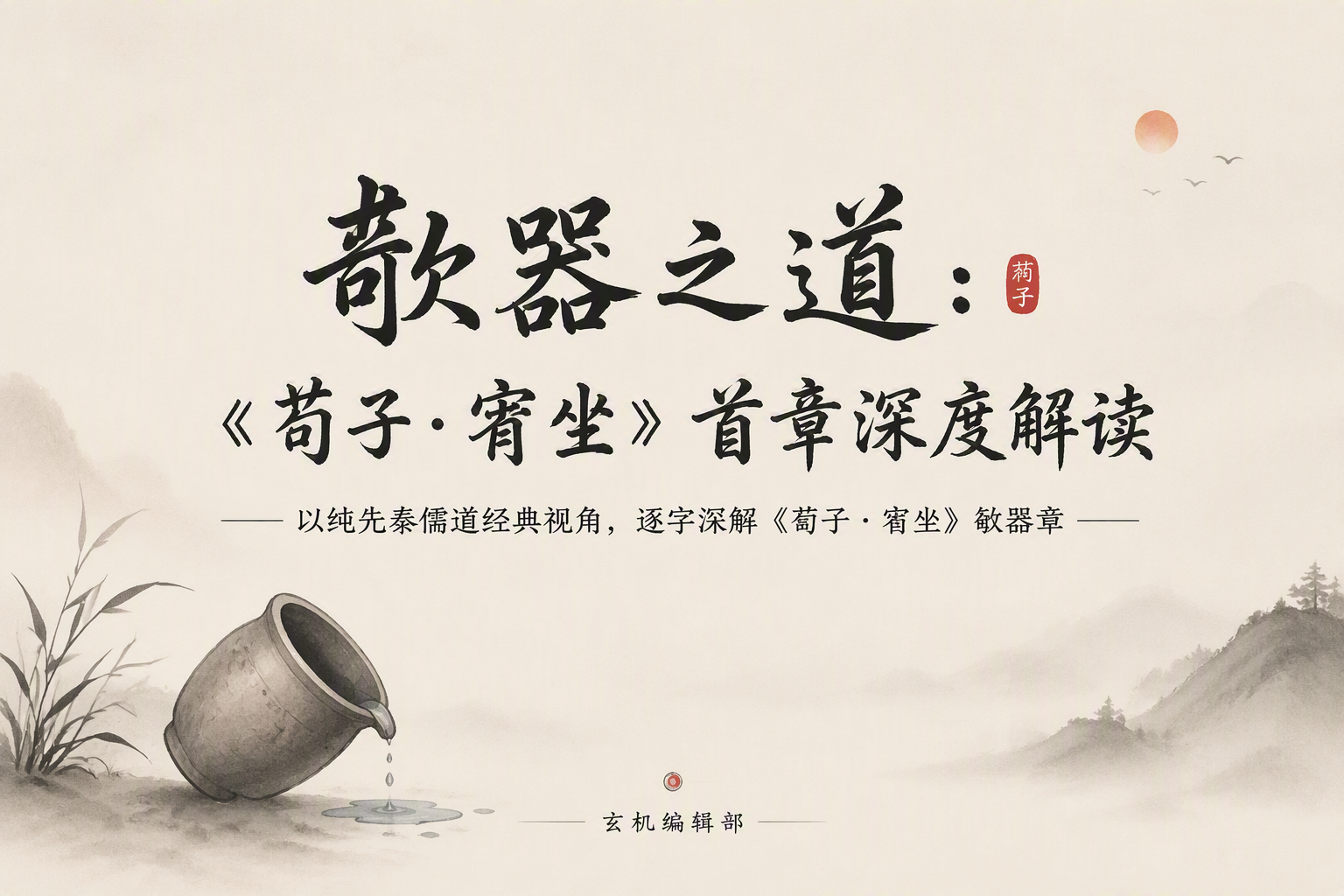
The Way of the Tilting Vessel: A Deep Reading of the Opening Chapter of Xunzi's "Youzuo"
Reading the tilting-vessel chapter of Xunzi's "Youzuo" word by word, purely through the lens of pre-Qin Confucian and Daoist classics. From the threefold meaning of the character 宥 (you), the political allegory of Duke Huan of Lu's ancestral temple, the two kinds of emptiness in "empty and it tilts," and the four layers of meaning behind Zilu's question about holding fullness rather than guarding the mean, to the relation between the four "guardings" — meeting cleverness with foolishness, meeting merit with yielding — and virtue, and the cosmological argument and social extension of "dipping out and diminishing." Drawing together the *Analects*, *Mencius*, *Laozi*, *Zhuangzi*, the *Great Treatise*, the *Zuo Tradition*, and the *Discourses of the States*, this essay reveals how a wordless inscription came to carry the whole pre-Qin wisdom of fullness, emptiness, loss, and gain.
Grain and Fire as Autumn: The Severance of Heaven and Earth and the Onset of Solemn Killing at Liqiu
This article offers an in-depth interpretation of Liqiu (Start of Autumn) among the Twenty-Four Solar Terms, drawing on pre-Qin Confucian and Daoist philosophy, the original meanings of Chinese characters, and astronomical-phenological perspectives. By examining the etymological roots of 'qiu' (autumn) as grain-and-fire, the astronomical coordinate of 135° solar longitude, and the image of Hexagram Pi (Standstill) from the Yijing — 'Heaven and Earth do not interact' — it reveals Liqiu as the pivotal moment when all things shift from 'growth' to 'gathering,' illuminating the virtue of Metal, the onset of solemn killing, and the ancient roots of the autumnal grief tradition.
Rotting Grass Transforms into Fireflies: The Philosophy of Metamorphosis and the Earth Virtue of Late Summer in the Great Heat
This article offers a deep reading of Great Heat (Dashu), the twelfth of the twenty-four solar terms, through the lenses of pre-Qin Confucian and Daoist philosophy, classical etymology, and astronomical phenology. It reveals the cosmic significance of the sun reaching ecliptic longitude 120°, when summer heat attains its zenith, and explores the Earth virtue of late summer, the metamorphosis of rotting grass into fireflies, and the hexagram Dun with its two rising yin lines — illuminating the ancient wisdom of reversal at the extreme and counterbalancing excess.
Rising Together to the Ranks of Lords: Innate Equality and the Pre-Qin Vision of Self-Cultivation, Compared with Western Freedom and Equality
Starting from a brief episode in the Analects, in which the noble Wenzi of Wei promotes his own household steward, Zhuan, to stand alongside him among the lords, this essay reads that small event against the great declarations of freedom and equality since the Renaissance: the West places its ideal at the starting line, while the pre-Qin thinkers built the ideal into lived reality.
A Systematic Survey of Duan-School Blind-Sect Fate Calculation
A systematic survey of Duan-school Blind-Sect (Mangpai) fate calculation, examined through its lineage, guest-and-host framework, substance-and-function framework, structural work (gong), emptiness and solidity, the Ten Gods, image-reading methods, tomb-and-storage palaces, and timing systems — with a clearly bounded comparison to the Ziping pattern method.
A Comprehensive Survey of the Fengshui Principle-and-Qi School
From historical origins, theoretical foundations, and the compass as core instrument, to the doctrines of Eight Mansions, Sanhe, Xuankong Flying Star, and other major schools—along with comparative case studies and inter-school debates—a panoramic survey of the principle-and-qi (liqi) tradition for advanced readers.
.png?v=3)
A Complete Study of Commercial Shop Fengshui (Esoteric Edition): From Form School and the Luopan to Xuankong Dating
A systematic account of commercial shop fengshui built on the traditional arts themselves — exterior form school (luantou), the Twenty-Four Mountains, Three Cycles Xuankong plotting, doors/paths/registers, annual date selection, Five Phases remediation, and worked case studies.
First Reading of Chapter One of the Upper Xici: Heaven and Earth Take Their Places, and Virtue Is Formed Through Ease and Simplicity
A close reading of Chapter One of the Upper Xici within the context of pre-Qin thought, moving through the layers of Heaven and Earth, Qian and Kun, the firm and the yielding, image and form, change, ease and simplicity, virtue and achievement, and the taking of one's place -- to see how the Yi runs through the Way of Heaven, the Way of Earth, and the Way of Man.
Warm Wind Arrives: The Way of Withdrawal at the Height of Flourishing in the Minor Heat
This article offers a deep reading of Minor Heat (Xiaoshu) through the dimensions of pre-Qin Confucian and Daoist philosophy, classical etymology, and astronomy and phenology. It analyzes the dual meanings of heat in the character 'shu' and the moderation implied by 'minor' as yet unextreme, reveals the noble person's way of withdrawing at the height of flourishing and retreating while the current still runs strong as expressed in the hexagram Dun (Retreat), and explores the ancient wisdom of Earth virtue presiding at the center of late summer and of nurturing the heart through concealment and stillness — inviting readers to return to a world of resonance between heaven and humanity.
Explaining the Yijing to a Distant Friend: An Introduction to the Xici Zhuan
An introduction to the Xici Zhuan (Appended Statements) of the Zhouyi, written for a faraway reader. Beginning with the fundamental concepts of hexagrams, lines, yin-yang, and the high and the low, it clarifies the composition and reading of the Xici, dispels the most common misunderstandings of beginners and overseas readers, and paves the way for a close study of the twelve chapters of the Upper Xici.
The Zenith of Daylight: Yang at Its Peak, Yin Nascent — The Celestial Pivot of the Summer Solstice
This essay examines the Summer Solstice from the perspectives of pre-Qin Confucian and Daoist philosophy, etymology, astronomy, and phenology. It analyzes the dual meaning of zhi (至) as both 'ultimate' and 'turning point,' reveals the cosmic pivot of 'one yin arising at the Summer Solstice,' and elucidates the ancient rites of gnomon shadow-measurement and solstice sacrifices — illuminating the ancestral wisdom of vigilance at the peak and moving in accord with the seasons.
Bearded Grain and Sown Seed: The Farming-Time Philosophy of Mangzhong and the First Stirring of Yin
Drawing on pre-Qin Confucian and Daoist thought, etymology, astronomy, and phenology, this article offers an in-depth reading of Mangzhong (Grain in Ear), the ninth of the twenty-four solar terms. It reveals the farming-time philosophy behind the folk saying "Mangzhong is busy sowing," examines the phenomena of the praying mantis emerging and the shrike beginning to cry at solar longitude seventy-five degrees, and unfolds how the Gou hexagram's "first stirring of yin" marks a cosmic turning point at the very height of yang—inviting readers into the ancient wisdom of racing against time and revering the seasons as one reveres the divine.
Full Yet Not Overflowing: The Wisdom of Waxing, Waning, and Humility in the Xiaoman Solar Term
This article offers an in-depth interpretation of Xiaoman (Grain Full), one of the twenty-four solar terms, drawing on pre-Qin Confucian and Daoist philosophy, philology, astronomy, and phenology. Through the etymology of "full yet not overflowing," and the phenological signs of bitter herbs flourishing and wheat's autumn arriving, it reveals the deep meaning behind why the twenty-four solar terms include a "small fullness" (Xiaoman) but no "great fullness"—illuminating the ancient Chinese wisdom of guarding against excess, prizing humility, of loss following fullness and gain following modesty, of completeness found even in imperfection, and the venerable cosmology of the unity of Heaven and humanity.
On the Usurpation of Status: A Critical Exegesis of the Analects Passage "Is Zang Wenzhong a Usurper of Status$1"
This article provides a rigorous exegesis of the *Analects* passage regarding Zang Wenzhong’s "usurpation of position," utilizing philological analysis and historical contextualization to examine the political ethics underlying his failure to promote the virtuous Liuxia Hui. By synthesizing evidence from the *Zuo Zhuan* and the *Records of the Grand Historian*, the study elucidates Confucius's profound discourse on the legitimacy of political authority and the moral imperatives of personnel selection.
Alas! I Have Never Seen One Who Loves Virtue as One Loves Beauty: A Philological and Exegetical Analysis of the Analects
This article provides a rigorous philological and historical analysis of the Analects passage, "Alas! I have never seen anyone who loves virtue as much as they love physical beauty." By examining the inherent tension between natural human desire and moral cultivation, the study reconstructs Confucius’ profound disillusionment with the human condition while elucidating the Confucian imperative of prioritizing moral integrity in governance.
An In-depth Interpretation of Lixia in the Twenty-Four Solar Terms: Philosophical, Philological, and Astronomical Perspectives
This article provides an in-depth analysis of Lixia (the Beginning of Summer) through the lenses of pre-Qin Confucian and Daoist philosophy, etymological roots, and astronomical observation, elucidating its significance as the critical juncture where the cosmic momentum shifts from "birth" to "growth." By examining the evolution of the character "xia" (夏) and the movement of the star Antares, the study reveals the profound wisdom behind the ancient mandate of "respectfully bestowing the seasons" and the harmonious worldview of unity between humanity and the cosmos.
Names Establish the World, the World is Established by Names: A Deep Interpretation of "The Names Established by the Later Kings" and "General Names Residing in People" in Xunzi’s "Rectification of Names"
This study offers a profound analysis of the *Zhengming* chapter in the *Xunzi*, specifically examining the philosophical implications of "the perfected names of the later kings" and "dispersed names." By situating Xunzi’s theory within the broader discourse of Pre-Qin thought, the article elucidates how the rectification of names functions as a critical nexus for political governance, social order, and epistemological framework.
The Beauty of the Three Dynasties Condensed into a Single Chapter: A Deep Interpretation of "Yan Yuan Asking about Governing the State" in the Analects of Confucius, Weilinggong
This article provides a rigorous analysis of the "Yan Yuan wen weibang" passage in the *Analects*, examining Confucius’s political pedagogy—centered on the calendar of the Xia, the carriage of the Shang, the ceremonial cap of the Zhou, and the music of Shao—as a synthesis of the essential wisdom of the Three Dynasties. By situating these practices within the broader framework of Confucian statecraft, the study elucidates the idealized civilizational paradigm of the tradition and the enduring philosophical significance of its transmission.
He Who Does Not Plan for the Future Will Find Trouble at His Door: A Philosophical Inquiry into Foresight and Causality in the Analects
This article provides a rigorous exegesis of the Confucian aphorism, "he who lacks foresight will find woe at hand," by examining the conceptual interplay between "foresight" (lü) and "woe" (you) within the framework of pre-Qin texts. Drawing upon the philosophical insights of the *Analects*, particularly the *Wei Ling Gong* chapter, it elucidates the teleological significance of proactive planning and the cultivation of sagacious vision as a means to transcend immediate existential contingencies.
The Distinction between Penalties and Virtue and the Learning of Heaven’s People: A Deep Exegesis of the Five Chapters in Xunzi’s "Dali"
This article offers an in-depth examination of the "Dali" chapter of the *Xunzi*, focusing on the dialectic between penal law and moral virtue (*xingde*) alongside the discourse of the "heaven-ordained people" (*tianmin*). By analyzing the historical evolution of penal practices, it elucidates the core tenets of pre-Qin Confucian populism and governance philosophy, underscoring the critical role of ritual and music in moral transformation while uncovering the metaphysical foundations of social order embedded in pre-Qin political thought.
Rain Bringing Forth the Hundred Grains: Guyu, Civilization's Spring Rain, and the Legend of Cangjie
Drawing on pre-Qin Confucian and Daoist philosophy, etymology, astronomy, phenology, and the legend of Cangjie's invention of writing, this article offers an in-depth reading of the Guyu (Grain Rain) solar term. It examines the humane grace of Heaven and Earth embodied in "rain giving birth to the hundred grains," the firm-yet-yielding way of hexagram Guai's "resolving away the last remnant of yin," and the profound meaning behind "Heaven rained down millet, and ghosts wept in the night" at the origin of writing—returning readers to the ancient world of the unity of Heaven and humanity.
Rhetoric, Mercantilism, and the Roots of Civilization: A Critical Examination of Duanmu Zigong
This scholarly examination of Duanmu Ci reconstructs the legendary life of Zigong by situating him within the multifaceted contexts of Pre-Qin diplomacy, mercantile economy, and intellectual discourse. By transcending the reductive label of a mere merchant, the study recovers his stature as a profound Confucian philosopher and intimate associate of Confucius, thereby elucidating the foundational layers and cultural roots of Pre-Qin civilization.
The Utility of Benevolence: Virtue Practice and Social Ecology in Zigong's Inquiry on Benevolence
This article provides an in-depth analysis of the "Zigong asks about achieving ren" passage from the *Analects' Gongye Chang* chapter. It critically examines the relationship between the aphorism "A craftsman wishing to do his work well must first sharpen his tools" and the socio-ethical environment, exploring Zigong's cultivation as a "tool" and revealing Confucian methodology for practicing *ren* within concrete socio-political relations, offering guidance for practical personalities.
The Realm of Clarity: The Ontological Significance and Life Philosophy of the Qingming Solar Term
This article offers a philological and philosophical examination of the Qingming solar term, exploring the cosmic significance and humanistic ideals embodied in the concepts of "clarity" (qing) and "luminosity" (ming). Through a comprehensive analysis of its dual nature as both a seasonal juncture and a cultural festival, the study elucidates the traditional worldview of the unity of man and nature, revealing the profound reflections within Chinese civilization on life, death, and ethical order.
Yin and Yang in Equal Measure: The Way of Central Harmony and the Equilibrium of Day and Night at the Spring Equinox
This article offers a multi-dimensional exploration of the Spring Equinox (Chunfen) among the Twenty-Four Solar Terms, drawing on pre-Qin Confucian and Daoist philosophy, the original meanings of Chinese characters, and astronomical phenomena. By analyzing the character 'fen' (divide/equalize), the sun's alignment with the equator, and seasonal signs such as the return of swallows and the onset of thunder, it reveals the profound wisdom of 'central harmony' and the unity of Heaven and humanity embedded in the equinox's equal days and nights.
From Mandate of Heaven to Mission: Semantic Rupture and Subject Reconstruction in Pre-Qin Theories of "Ming"
This article deeply analyzes the semantic fission of the character "ming" (命) in pre-Qin thought, tracing its evolution from divine mandate and innate nature to an active mission, demonstrating that it was not passive fatalism but rather proactive assumption of responsibility beyond cognitive horizons. By re-examining core propositions like Confucius's "knowing the mandate of Heaven," the study reveals the dynamic relationship of Heaven-human interaction in pre-Qin philosophy, showcasing the robust subjectivity and sense of mission within traditional Chinese culture.
The Metaphysical Foundations of Pre-Qin Qi Theory: Physical Reduction and Cognitive Paradigm Reconstruction
This paper examines the physical underpinnings of pre-Qin theories of *qi*, positing *qi* as a unified abstraction of matter, energy, and information. By analyzing texts such as those by Zhuangzi and Laozi, it reveals a cognitive revolution within pre-Qin thought, transitioning from mysticism towards naturalistic rationality and redefining the core value and scientific significance of *qi* in cosmology and life sciences.
A Clap of Spring Thunder: The Awakening of Life and the Way of Dormancy in the Jingzhe Solar Term
This article offers a deep reading of Jingzhe (Awakening of Insects) among the Twenty-Four Solar Terms, drawing on pre-Qin Confucian and Daoist philosophy, etymological origins, astronomy, and phenology. Through an examination of the historical renaming from 'Qizhe' to 'Jingzhe,' an analysis of how spring thunder rouses hibernating creatures, and the cosmic vision of the Zhen (Thunder) hexagram's 'the sovereign emerges from Zhen' in the Book of Changes, the essay reveals the critical threshold at which life transitions from dormancy to vigorous action, illuminating the ancient Way of bending and stretching to preserve one's being.
The Highest Good Is Like Water: The Nourishing Virtue of Yushui and How Heaven-One Begets Water
This article offers a deep reading of Yushui (Rain Water) among the Twenty-Four Solar Terms, drawing on pre-Qin Confucian and Daoist philosophy, etymology, and astronomical phenology. Through an examination of the original meanings of the characters "雨" (rain) and "水" (water), the astronomical positioning of the sun at 330° of celestial longitude, and the three phenological signs of the term, combined with Laozi's teaching that 'the highest good is like water,' Guanzi's view of water as the origin of all things, and the Book of Changes' vision of Heaven-One begetting water and clouds moving to bring forth rain, the essay reveals the virtue of water and the meaning—between Heaven and humanity—of spring rain nourishing all things.
Structure, Ethics, and Ontology of the Jiaren (Family) Hexagram in the Zhouyi
This article offers a deep exploration of the philosophical significance of Hexagram 37 'Jiaren' (Family) in the Zhouyi (Book of Changes), analyzing the relationship between the Wind-over-Fire trigram image and the Way of the family, and elucidating the foundational status of 'family' in ancient social structures through pre-Qin Confucian thought on 'roots' (ben) as found in Confucius, Mencius, and the Great Learning.
Heaven and Fire, Fellowship: A Deep Exploration of Confucian-Daoist Dialogue and Archaic Spiritual Origins in the Pre-Qin Perspective
This article offers a deep investigation of the Hexagram Tong Ren (Fellowship with Others) from the Yijing (Book of Changes), grounded in pre-Qin Confucian and Daoist thought and archaic culture, tracing layer by layer the meanings of the hexagram image, judgment, and line statements. Through a careful analysis of the distinction between 'sameness' (tong) and 'harmony' (he), and drawing on the structural logic of the Xu Gua Zhuan (Sequence of Hexagrams), the article illuminates Tong Ren's pivotal role in the transition from obstruction to openness, revealing its primordial wisdom of seeking Great Unity within difference.
An In-Depth Study of the Way of Ruler and Minister in the Analects Xianwen Chapter
This article focuses on the core political discourses in the Xianwen chapter of the Analects concerning Zang Wuzhong, Guan Zhong, Duke Ling of Wei, and others, analyzing Confucius's profound insights on ruler-minister relations, the distinction between hegemony and kingship, and the weighing of humaneness against righteousness — particularly the chasm between 'the difficulty of action' and 'the essence of humaneness (ren).'
An In-Depth Study of Xunzi's 'Jiebi' Chapter: On the Cognitive Foundations of the Mind -- Xu, Yi, and Jing
This article offers a thorough analysis of the core proposition in Xunzi's 'Jiebi' (Dispelling Obscurations) chapter concerning the nature of cognition: 'How does a person know$33 Through the mind. How does the mind know$34 Through xu (openness), yi (unity), and jing (stillness).' It systematically elucidates the dialectical relationship among these three concepts, their epistemological significance, and their roots in high antiquity, revealing the systematic rigor and precision of pre-Qin cognitive theory.
Xunzi's 'Jiebi' (Dispelling Obscuration): On the Wholeness of the Dao, Cognitive Limitation, and the Blessing of Unobscured Vision
This article offers an in-depth reading of the 'Jiebi' chapter of the Xunzi, exploring the cognitive roots of the 'calamity of obscuration' among the pre-Qin thinkers. Through an analysis of 'the Dao embodies constancy and encompasses all change,' it reveals the predicament of human cognition clinging to 'a single corner,' and elucidates the transcendent value of Confucius's 'benevolence and wisdom, unobscured,' with the aim of understanding how to overcome cognitive bias.
The Imagery of Music in Xunzi's 'Discourse on Music': Character, Cosmos, and the Civilizing Power of Ritual Music
This essay offers an in-depth reading of the passage on 'the imagery of music' (sheng yue zhi xiang) in Xunzi's 'Discourse on Music,' elucidating how musical sounds embody character-qualities that correspond to heaven, earth, and the myriad things, and situating the discussion within Master Xun's Confucian vision of transforming human nature through ritual and music.
The Core of Xunzi's Discourse on Ritual: The Origin, Structural Pattern, and Gradations of Ritual
This article offers an in-depth reading of the opening core text of Xunzi's Discourse on Ritual (Lilun), systematically analyzing the logical chain by which ritual arises from human desire and social conflict, elucidating the structural vision of 'honoring the root is called pattern; cleaving to function is called order,' and exploring the graduated levels of abundance, reduction, and the middle course in ritual, together with the Way of the noble person.
An In-Depth Interpretation of 'Yi' from the Greater Odes of the Classic of Poetry: Admonition and Self-Vigilance in the Pre-Qin Perspective
This essay undertakes an in-depth study of the 'Yi' ode from the Greater Odes (Daya) section of the Classic of Poetry (Shijing) through the lens of pre-Qin thought. It examines the philological origins of the character 'yi' (restraint), confirms Duke Wu of Wei as its author with 'self-vigilance' as its guiding purpose, and elucidates the poem's emphasis on dignity, virtue, its critique of King Li's misgovernance, and its enduring political philosophy and moral cultivation significance.
Welcoming the Bride at Frost's Descent: Ritual Order, Heavenly Dao, and Measured Temperance in Pre-Qin Marriage Institutions
This article offers an in-depth reading of the twelve characters 'Frost's Descent — welcome the bride; ice thaws — gradually cease; every ten days — one conjugal union,' tracing their origins through the Rites of Zhou, the Record of Rites, and other pre-Qin classics, and analyzing the marriage-season restrictions, yin-yang philosophy, agrarian-political considerations, and conjugal temperance they encode, with the aim of reconstructing the core of the pre-Qin ritual-thought system.
An In-Depth Interpretation of Mengzi's 'Ox Mountain' Chapter: The Core of the Theory of Innate Goodness and the Cultivation of Heart-Mind
This article takes as its core text the 'Ox Mountain' chapter from the Gaozi section of the Mengzi, and draws upon a wide range of pre-Qin philosophical sources to analyze the argumentative structure for innate human goodness, the mechanisms by which external forces damage the heart-mind, and the philosophical foundations and cultivation methods of the theory of innate goodness.
Spirits and Sincerity in the Zhongyong: The Metaphysical Foundation and Manifestation of the Dao-Substance
This article offers an in-depth reading of the chapters on 'the virtue of ghosts and spirits' and 'sincerity is self-completing' in the Zhongyong, exploring their significance as the core of Confucian metaphysics. Through an analysis of pre-Qin conceptions of ghosts and spirits, it demonstrates that the chapter on spirits serves to prove that 'sincerity cannot be concealed,' and further elucidates how the substance of cheng (sincerity) matches Heaven and supports all things, revealing the ontological foundation of the Doctrine of the Mean.
The Essence of the Xici Shangzhuan: A Philosophical Inquiry into the Junzi's Settled Peace and the Order of the Yijing
This article offers a deep reading of the core proposition in the Xici Shangzhuan — 'What the junzi dwells in and finds peace in is the order of the Yi' — integrating the pre-Qin context, the Confucian scholarly lineage, and the structure of the Zhouyi to elucidate how the junzi, by embodying the Way of Heaven and Earth, takes the Yi as the foundation of settled existence, contemplates the images and savors the statements, and ultimately attains the state of 'auspiciousness with nothing unfavorable.'
Celestial Stems Unfolding and the Hidden Shield Transformed: A Unified Mathematical-Metaphysical Inquiry into the Information Volume of Bazi and Qimen Dunjia
Starting from the mathematical structure of Taiji, the Two Modes, Four Images, and Eight Trigrams in the Book of Changes, this article systematically explores the information-carrying capacity of Bazi and Qimen Dunjia as divinatory systems. Through analysis of Yin-Yang, the Five Phases, the Hetu and Luoshu, and other classical mathematical foundations, it seeks to provide a unified perspective for measuring and comparing the information volume of these two arts.
Exploring the Most Auspicious Yao among the 384 Lines of the Zhouyi: From 'Yuanji' to 'Ji Wu Bu Li'
This article delves into the system of auspiciousness and misfortune within the 384 line statements of the Zhouyi, focusing on the deeper meaning of 'ji' (auspiciousness), and through a thorough survey and comparison of 'yuanji' (supremely auspicious) and other high-grade auspicious judgments, seeks to identify the most auspicious line in the Zhouyi and reveal the philosophical wisdom and practical guidance it embodies.
Zhuangzi's 'Gengsang Chu': A Pre-Qin Philosophical Inquiry into 'When the Inner Universe Is Tranquil and Settled, Celestial Light Emanates'
This article offers an in-depth reading of the central proposition 'When the inner universe is tranquil and settled, celestial light emanates' from the Gengsang Chu chapter of the Zhuangzi, integrating pre-Qin classical sources to elucidate its five-layered philosophical architecture: inner stillness, the sympathetic resonance of Heaven and humanity, the transcendence of intellective limits, and the order of the celestial Way.
An Analysis of 'Shen' and 'Zhi' in the Core Passage of Guanzi: Neiye, and an Inquiry into Pre-Qin Philosophy of Mind and Human Nature
This article offers a deep reading of the core passage in the Guanzi: Neiye — 'That which can transform a single thing is called shen (spirit); that which can adapt to a single affair is called zhi (wisdom)' — systematically tracing the philosophical categories of shen, zhi, jing, qi, and dao in the pre-Qin era, elucidating their pivotal role in the cultivation of mind and character and in the Way of inner sageliness and outer kingliness, striving to recover the original intent of the ancients.
A Study of the Structure, Philosophical Principles, and Philosophy of Hexagram Huo Tian Da You (Fire over Heaven, Great Possession)
This article systematically investigates the fourteenth hexagram of the Yijing, 'Fire over Heaven — Great Possession' (Huo Tian Da You), analyzing its trigram structure of Li above Qian below, elucidating the rich connotations of 'Great Possession,' and drawing upon pre-Qin literature to expound the principle of 'one yielding line in the place of honor, five firm lines responding to it' — the way of grand virtue and great enterprise — revealing its profound significance in ancient political philosophy.
An In-Depth Interpretation and Pre-Qin Scholarly Inquiry into 'Enriching the Spirit by Emulating the Five Dragons' from the Guiguzi
This article focuses on the opening chapter of the Guiguzi, 'Enriching the Spirit by Emulating the Five Dragons' (Sheng Shen Fa Wu Long), offering exegesis and critical analysis of the original text from a Pre-Qin perspective, drawing upon texts no later than the two Han dynasties. It explores the meaning of 'enriching the spirit,' the cosmogony of Dao and Qi, the distinction between the True Person and the Sage, and the inner connections among method, spirit, mind, and vital breath, aiming to reveal this chapter's scholarly value as the programmatic foundation of the entire Guiguzi.
The Mystic Pivot of Earthly Order: A Study on the Ancient Origins of the Six Combinations and Qi Transformations of the Twelve Earthly Branches
This article offers an in-depth investigation into the pre-Qin, high-antiquity origins and inner rationale of the Six Combinations and their Qi transformations among the Twelve Earthly Branches (e.g., Zi-Chou combining to transform into Earth). Through textual examination of the Earthly Branches' origins, their connection with Jupiter's orbital cycle, the correspondences between the twelve months and the twelve sovereign hexagrams, and the spatial positioning of the four Earth-branches at the four inter-cardinal directions, the essay reveals the profound astronomical and yin-yang philosophical underpinnings of the Earthly Branch system as a cornerstone of Chinese metaphysical arts.
Guiguzi's 'Nourishing the Will by Emulating the Numinous Turtle': A Deep Interpretation of Archaic Wisdom
This article undertakes an in-depth exploration of the proposition 'nourishing the will by emulating the numinous turtle' (yang zhi fa ling gui) in the Guiguzi, examining the symbolic significance of the turtle in high antiquity, the wu-xi shamanic tradition, turtle-shell divination culture, ritual status, and longevity philosophy from multiple dimensions, revealing the profound philosophical thought and methodology of spiritual cultivation it embodies, and striving to restore its original meaning within the pre-Qin intellectual context.
Probing the Dao of Xian: A Philosophical Investigation of the Way of Husband and Wife and the Root of Human Relations in the Xian Hexagram of the Yijing
This article offers an in-depth reading of the core proposition concerning the Xian (Influence/Resonance) hexagram of the Yijing: 'The Xian of the Yi reveals husband and wife. The way of husband and wife must not be left uncorrected, for it is the root of ruler-minister and father-son relations.' It systematically examines the hexagram's position in the structure of the Yi, the etymological relationship between xian and gan (resonance), and analyzes how 'the soft above and the firm below' embodies the principle of yin-yang sympathetic resonance and its foundational significance for pre-Qin ethical order.
The Junzi's 'Dwelling in Ease and Savoring Divination' in the Xici: Restoring Pre-Qin Moral Nature and Cosmic Order
This article offers an in-depth philological investigation of the passage from the Xici Shangzhuan (Great Commentary on the Yijing): 'The junzi, when at rest, contemplates the images and savors the texts; when about to act, observes the transformations and savors the divination.' It restores how the pre-Qin junzi attained existential security through apprehending the 'order' (xu) of the Yi, and internalized cosmic order into personal cultivation through an attitude of aesthetic 'savoring' (wan).
Between Efficacy and Image: A Radical Inquiry into the Roots of the Yi Dao's Manifest and Subtle
This article offers an in-depth analysis of the core proposition of 'yao effecting and xiang imaging' in the Xici zhuan (Great Commentary) of the Zhouyi, examining the dynamic and static distinction between 'effecting' and 'imaging,' tracing the referent of 'this,' and elucidating how yao and xiang constitute the epistemological framework through which the Way of the Yi reveals the subtle and the manifest.
An Inquiry into the Chapter 'The Sage Perceives the Profundity of All Under Heaven': The Primordial Code of Xiang and Yao
This article investigates the central thesis of the Xi Ci Shang Zhuan (Great Commentary, Upper Section) of the Zhouyi — how the sage transforms the hidden textures of reality (ze) into externalized images (xiang) through the cognitive leap of 'gazing upward and examining below.' It reveals the inner connection between yao (lines) and ancient ceremonial institutions, reconstructing the foundations of Yijing theory.
The Pinnacle of Vital Essence: A Deep Inquiry into Pre-Qin Arts of the Mind and the Way of Inner Cultivation
This article offers an in-depth interpretation of the opening discourse on the Dao in the Guanzi 'Neiye' (Inner Cultivation), analyzing the threefold nature of 'thorough and dense, broad and expansive, firm and steadfast,' its dialectical unity, and its significance for self-cultivation within the intellectual context of pre-Qin and high antiquity.
East Wind Melts the Ice: The Way of the New Year's Beginning and the Origination of All Things in Lichun
This article offers an in-depth interpretation of Lichun (the Beginning of Spring), the first of the Twenty-Four Solar Terms, through the multiple lenses of pre-Qin Confucian and Daoist philosophy, philology, and astronomical phenomenology. By tracing the origin of the character "chun" (萅), the image of the three yang lines ascending in the Tai hexagram, and the mythic archetype of the wood spirit Goumang, it reveals the profound significance of Lichun as the node of the year's beginning and the origination of all things, returning readers to the ancient world of the ancestors' communion between Heaven and humanity.
The Pivot of Terrestrial Order: A Study of the Six Conjunctions and Qi Transformations of the Twelve Earthly Branches in High Antiquity
This essay strips away the veneer of divinatory numerology to return to pre-Qin astronomy and cosmology, offering a rigorous investigation of the true nature of the Six Conjunctions of the Twelve Earthly Branches — Zi-Chou, Yin-Hai, Mao-Xu, Chen-You, and the rest. It focuses on the astronomical 'conjugation' essence of the Six Conjunctions, and the philosophical implications — sealing and storing, sprouting and rising, refining and transforming, revolution and change — concealed behind their 'qi transformations.'
'Fire over Heaven -- Da You: Abundance, Kingship, and the Mandate of Heaven in Pre-Qin Thought'
'An in-depth analysis of Hexagram 14 (Da You) of the I Ching from the perspectives of paleography and Zhou dynasty history. This article explores the original theological imagery of Da You, the political structure of Li above Qian below, and the philosophical ladder of self-cultivation and governance from commoner to Son of Heaven, revealing the ethics of wealth and the concept of Heavenly Mandate in the pre-Qin worldview.'
The Profound Principles of the Five Combinations of the Heavenly Stems and Various Scholarly Conjectures: An Age-Old Mystery from the Hetu and Luoshu to Celestial Astronomy
The Five Combinations of the Heavenly Stems (Jia-Ji combining into Earth, Yi-Geng into Metal, Bing-Xin into Water, Ding-Ren into Wood, Wu-Gui into Fire) constitute one of the most fundamental yet mysterious theories in Chinese metaphysical arts. This article delves into the profound principles behind them, analyzing various conjectures and demonstrations of 'combination and transformation of qi' from dimensions including the Hetu numerology, celestial astronomy, and the Five Phases and Six Qi system, revealing the cosmic vision underlying this ancient law.
The Grand Expansion Yarrow Stalk Method: A Comprehensive Guide to Multi-Dimensional Hexagram Interpretation
An in-depth analysis of the functional divisions and operational procedures for the Primary Hexagram, Transformed Hexagram, Mutual Hexagram, Reversed Hexagram, and Inverted Hexagram in the Yijing, mastering when to invoke auxiliary hexagrams, how to resolve conflicts between hexagram images, and a systematic approach to holographic divination.
An In-Depth Analysis of 'Multiple Judgments from a Single Chart' in Qimen Dunjia: The Yixue Wisdom of Holographic Space-Time and Multidimensional Perspectives
A thorough exploration of the principles behind Qimen Dunjia's capacity for 'multiple judgments from a single chart.' Through holographic cosmology, multidimensional coordinate systems, the symbolic system of universal correspondences, and the shifting of Taiji focal points, this article dissects the core mechanisms of what is regarded as the highest art of divination in ancient China.
'A Deep Distinction Between the "Life Chart" and the "Hourly Chart" in Qimen Dunjia: A Temporal Philosophy from Destiny to Contingency'
'An in-depth analysis of the core differences between the "Life Chart" (Mingpan / Zhongshen Pan) and the "Hourly Chart" (Shi Pan / Shijia Qimen) in Qimen Dunjia. Exploring from the dimensions of temporal scope, analytical logic, application range, and philosophical essence, this article reveals the dialectical relationship between fate and contingency in Yixue divination.'
On the Great Expansion Milfoil Method: The Mathematical Ritual of Cosmic Genesis and Analysis of Authentic Divinations in the Zuo Zhuan
An in-depth analysis of the philosophical core, the detailed procedure of the Four Operations and Eighteen Transformations, and the mathematical mysteries of non-uniform probability in the Yijing's Great Expansion milfoil divination method, combined with the classic case of Duke Mu of Qin's campaign against Jin from the Zuo Zhuan (Duke Xi, Year 15) to reconstruct the hexagram-interpretation logic of the pre-Qin perspective.
From End to Beginning: The Way of Culmination and Return in the Great Cold Solar Term
This article offers a deep reading of Great Cold (Dahan), the final of the Twenty-Four Solar Terms, drawing on pre-Qin Confucian and Daoist philosophy, etymological analysis, and astronomical and phenological traditions. It reveals the dialectic of extreme cold and returning spring, the cyclic principle that every ending harbors a new beginning, and illuminates the late-winter rites of the Grand Nuo exorcism and the clay ox ceremony—inviting the reader into the ancients' cosmic wisdom of 'tracing origins by returning to endings' and the eternal circle of ceaseless renewal.
Nurturing Spring within the Cold: The Ascending Hexagram of Lesser Cold and the Prescience of Birds
This article offers a multidimensional exploration of Lesser Cold (Xiaohan) from the perspectives of pre-Qin Confucian and Daoist philosophy, etymological origins, astronomical observation, and phenological reasoning. It reveals the 'firm force gradually ascending' imagery of the Lin (Approach) hexagram in the twelfth month, the wisdom of birds — wild geese turning north, magpies building nests, pheasants calling — as creatures that 'sense yang and move first.' It examines the paradox of why 'Lesser Cold is often colder than Greater Cold,' and elucidates the spirit of the La sacrifice — offering thanks to origins in the depth of winter — and the ancient cosmology of the unity of Heaven and humanity.