Visual Demonstration
Beautiful animations vividly display each step of Da Yan Shi Fa, making the ancient divination method engaging and intuitive.
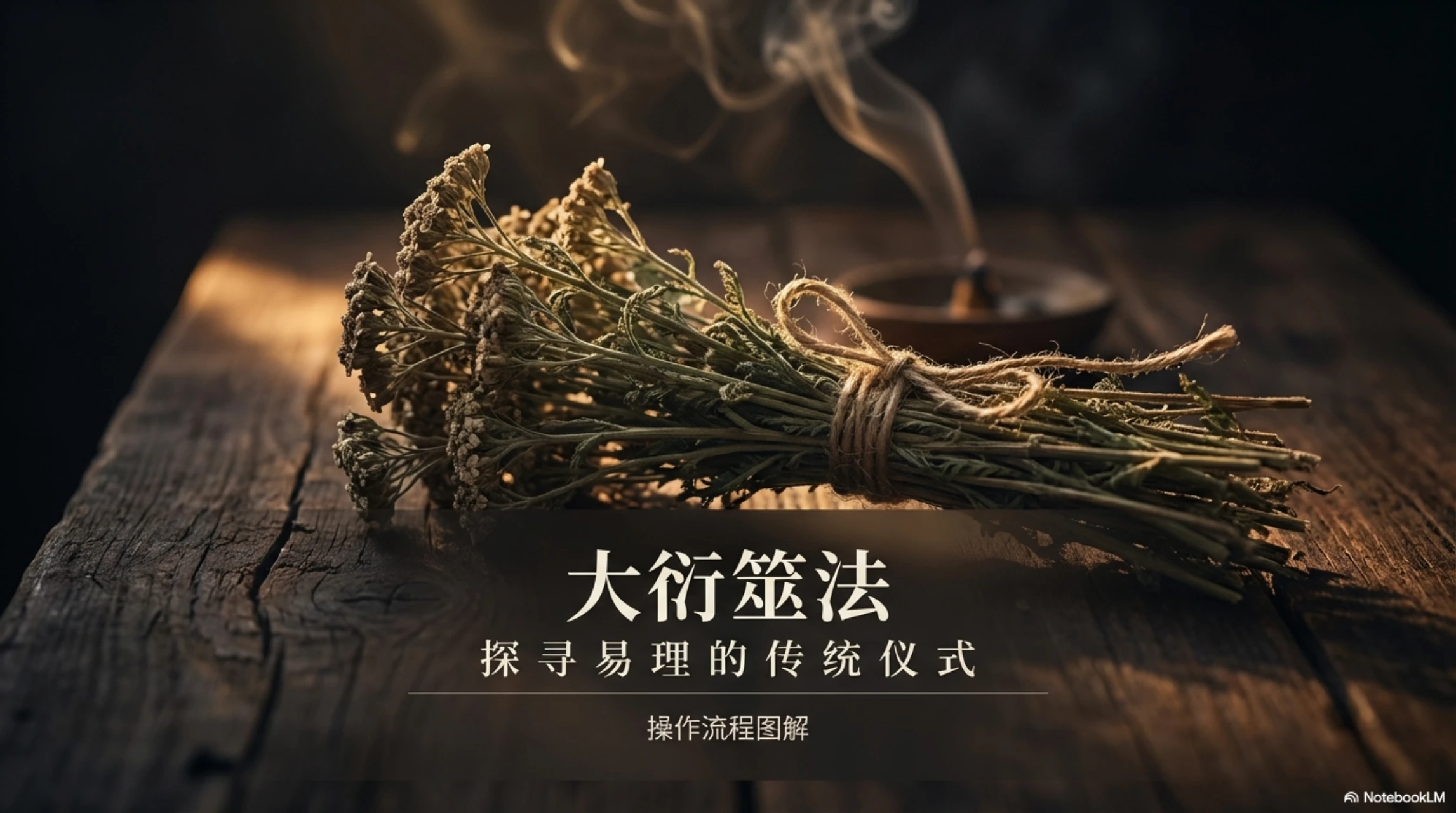
Experience the ancient yarrow stalk divination method recorded in the I Ching through vivid animations
Experience dividing, setting aside, and counting yourself
Laying out the yarrow stalks…
No saved castings yet
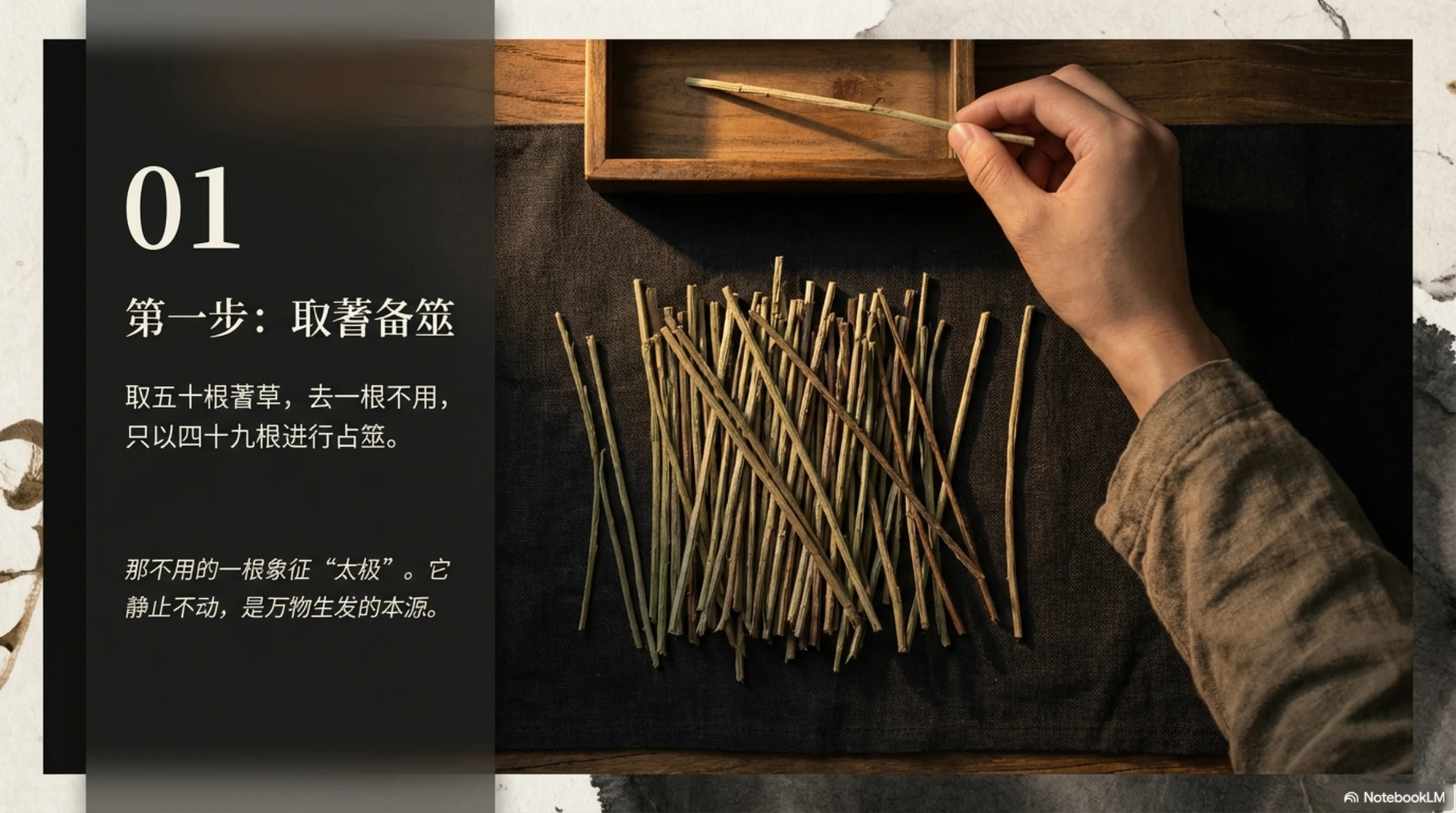
Take fifty yarrow stalks, set one aside unused, and use forty-nine for divination, symbolizing Taiji generating the Two Forces.
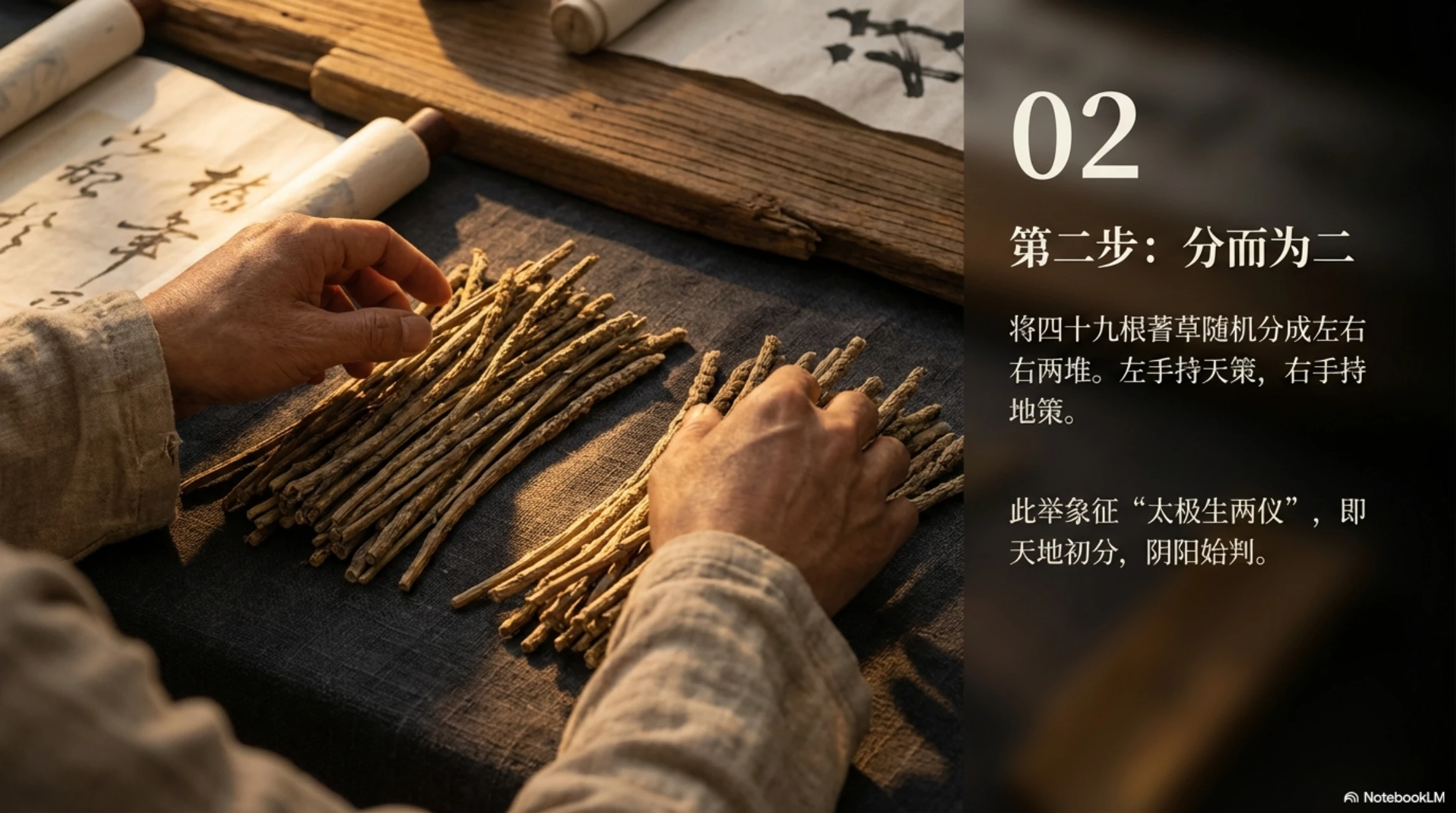
Randomly divide the stalks into left and right piles - left represents Heaven, right represents Earth.
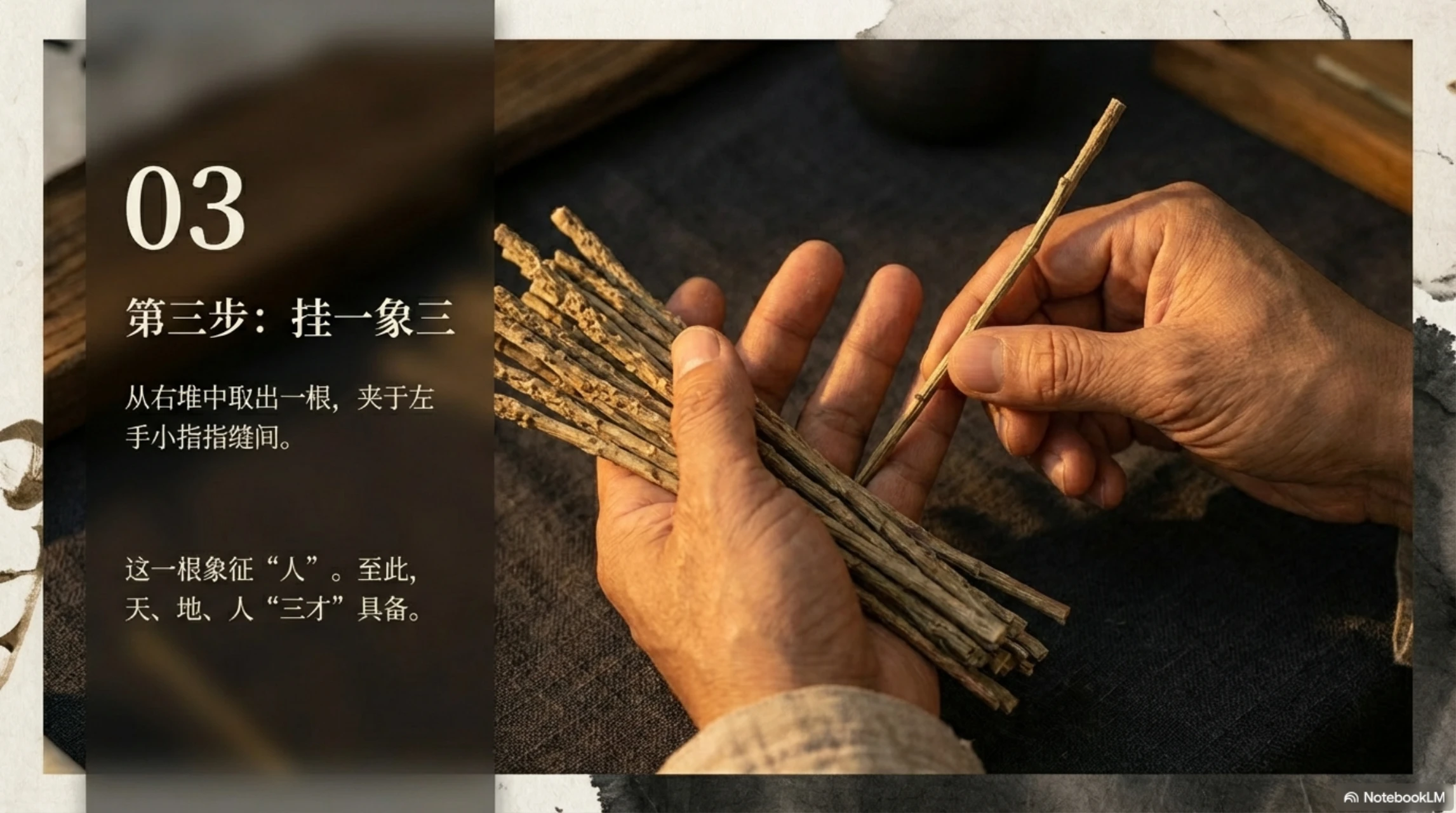
Take one stalk from the right pile and hold it between fingers, symbolizing humanity - Heaven, Earth, and Human.
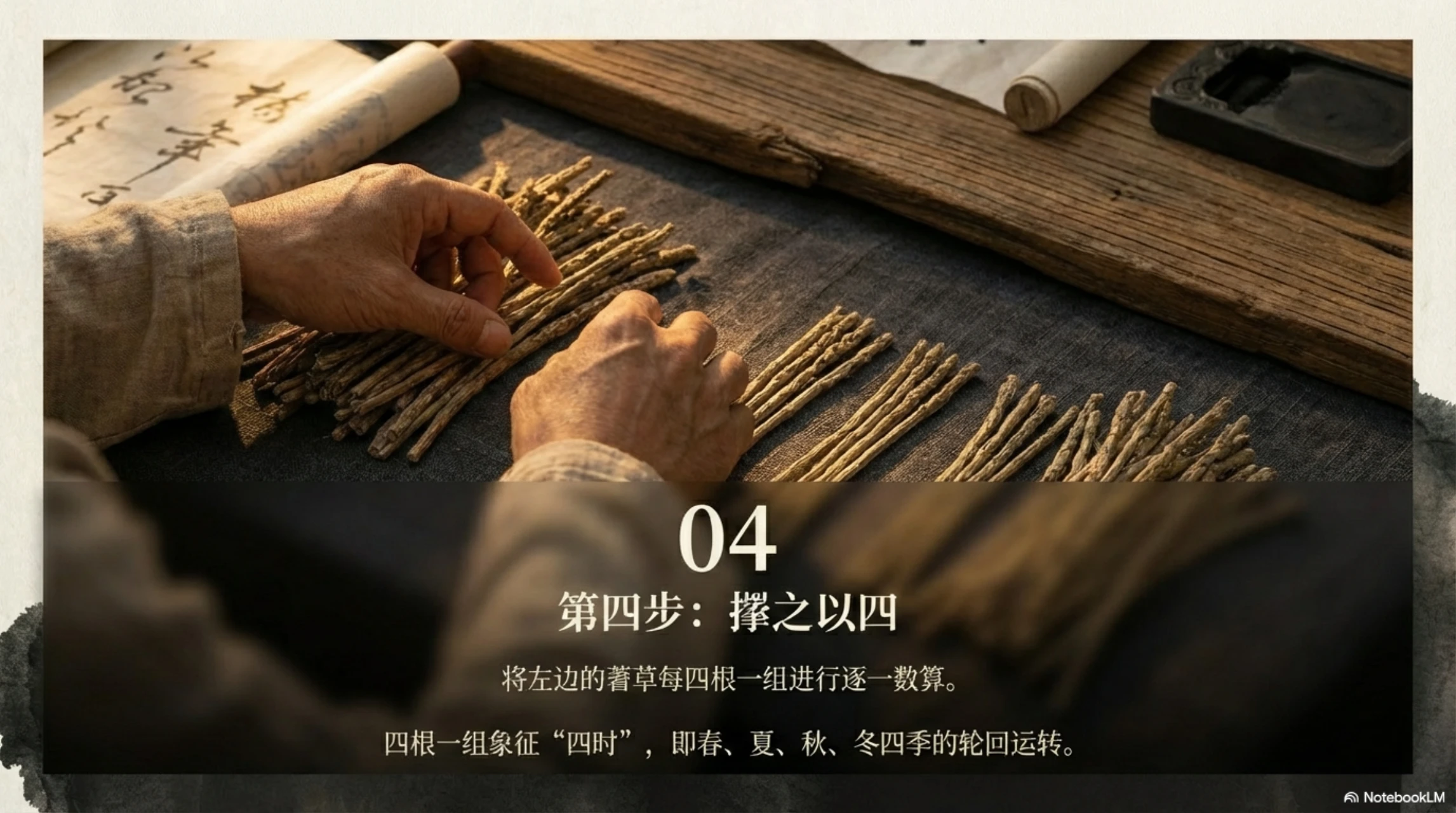
Count the left pile by groups of four, symbolizing the four seasons of spring, summer, autumn, and winter.
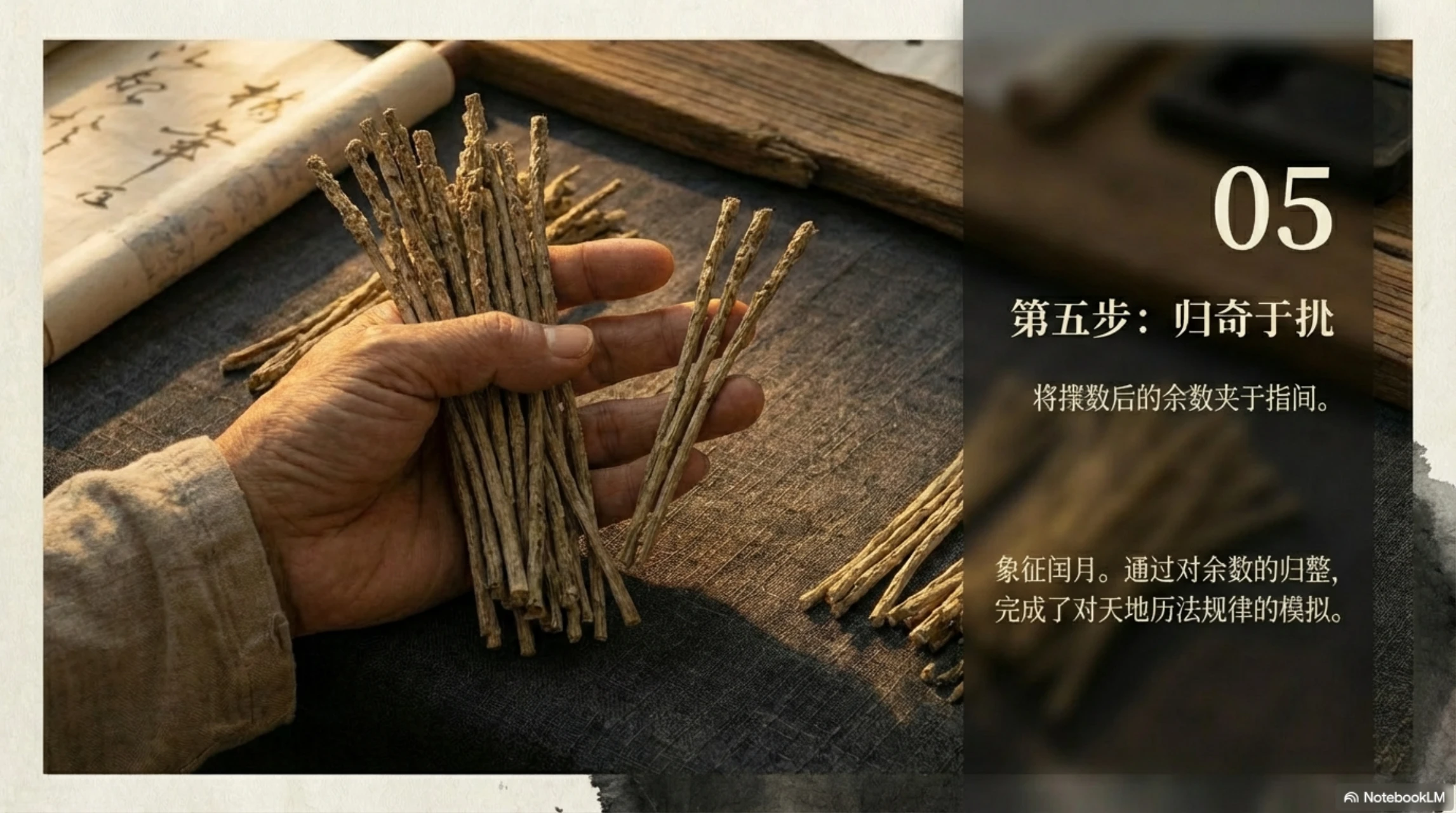
Hold the remainder between fingers; after three changes, derive one line.
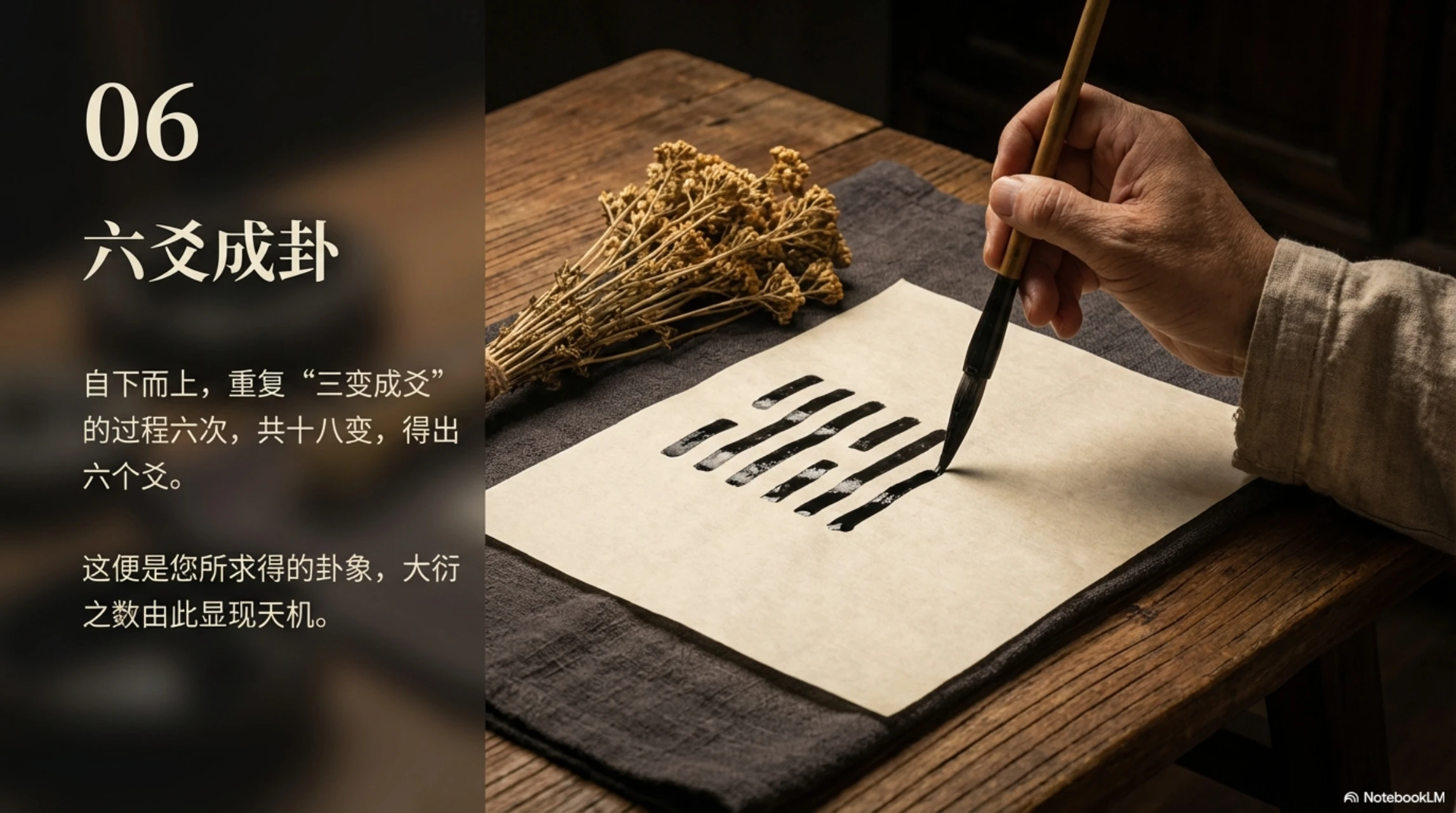
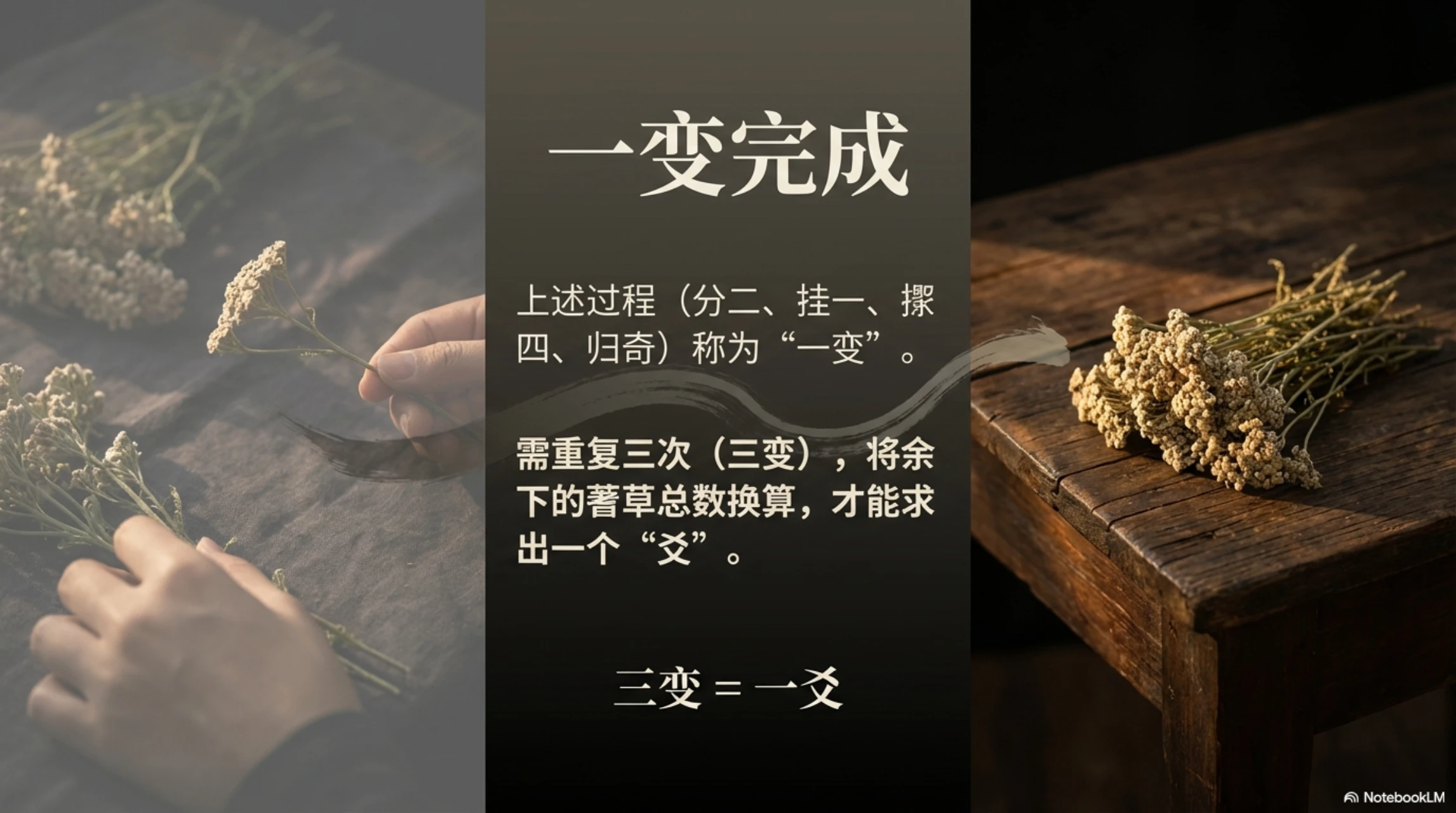
Dividing, setting aside, counting by fours, and collecting — repeated three times — completes one 'three-change' cycle, yielding a single line (value 6, 7, 8, or 9). Build upward from the bottom line; after six rounds (eighteen changes total), the primary and changed hexagrams emerge, ready for interpretation.
Da Yan Shi Fa originates from the 'Commentary on the Appended Judgments' in the I Ching and is the most orthodox divination method in ancient China. Legend has it that Fuxi drew the Eight Trigrams, King Wen developed the I Ching, and Confucius wrote the Ten Wings. This method uses yarrow stalks as a medium, connecting heaven and humanity through rigorous mathematical reasoning.
"The number of the great expansion is fifty, of which forty-nine are used. Divide them into two lots to represent the two primal forces; set one aside to represent the three powers; count them by fours to represent the four seasons; return the remainder to symbolize the intercalary month." - I Ching, Commentary on the Appended Judgments
Beautiful animations vividly display each step of Da Yan Shi Fa, making the ancient divination method engaging and intuitive.
Strictly follows the Da Yan Shi Fa method recorded in the I Ching, ensuring each hexagram is generated according to tradition.
Detailed step explanations and historical introduction help you deeply understand the principles and cultural significance.
Explore the I Ching and traditional Chinese culture
Approaching the subject from the standpoint of pre-Qin Confucianism, this article examines the origin, essence, and civilizational foundations of ritual propriety (li), seeking to understand the profound meaning it carries between human ethical order and the Way of Heaven.
This article offers a deep exploration of the philosophical significance of Hexagram 37 'Jiaren' (Family) in the Zhouyi (Book of Changes), analyzing the relationship between the Wind-over-Fire trigram image and the Way of the family, and elucidating the foundational status of 'family' in ancient social structures through pre-Qin Confucian thought on 'roots' (ben) as found in Confucius, Mencius, and the Great Learning.
This article offers a deep reading of the core proposition in the Xici Shangzhuan — 'What the junzi dwells in and finds peace in is the order of the Yi' — integrating the pre-Qin context, the Confucian scholarly lineage, and the structure of the Zhouyi to elucidate how the junzi, by embodying the Way of Heaven and Earth, takes the Yi as the foundation of settled existence, contemplates the images and savors the statements, and ultimately attains the state of 'auspiciousness with nothing unfavorable.'
A line-by-line exegesis of 'Substantiating Intent, Modeled on the Flying Serpent,' the third technique of the Seven Techniques of the Yin Tally in the Original Canon of the *Guiguzi*. Beginning from the definition 'substantiated intent is the deliberation of qi,' it traces the pathology of a hollow intent, the cultivation sequence from calming the five viscera to contemplating the Great Void, the cognitive attainment of 'knowing all under Heaven without leaving one's door,' and clarifies the image of the flying serpent through three pieces of pre-Qin evidence drawn from the *Xunzi*, *Shenzi*, and the *Great Treatise*.
This essay undertakes an in-depth study of the 'Yi' ode from the Greater Odes (Daya) section of the Classic of Poetry (Shijing) through the lens of pre-Qin thought. It examines the philological origins of the character 'yi' (restraint), confirms Duke Wu of Wei as its author with 'self-vigilance' as its guiding purpose, and elucidates the poem's emphasis on dignity, virtue, its critique of King Li's misgovernance, and its enduring political philosophy and moral cultivation significance.
A complete study of the *Zhengming* (Rectification of Names) chapter of the *Xunzi*. It takes up the Master's chain—"if names are not rectified, speech does not flow"—and opens onto the distinction between names having no fixed appropriateness and names having a fixed goodness; it traces in detail the boundary of convention-becoming-custom, the Heavenly Faculties' sorting of categories and the mind's verifying cognition, the three delusions and the inevitability of disputation, the three grades of speech, how order and disorder lie in what the mind approves, the Way as the true balance across past and present, and ends with "the self enslaved to things" and "valuing the self and putting things to service." It takes Confucian and Daoist principle as its foundation, drawing on the *Analects*, *Mencius*, *Doctrine of the Mean*, *Laozi*, *Zhuangzi*, *Zuo Tradition*, and the *Book of Songs*.