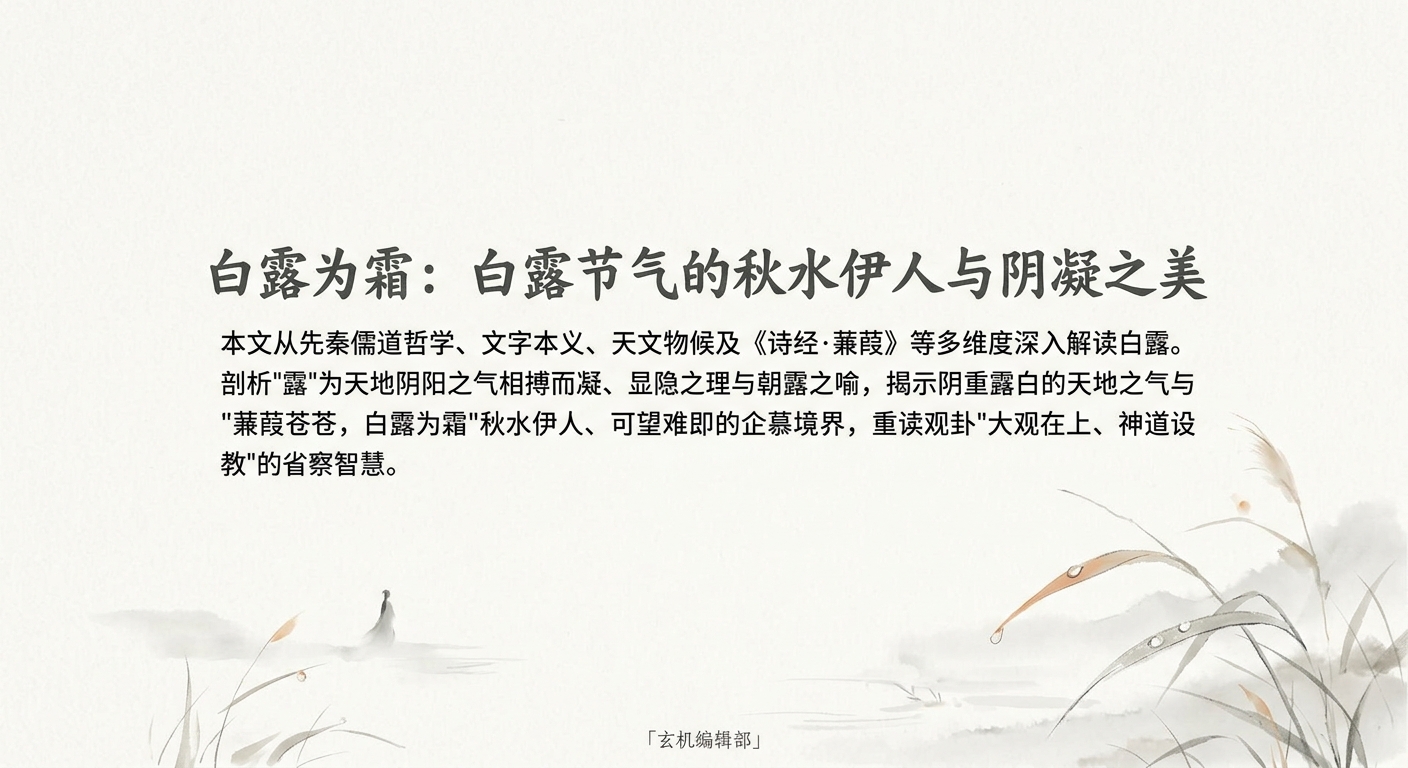
White Dew Turns to Frost: The Autumn Beauty of Bailu — The Figure Beyond the Water and the Splendor of Yin's Condensation
This essay offers an in-depth exploration of the Bailu (White Dew) solar term from the perspectives of pre-Qin Confucian and Daoist philosophy, etymological analysis, astronomy and phenology, and the Classic of Poetry's 'Reeds and Rushes' (Jianjia). It examines how dew forms through the interplay of yin and yang qi, the philosophy of concealment and manifestation, the metaphor of morning dew, the celestial shift as yin grows heavy and dew turns white, the eternal longing of 'reeds so grey, white dew turns to frost' — the unattainable figure beyond the autumn waters — and the wisdom of contemplation found in the Guan hexagram's 'great observation above' and 'teaching through the numinous way.'
Chapter Fourteen: White Dew in Literature — The Classic of Poetry, the Songs of Chu, and the Tradition of Autumn Longing
I. Dew in the Classic of Poetry: From Dawn to Eternity
In the Classic of Poetry, "dew" is a frequently appearing image rich in meaning. Beyond "Reeds and Rushes" (already discussed at length), several other poems invoke dew.
The Classic of Poetry (Zheng Feng, "Wild Vine Grass"): "In the wild, vine-grass spreads; the dew falls round and full. There is a beautiful person, lovely of eye and brow. Meeting by chance — exactly as I wished." Here "round and full dew" (ling lu tuan xi) evokes the encounter with beauty.
The Classic of Poetry (Xiaoya, "Deep Dew"): "Deep, deep the dew — only the sun can dry it." A banqueting poem using dew as an evocative image. "Only the sun can dry it" both describes dew's physical nature and carries deeper meaning — the loyal subject requires the ruler's grace to achieve, or joyful gatherings are brief and should be seized.
II. Dew in the Songs of Chu (Chuci): The Lofty Purity of Dining on Dew
In the Songs of Chu, dew acquires a new, loftier significance — dining on dew and drinking dew symbolizes a purity beyond the mundane world. Qu Yuan ("the Yuan" — the great poet, here referred to as "Qu Zi Xiansheng") wrote in the Lisao: "At dawn I drink the dew dripping from magnolia; at dusk I dine on fallen petals of autumn chrysanthemum." Why did the poet drink dew and dine on petals$6 Because dew is the condensed essence of heaven and earth's qi — the purest, most immaculate substance; chrysanthemum is the flower that defies frost, symbolizing lofty integrity.
This represents a profound transformation: dew shifts from the "beautiful yet brief" metaphor of impermanence in the Classic of Poetry to the "pure and immaculate" emblem of lofty integrity in the Songs of Chu. Later, this imagery further evolved into the Daoist cultivation motif of "dining on rosy clouds and drinking dew" — dew as "the condensed essence of heaven and earth's qi" becoming a medium for the pursuit of immortality.
III. The Fountainhead of the Autumn Melancholy Tradition: Song Yu's Nine Arguments
The Nine Arguments (Jiubian) opens: "How sorrowful is autumn's qi! Desolate — the grasses and trees waver, fall, and wither. Chilling — as if on a distant journey, ascending mountains and fording streams, bidding farewell to one about to depart." These lines establish the keynote of the "autumn melancholy" tradition in Chinese literature.
Yet Chinese literary autumn melancholy is not entirely despondent. As argued regarding "Reeds and Rushes," within autumn sorrow lies a deep-seated quest. Song Yu's grief is the grief of "a poor scholar who has lost his post yet whose ambitions remain unquiet" — it harbors an ardent commitment to lofty ideals. This quality of "grieving yet undaunted" distinguishes the finest works in the autumn melancholy tradition.
IV. Dew and Autumn Longing: A Lament for Time and Life
The Master said, standing by the river: "What passes is like this — never ceasing, day or night" (Lunyu, "Zi Han"). This consciousness of time's passage resonates with the dew imagery — both are profound laments for time's irretrievability. At the root, the obsession with lamenting time springs from the deep love of life. It is precisely because we love this finite life so dearly that we are so sensitive to its passing.
V. The Unity of Heaven and Humanity in Literature: From Phenology to the Landscape of the Heart
Surveying the White Dew imagery across the Classic of Poetry, the Songs of Chu, and later literature, we see a profound phenomenon: literature is the most poetic expression of the cosmology of heaven-and-humanity unity. "Reeds and Rushes" fuses "white dew turns to frost" with "the beloved, beyond reach"; the Lisao fuses "drinking dew and dining on petals" with "the lofty pursuit of integrity"; the Nine Arguments fuses "grasses and trees waver and fall" with "the scholar's unfulfilled ambitions." In each case, the phenology of heaven and earth and the sentiments of the human heart are inseparably blended.