Bearded Grain and Sown Seed: The Farming-Time Philosophy of Mangzhong and the First Stirring of Yin
Drawing on pre-Qin Confucian and Daoist thought, etymology, astronomy, and phenology, this article offers an in-depth reading of Mangzhong (Grain in Ear), the ninth of the twenty-four solar terms. It reveals the farming-time philosophy behind the folk saying "Mangzhong is busy sowing," examines the phenomena of the praying mantis emerging and the shrike beginning to cry at solar longitude seventy-five degrees, and unfolds how the Gou hexagram's "first stirring of yin" marks a cosmic turning point at the very height of yang—inviting readers into the ancient wisdom of racing against time and revering the seasons as one reveres the divine.
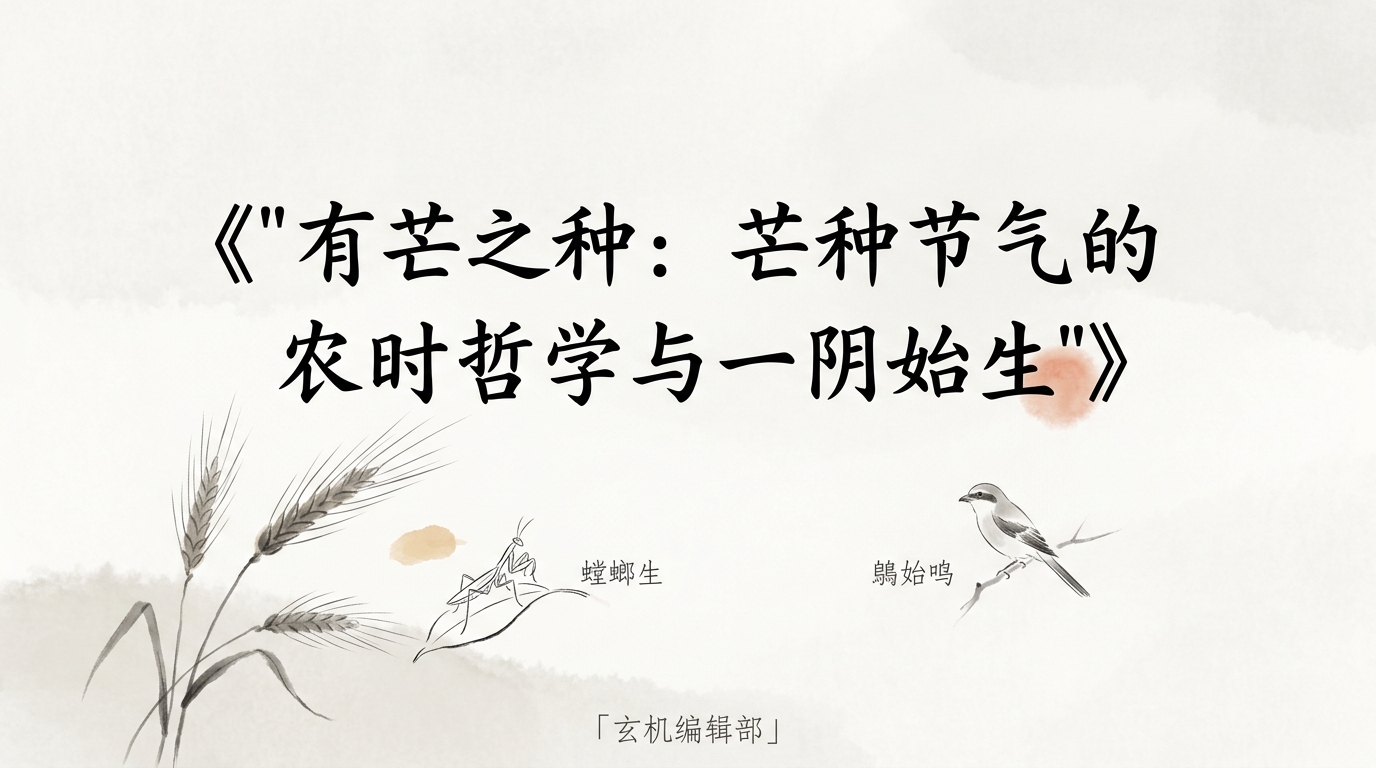
Chapter 9: The Three Phenological Markers of Mangzhong: The Mantis Emerges, the Shrike Begins to Cry, the Mockingbird Falls Silent
I. Phenology: The Living Language of Heaven's Way in Motion
Before delving into the specific phenological markers of Mangzhong, we must understand: why did the ancients place such importance on phenology (物候)$18
Phenology is the living imprint left by the operation of Heaven's Way upon the world of living things. The ancients had no thermometers and did not consult calendars; instead, they grasped the rhythm of Heaven and Earth's qi by observing the subtle changes in plants and animals—the emergence of an insect, the cry of a bird, the silence of a bird. In their cosmology, the myriad things of Heaven and Earth formed an organic whole, and any change in the behavior of any living creature was a signal of the shifting of the whole cosmic cycle.
The "Shixun Jie" (時訓解) chapter of the Yi Zhoushu (逸周書, Lost Book of Zhou) gives a clear record of the three phenological markers of Mangzhong: "On the day of Mangzhong, the praying mantis is born; five days later, the shrike begins to cry; five days after that, the mockingbird falls silent" (芒种之日,螳螂生;又五日,鵙始鸣;又五日,反舌无声). When Mangzhong arrives, the praying mantis begins to hatch; five days later, the shrike begins to cry; five days after that, the mockingbird ceases its song. These three markers, five days apart, together span fifteen days, precisely constituting the entire period of Mangzhong.
Even more worth noting, the "Shixun Jie" of the Yi Zhoushu also records the consequences of phenological disorder: "If the mantis does not hatch, this is called 'the stilling of yin'; if the shrike does not begin to cry, it portends that treachery is stifling and obstructing good governance; if the mockingbird continues to cry, it portends that a flattering minister stands at the ruler's side" (螳螂不生,是谓阴息;鵙不始鸣,令奸壅偪;反舌有声,佞臣在侧). If the mantis fails to hatch, it is called "the stilling of yin" (阴息—the halting of yin qi, signifying a disorder between yin and yang); if the shrike fails to cry, it foretells that treachery and villainy are obstructing and blocking good governance; if the mockingbird, which should be silent, continues to cry, it foretells that a flattering, treacherous minister stands at the ruler's side. Though such interpretations of "portents and calamities" may appear, to modern eyes, to lack scientific grounding, they profoundly reflect the ancients' conviction of "the mutual resonance of Heaven and humanity" (天人感应)—the order of nature and the order of human affairs are intimately interconnected, and disorder in phenology is Heaven's warning of disorder in human affairs.
II. First Marker: The Mantis Emerges—A Creature of Killing That Stirs in Response to Yin Qi
The first phenological marker of Mangzhong is "the mantis is born" (螳螂生).
Why does the praying mantis begin to hatch during Mangzhong$19 The ancients offered a profound explanation—the mantis is born in response to yin qi. The mantis lays its eggs in late autumn of the previous year (the eggs stored within an egg case, or piaoxiao), and after lying dormant through the entire winter, hatches only at the time of Mangzhong. The ancients observed that the mantis's hatching coincided precisely with the first stirring of yin in midsummer, and thus concluded that the mantis was "born in response to yin qi"—its birth was precisely a response to that newly sprouted yin.
This observation is laden with significance. At Mangzhong, when yang qi is fullest, most things "grow in response to yang qi" (thriving vigorously, flourishing exuberantly); yet the mantis, uniquely, "is born in response to yin qi." This makes the mantis a distinctive "messenger of yin" within the phenology of Mangzhong—its appearance precisely confirms the turning point of Heaven's Way that is the Gou hexagram's "first stirring of yin." When all things are flourishing in the fullness of yang, this creature of killing, the mantis, born in response to yin, quietly hatches, as if an emissary sent by Heaven's Way, reminding people: within the fullness of yang, yin has already secretly begun to stir.
To the ancients, the mantis was a distinctive creature. Its body is shaped like a blade or an axe, its forelimbs sharp as sickles—it is a fierce hunter of the insect world, preying on other insects to live. Its posture of "raising its arms like an axe" carries a certain quality of killing severity. And this quality of killing severity accords precisely with the nature of "yin"—yin governs gathering-in and killing, in contrast to yang, which governs birth and growth. That such a creature—born in response to yin, carrying a quality of killing severity—should appear precisely at Mangzhong, the height of yang's fullness, is a marvelous symbol of the dialectic of yin and yang.
III. The Mantis Blocking the Chariot: Courage and Overreach in the Zhuangzi
Speaking of the mantis, we cannot fail to mention Master Zhuang's famous parable—"the mantis blocking the chariot" (螳臂当车).
The "Ren Jian Shi" (人間世, "In the World of Men") chapter of the Zhuangzi records: "Do you not know the mantis$20 It raises its forelegs in anger to block the path of an oncoming chariot, unaware that it is not equal to the task—this is because it overprizes its own ability" (汝不知夫螳螂乎?怒其臂以当车辙,不知其不胜任也,是其才之美者也). Do you not know the mantis$21 It rouses its forelimbs to block the crushing wheel of the chariot, unaware that it is utterly incapable of the task—this is because of its own overconfidence in its ability ("cai zhi mei," 才之美).
This parable is often understood as a satire on "overreaching one's ability." But Master Zhuang's true intent runs far deeper and more dialectically than this single layer of satire.
On the one hand, the mantis blocking the chariot is indeed a case of "not knowing it is unequal to the task"—the mantis, a creature of the utmost smallness, pits itself against the immense weight of the chariot wheel, and the result can only be that it is crushed to pieces. This is the tragedy of "courage without measure of one's own strength," a warning against blind self-confidence. Through this, Master Zhuang admonishes people to recognize clearly the limits of their own capacity, not to force matters recklessly, not to strike a stone with an egg.
Yet on the other hand, Master Zhuang also calls this "the very thing that is beautiful about its ability"—this is precisely the beauty of its capability. The mantis, knowing full well the task cannot be accomplished, acts anyway; is not that resolute courage, that fierce refusal to bow before overwhelming power, itself a kind of magnificent beauty$22 This is Master Zhuang's dialectic—the very same act is at once the folly of "overreaching one's strength" and the courage of "the beauty of ability"; it is both worthy of ridicule and moving to behold.
This dialectic resonates deeply with the vigorous qi of Mangzhong's "mang" and with the mantis's killing form. The mantis's posture of raising its forelimbs to block the chariot is precisely the utmost expression of "baring one's edge"—knowing full well it cannot prevail, it still displays its own sharp edge. This is a tragic vigor. And Master Zhuang's wisdom lies in this: he perceives both the preciousness of this vigor (the beauty of ability) and its danger (being unequal to the task). This is precisely like the admonition of the Gou hexagram—the sharp edge (yang firmness) is beautiful, yet requires the restraint of being "tied to the metal wheel-stop"; courage is precious, yet requires the clear-eyed awareness of "knowing one is unequal to the task." The "mang" of Mangzhong must both display its edge and remain alert to its own breaking—the parable of the mantis blocking the chariot is a vivid footnote to precisely this dialectic.
IV. Second Marker: The Shrike Begins to Cry—The Sound of Yin Qi in Birdsong
The second phenological marker of Mangzhong is "the shrike begins to cry" (鵙始鸣).
"Ju" (鵙) is the shrike. At the second marker of Mangzhong, the shrike begins to cry. Why was the shrike's cry listed as a marker of Mangzhong$23 This, too, is connected to the waxing and waning of yin and yang qi.
The shrike is a bird that cries in response to yin qi. The ancients observed that the shrike begins to cry precisely when yin qi first sprouts in midsummer, its cry urgent, sharp, carrying a quality of killing severity. This follows the same logic as the mantis's "being born in response to yin qi"—both are responses to that newly sprouted yin. The shrike's cry is the sound that yin qi makes within the world of birds.
The shrike also carries a distinctive image within pre-Qin culture. Though the Book of Songs does not devote an ode directly to the "ju," the shrike, as a bird of fierce temperament and skilled predation (it impales its prey on thorns, hence its nickname "the butcher bird"), bears an image quite similar in its killing severity to that of the mantis. The shrike's cry, like the mantis's birth, thus carries the coloring of "yin qi" and "killing severity." At Mangzhong, when yang qi is fullest, the mantis is born on the earth and the shrike cries in the sky—the killing creature of the earth and the severe bird of the heavens take the stage together, jointly sounding the prelude to "the first stirring of yin."
Later ages developed the expression "the shrike and swallow part ways" (劳燕分飞): "lao" (劳) refers to the shrike, and "yan" (燕) to the swallow. The shrike and the swallow, one flying south and the other north, part along different paths, thus becoming a symbol of parting. Though this image took shape in later ages, its root may well lie precisely in the shrike's cry, laden as it is with a sense of killing severity and turning—its appearance is always bound up with some sense of "parting," "change," "turning." The shrike beginning to cry at Mangzhong is precisely a foretelling of this "parting of ways," as Heaven's Way turns from fullness to decline, from yang entering into yin.
V. Third Marker: The Mockingbird Falls Silent—The Waxing and Waning of Sound, and the Alternation of Yin and Yang
The third phenological marker of Mangzhong is "the mockingbird falls silent" (反舌无声).
"Fanshe" (反舌, "reversed tongue") refers to the mockingbird (also said to be the baishe, "hundred-tongue" bird, skilled at mimicking the calls of a hundred birds, its song intricate and ever-changing). At the third marker of Mangzhong, the mockingbird falls silent. This is a phenological marker laden with philosophical implication—it records not the "appearance" of some sound, but the "disappearance" of one.
Why does the mockingbird fall silent at the third marker of Mangzhong$24 The ancients' explanation remains tightly bound to yin and yang—the mockingbird cries in response to yang qi, and so its song is at its fullest at the height of yang qi, in the turn from spring to summer; but by the third marker of Mangzhong, yin qi has gradually sprouted (the Gou hexagram's one yin has already been born and is gradually growing), yang qi begins to withdraw, and the mockingbird falls silent along with it. Its silence is a response to yang qi's beginning decline.
Observe the exquisite contrast between the second and third markers of Mangzhong: at the second marker, "the shrike begins to cry"—the shrike (a bird that responds to yin) begins its cry; at the third marker, "the mockingbird falls silent"—the mockingbird (a bird that responds to yang) ceases its song. One bird begins to cry, the other enters silence; one sound rises, the other falls. Between this "crying" and this "silence" lies precisely the correspondence to the waxing and waning of yin and yang qi—yin qi gradually sprouts, and so the shrike, which responds to yin, begins to cry; yang qi gradually withdraws, and so the mockingbird, which responds to yang, falls silent.
What a subtle and profound observation this is! Through the contrast between two birds' "crying" and "silence," the ancients captured the most faint and elusive turning of Heaven and Earth's qi. The waxing and waning of sound became the living language of yin and yang's alternation. The shrike's cry is the "voicing" of yin qi; the mockingbird's silence is the "hushing" of yang qi. Between this crying and this silence, this rising and this falling, the entire transformation of yin and yang across midsummer was heard, and seen, by the ancients.
The "Record of Music" (樂記) chapter of the Liji says: "All sound arises from the stirring of the human heart" (凡音之起,由人心生也). All sound arises from the stirring of an inner feeling. And in the cosmology of the ancients, the sounds of the natural world (birdsong, the singing of insects) likewise arise from the "stirring" of Heaven and Earth's qi. The shrike's first cry and the mockingbird's silence are precisely one "voicing" and one "hushing" of Heaven and Earth's qi—they are the message of yin and yang, written by Heaven and Earth in sound. The "mockingbird falls silent" at the third marker of Mangzhong is thus no simple phenological record, but a profound parable of how "the waxing and waning of sound corresponds to the alternation of yin and yang." It reminds us that the turning point of Heaven's Way very often lies not in what is loud, but within that silence which gradually descends.