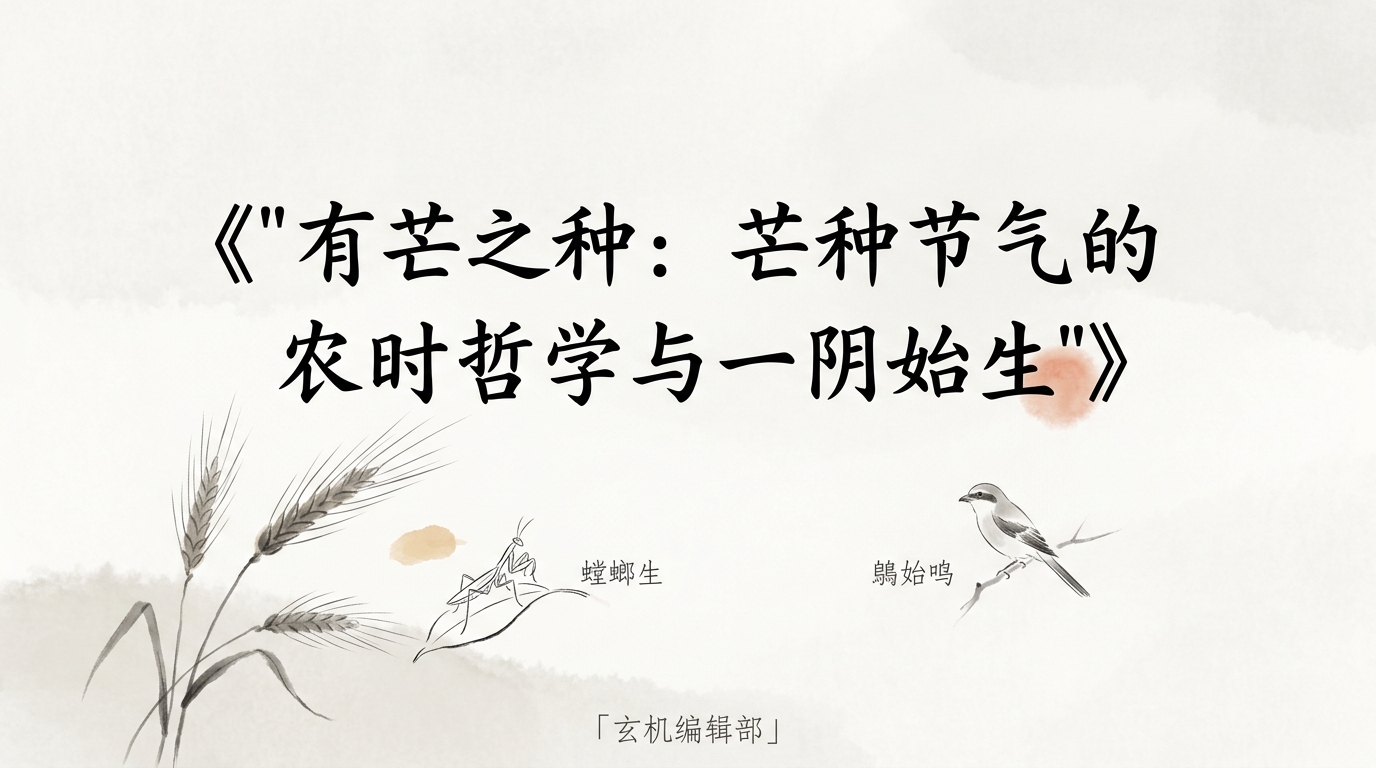
Bearded Grain and Sown Seed: The Farming-Time Philosophy of Mangzhong and the First Stirring of Yin
Drawing on pre-Qin Confucian and Daoist thought, etymology, astronomy, and phenology, this article offers an in-depth reading of Mangzhong (Grain in Ear), the ninth of the twenty-four solar terms. It reveals the farming-time philosophy behind the folk saying "Mangzhong is busy sowing," examines the phenomena of the praying mantis emerging and the shrike beginning to cry at solar longitude seventy-five degrees, and unfolds how the Gou hexagram's "first stirring of yin" marks a cosmic turning point at the very height of yang—inviting readers into the ancient wisdom of racing against time and revering the seasons as one reveres the divine.
Chapter 12: Cultivating Body and Mind: Motion to Release Yang, Stillness to Nurture Yin
I. The Dialectic Between the "Busyness" of Mangzhong and the "Settledness" of the Heart
Mangzhong is the busiest solar term of the year, and yet, paradoxically, pre-Qin wisdom on cultivation repeatedly emphasizes, precisely during this busiest season, the words "settled" and "still." This appears contradictory, yet it in fact contains the deepest dialectic of body-and-mind cultivation.
We have already cited the admonition of the Liji's "Monthly Ordinances" for the month of midsummer: "The noble person fasts and purifies himself; in his dwelling he must keep his body covered, must not be impetuous, must still sound and sensual pleasure... must moderate his cravings and desires, must settle his heart and qi" (君子齐戒,处必掩身,毋躁,止声色……节嗜欲,定心气). At midsummer, when yang qi is fullest and farm labor busiest, the "Monthly Ordinances" instead demands that the noble person restrain himself, remain quiet, settle his heart. Why$9 Because the more intense the outward "busyness," the more essential the inward "settledness" becomes. If one is busy outwardly and also disordered inwardly, the busyness will inevitably breed chaos, and the toil will inevitably injure the body; only when one is busy outwardly yet settled inwardly, governing the outward busyness through inward settledness, can one be busy without falling into disorder, and toil without being harmed.
This is precisely the essence of the Confucian discipline of "holding to reverence" and "holding to stillness." The Daxue (大學, Great Learning) says: "Knowing where to rest, one afterward has settledness; having settledness, one is afterward able to be still; being still, one is afterward able to be at peace; being at peace, one is afterward able to deliberate; deliberating, one is afterward able to attain" (知止而后有定,定而后能静,静而后能安,安而后能虑,虑而后能得). Knowing where one's goal lies, the heart afterward becomes settled; the heart being settled, one is afterward able to attain quietude; being quiet, one is afterward able to attain calm; being calm, one is afterward able to deliberate thoroughly; deliberating thoroughly, one is afterward able to gain something. Though the farm labor of Mangzhong is busy, only when the heart is "settled," "still," and "at peace" can one "deliberate" thoroughly (arranging harvesting and sowing sensibly) and "attain" a harvest. The "busyness" of Mangzhong precisely requires this inward "settled stillness" as its foundation.
II. "Letting the Qi Be Released": The Way of Health Cultivation That Accords with the Virtue of Fire
The first principle of health cultivation at Mangzhong is "letting the qi be released," according with the fullness of the virtue of Fire.
We have already cited the Huangdi Neijing's teaching: "In the three months of summer... let the qi be released, as though what one loves lies beyond oneself." At Mangzhong, yang qi is at its fullest; if it becomes pent up within, it will turn to fire and injure the body—leading to symptoms of "excess fire" such as irritability, insomnia, and mouth sores. So the way of health cultivation is to let the fullness of yang qi be released outward in moderation.
How is it to be released$10 The most natural way is precisely the "busy sowing" of Mangzhong—laboring in the fields, sweating profusely. Sweating is the natural channel by which yang qi is released. Moderate labor and sweating during midsummer both accomplish the farm work and release the pent-up yang qi—one might call it "two birds with one stone." This is why, although the ancients suffered from the busyness of Mangzhong, their bodies often remained healthy precisely because of this release—the labor itself was a way of health cultivation, according with the virtue of Fire and releasing yang qi.
But "release" must also have its limits. If yang qi is released to excess (as when one labors under the blazing summer sun for too long without rest), it will "injure the body fluids and deplete the qi," leading to heatstroke or collapse. So health cultivation at Mangzhong emphasizes "release with moderation"—laboring in moderation, promptly replenishing fluids after sweating (the ancients drank sour plum soup and mung bean soup to relieve summer heat and generate fluids), and avoiding the height of the noon sun (hence the custom of the midday rest, "xieshang"). This wisdom of "release with moderation" is precisely the expression, in health cultivation, of the doctrine of the mean—according with the fullness of the virtue of Fire (release) while not allowing yang qi to be depleted to excess (moderation).
III. "Stillness to Nurture Yin": Guarding the Newly Born Yin
The second principle of health cultivation at Mangzhong is "stillness to nurture yin," guarding that newly born yin.
As discussed above, at Mangzhong the virtue of Fire is at its fullest while the first yin secretly sprouts (the first yin born in the Gou hexagram). Within the human body, this thread of newly born yin corresponds to forces of moistening and gathering-in such as "yin fluids" and "yin blood." At the very height of yang qi's fullness, it is easiest to deplete and injure the yin fluids; and that newly born yin is itself exceedingly fragile, requiring careful guarding. So health cultivation at Mangzhong must, while "releasing yang," also, and more importantly, "nurture yin."
How is yin to be nurtured$11 The core lies in the single word "stillness." The Liji's "Monthly Ordinances" teaching of "settling the heart and qi," and the Huangdi Neijing's teaching of "keeping one's intent free of anger," are both methods for nurturing yin. When the heart is still, yin is generated; when the heart is agitated, yin is depleted. Though Mangzhong is busy, one must, amid the busyness, be skilled at stealing moments of quietude—a midday rest, a calm sitting at dusk, an early sleep at night—all are ways of "stillness to nurture yin." In the busiest of all solar terms, this cultivation of "stillness" is, paradoxically, most needed—guarding, through moments of quietude, that newly born yin, and balancing that excessive yang.
In diet, nurturing yin at Mangzhong also emphasizes "eating bitter foods." As discussed above, the flavor of midsummer is bitter. Bitter foods (bitter melon, bitter greens, lotus-seed heart, and the like) can clear the heart, reduce fire, nurture yin, and generate fluids, according precisely with the season of Mangzhong's "virtue of Fire at its height." The ancients often ate bitter foods during Mangzhong, both according with the Five-Phases principle that "bitterness belongs to Fire," and using the clearing, reducing quality of bitterness to balance the excess of the virtue of Fire and guard the newly born yin. This is a perfect union of dietary health cultivation with Five-Phases philosophy and the Way of yin and yang.
IV. Combining Motion and Stillness: The Middle Way of Body-and-Mind Cultivation at Mangzhong
Surveying health cultivation at Mangzhong as a whole, its core is "combining motion and stillness"—motion to release yang, stillness to nurture yin.
"Motion" refers to according with the fullness of the virtue of Fire through moderate labor and sweating, releasing the pent-up yang qi. The "busy sowing" of Mangzhong is precisely the natural form this "motion" takes.
"Stillness" refers to guarding the newly born yin through inward settledness, moments of quietude, and the clearing, reducing quality of bitter flavors, nurturing that fragile yin fluid. The midday rest and settled heart of Mangzhong are precisely the concrete practice of this "stillness."
Motion and stillness, releasing yang and nurturing yin, seem contradictory, yet in fact are unified under the fundamental purpose of "harmonizing yin and yang." The special season of Mangzhong, in which the virtue of Fire is fullest while the first yin secretly sprouts, requires one both to accord with the fullness of yang (motion, release) and to guard the sprouting of yin (stillness, nurture). Only by combining motion and stillness, tending to both yin and yang together, can one preserve balance and health of body and mind during this hottest, busiest of solar terms.
This wisdom of cultivation through "combining motion and stillness" accords entirely with the philosophy of the Gen hexagram in the Zhouyi: "Halt when it is time to halt, move when it is time to move; motion and stillness never miss their proper timing." Moving (laboring to release yang) when motion is due, and being still (resting to nurture yin) when stillness is due, with both motion and stillness according with their proper timing—this is precisely the middle way of body-and-mind cultivation at Mangzhong. It is neither ceaseless busyness (motion without stillness depletes the yin fluids) nor ceaseless quietude (stillness without motion seals in the yang qi), but rather the finding of that perfect point of balance between motion and stillness, yang and yin. Through its distinctive season of "Fire at its extremity, with the first yin born," Mangzhong teaches us precisely this profound cultivation of motion and stillness completing each other, yin and yang harmonized.