He Who Does Not Plan for the Future Will Find Trouble at His Door: A Philosophical Inquiry into Foresight and Causality in the Analects
This article provides a rigorous exegesis of the Confucian aphorism, "he who lacks foresight will find woe at hand," by examining the conceptual interplay between "foresight" (lü) and "woe" (you) within the framework of pre-Qin texts. Drawing upon the philosophical insights of the *Analects*, particularly the *Wei Ling Gong* chapter, it elucidates the teleological significance of proactive planning and the cultivation of sagacious vision as a means to transcend immediate existential contingencies.
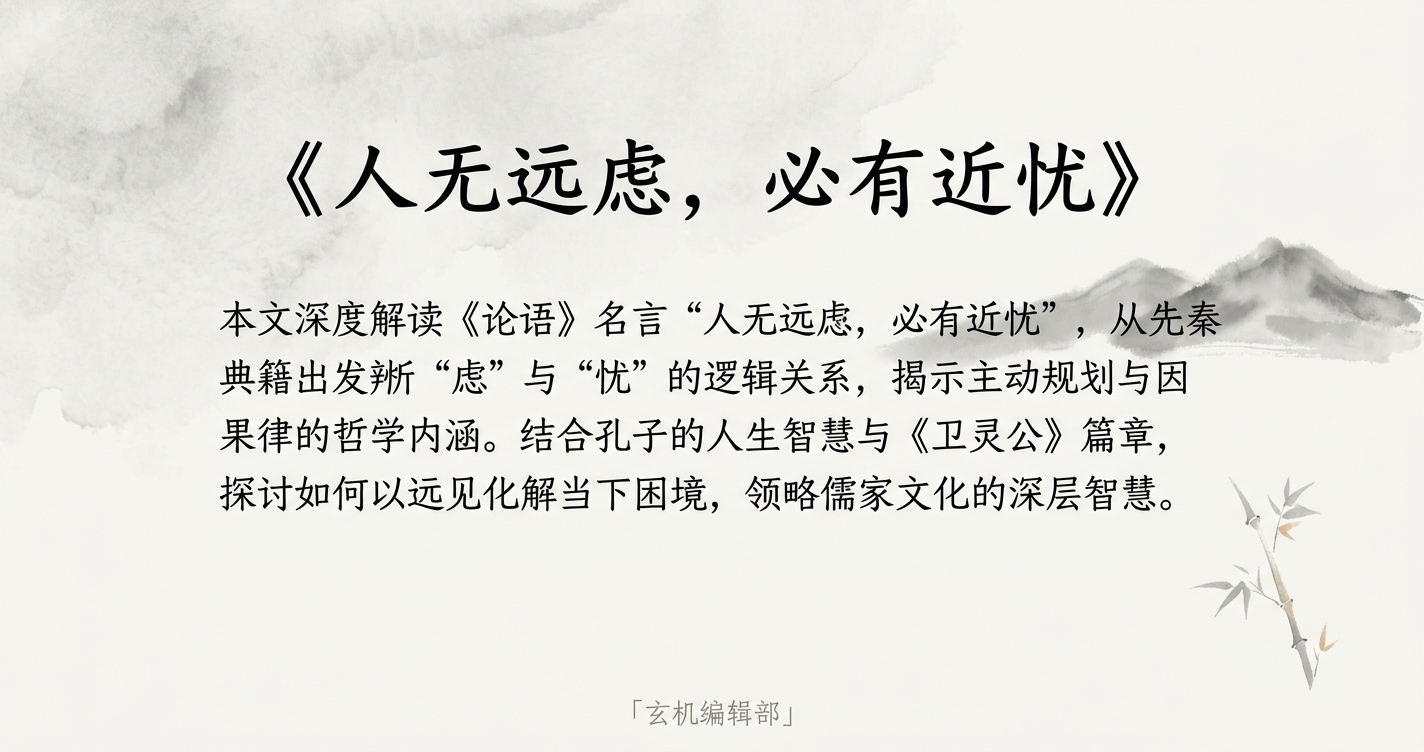
On Long-term Foresight and Immediate Anxiety
— A Deep Interpretation of Pre-Qin Classics and Ancient Wisdom
I. Introduction: The Weight of a Single Sentence
The Analects of Confucius (Lunyu), Book of Duke Ling of Wei records:
The Master said: "If a person does not have long-term foresight, they will certainly have immediate anxieties." (子曰:“人无远虑,必有近忧。”)
Ten characters. There is no preamble, no argumentation, no metaphor, and not even a follow-up question from a disciple. Once Confucius uttered these words, it was as if an unalterable law had been added to the cosmos. In the entire Analects, such a categorical and resolute statement is rare. Confucius was typically mild, refined, and adept at eliciting thought, often engaging his disciples with a questioning tone, such as, "Is it not...$1" Yet here, he used the word "certainly" (bi, 必). "Certainty" is the language of resolution. This is not a probabilistic prediction, nor a guess based on high statistical likelihood; it is a law of causality: without long-term foresight, immediate anxiety is inevitable.
Why was Confucius so resolute$2
Why did he not say, "If a person lacks long-term foresight, they might have immediate anxieties"$3 Why not, "If a person lacks long-term foresight, they fear they may have immediate anxieties"$4 The single character "certainly" elevates this statement from an empirical piece of advice to a near-metaphysical proposition. It asserts not a coincidental correlation, but an inescapable cause-and-effect relationship. Where does this necessity arise$5 This is the first layer of depth we must investigate.
The reason this sentence has been passed down for millennia lies in its unique, symmetrical structure: "far" (yuan, 远) is contrasted with "near" (jin, 近), and "foresight" (lü, 虑) with "anxiety" (you, 忧). The absence of long-term foresight does not lead to long-term anxiety, but precisely to immediate anxiety. Hidden here is a profound dialectic of time: you might think that by omitting foresight, you can enjoy present comfort; yet, precisely because you skipped that step, disaster is not waiting for you in the distance—it has walked straight up to your doorstep. The hidden dangers of the future have not vanished because you ignored them; rather, they have accelerated, closed in, and transformed into an anxiety now right under your nose.
Why is this so$6
Let us begin by peeling back the layers of this statement, starting from the most fundamental definitions.
II. Etymological Origins: Far, Near, Foresight, and Anxiety
1. Distinguishing "Foresight" (Lü) from "Anxiety" (You)
In modern parlance, lü and you are often used interchangeably to signify worry or anxiety. However, in the pre-Qin context, these two characters bear vastly different connotations.
The character "Lü" (虑) is composed of "tiger" (hu, 虍) and "thought" (si, 思). Hu signifies tiger stripes (implying pattern and focus), and Si represents the movement of the heart-mind. Duan Yucai noted that lü carries the meaning of deliberation and planning. Lü is not passive worry, but active contemplation, maneuvering, and premeditation. It points to a clear, rational, and goal-oriented cognitive activity. In pre-Qin texts, lü is frequently paired with "plotting" (mou, 谋), "calculating" (ji, 计), and "measuring" (du, 度).
Interestingly, the Analects (Book of Duke Ling of Wei) contains another passage that resonates with this:
The Master said: "It is humans who can broaden the Dao; it is not the Dao that broadens humans." (子曰:“人能弘道,非道弘人。”)
Why place "humans broadening the Dao" in the same chapter as "long-term foresight"$7 This is no coincidence. "Broadening the Dao" requires human agency, requiring one to scheme, contemplate, and plan how to unfold the "Way" within the world. This agency is the core essence of lü.
The character "You" (忧) is different. Derived from "heart" (xin, 心), its primary meaning is sorrow or vexation. You is passive—affliction comes before you, and you must endure it. You are not thinking about the future; you are being swallowed by the predicament of the present. You is a state of emotion, while lü is a rational activity.
Thus, the deep structure of the Master’s words is: When active rational deliberation is absent, passive emotional predicament inevitably descends. If you abandon the agency of "foresight," you are condemned to suffer the passivity of "anxiety."
2. Distinguishing "Far" (Yuan) from "Near" (Jin)
"Far" and "near" are first and foremost temporal concepts here. "Long-term foresight" points to the future, while "immediate anxiety" points to the present. Yet in pre-Qin thought, these are never merely temporal; they are spatial, relational, and even value-laden.
The Analects (Book of Zi Lu) records:
Duke Ye asked about governance. The Master said: "Those who are near will be happy, and those who are far will come." (叶公问政。子曰:“近者说,远者来。”)
Good governance brings delight to those close by and attracts those from afar. This resonates with the logic of our subject: the Way of governance requires attending to both the near and the far; the Way of life requires caring for both the present and the future.
3. Distinguishing "None" (Wu) from "Certainly" (Bi)
"None" (wu, 无) and "certainly" (bi, 必) are the logical skeleton of the sentence.
Wu is not "a little less"; it signifies total absence. Only in a state of complete lack of foresight does "immediate anxiety" become inevitable. The profound insight here is that in the world of human affairs, inaction is itself an action. You believe you are doing nothing, but "not foreseeing" is a choice, an attitude toward the future. Time does not stop because you stop thinking. Your "none" (wu) inevitably translates, in the river of time, into concrete, inescapable anxiety.
III. Textual Evidence: Resonance in the Duke Ling of Wei Chapter
To understand a statement deeply, we must place it back into its textual environment.
1. Resonating with "Walking the Straight Path"
The chapter begins with Duke Ling asking Confucius about military formations. Confucius declined, saying he had not learned such things, and left the state the next day. A ruler obsessed with the technicalities of the present (the military) rather than the foundational Way is the very definition of "lacking long-term foresight."
2. Resonating with "Commitment to Ren (Benevolence)"
The Master said: "Determined scholars and benevolent persons will not seek to live at the expense of benevolence, but will even sacrifice their lives to perfect benevolence." (子曰:“志士仁人,无求生以害仁,有杀身以成仁。”)
"Sacrificing life to perfect benevolence" is the ultimate long-term foresight—placing life's value in a dimension far beyond mere physical survival.
IV. The Zhouyi Wisdom: The Logic of Danger in Comfort
If the Analects provides the aphorism, the Zhouyi (Book of Changes) provides the systemic philosophical scaffold. The entire work is essentially a "book of long-term foresight," teaching people how to foresee the future within the constant changes of the world.
The Logic of "Frost and Ice"
The Kun Hexagram states: "When one treads on hoarfrost, the solid ice will soon arrive." (“履霜,坚冰至。”) This is the most concise expression of foresight in the Zhouyi. Why does the arrival of frost signal ice$8 Because development follows patterns. A person of foresight sees the development in the initial sign. The commentary remarks: "The family that accumulates goodness is sure to have surplus happiness; the family that accumulates evil is sure to have surplus misery... This stems from not distinguishing early enough." (“由辩之不早辩也。”)
"Not distinguishing early enough" is the absence of long-term foresight. The arrival of disaster is the ultimate immediate anxiety.
V. Philosophical Synthesis: The Necessity of Foresight
Why does the lack of foresight certainly result in anxiety$9
- The Irreversibility of Time: We cannot return to the past. We can only prepare in the present for the future.
- The Nature of Change: The world is in flux. To ignore change is to be caught off guard.
- Human Inertia: As Xunzi noted, human nature tends toward self-interest and shortsightedness. Without rational foresight, these tendencies lead to chaos.
Ultimately, "Long-term Foresight" is not a tool of calculation, but a fundamental characteristic of being human. Animals live for the moment; humans, through the virtue of "Rightness" (Yi), can transcend instinct, look ahead, and plan. To abandon foresight is to abandon the very dignity that defines humanity.
"If a person does not have long-term foresight, they will certainly have immediate anxieties." This is not merely a piece of practical advice; it is a profound observation on the human condition. It serves as a mirror: Are you consciously facing the future, or are you sleepwalking through the present$10 Are you the master of your fate, or are you being pushed by the tide$11
This question, posed by the Master millennia ago, remains the most urgent inquiry for the modern individual.
Comments
(0)No comments yet. Be the first! ✨