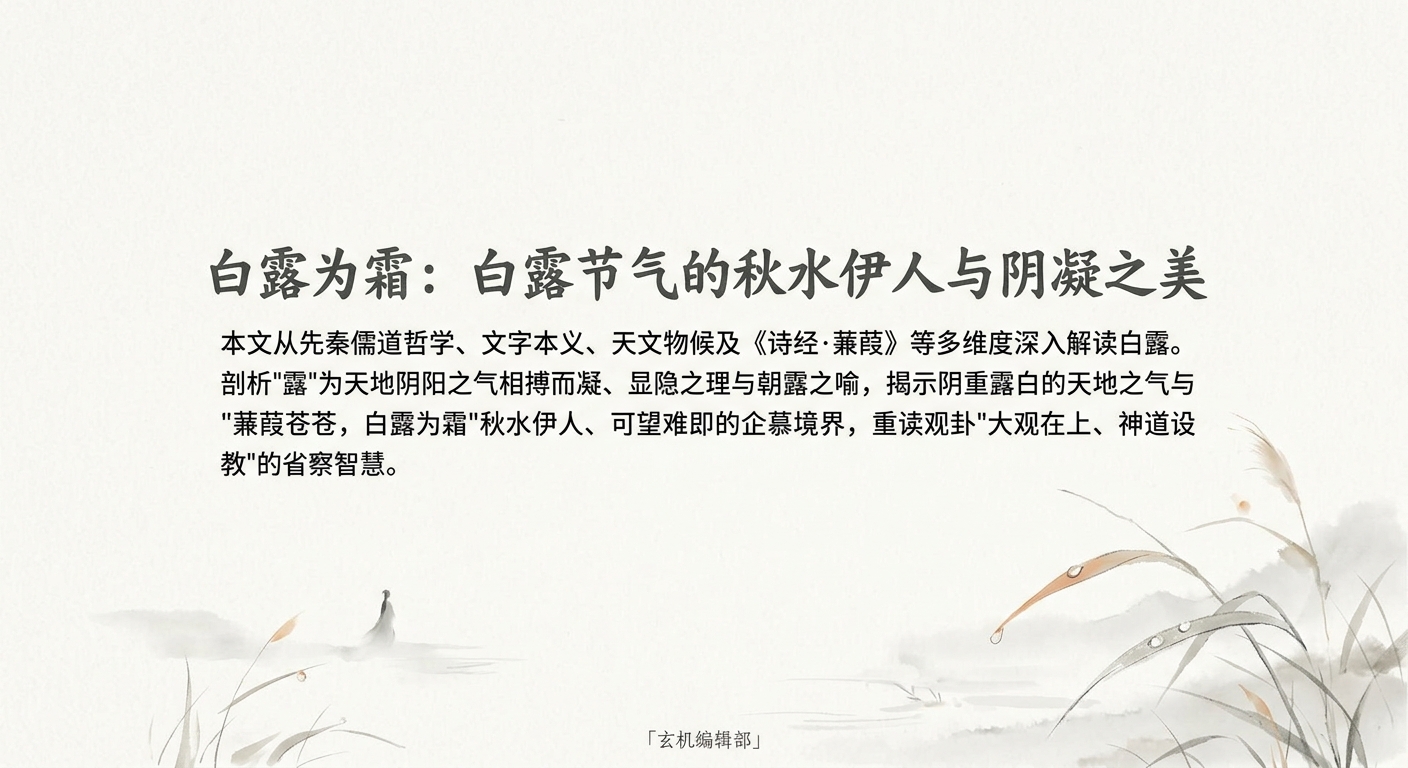
White Dew Turns to Frost: The Autumn Beauty of Bailu — The Figure Beyond the Water and the Splendor of Yin's Condensation
This essay offers an in-depth exploration of the Bailu (White Dew) solar term from the perspectives of pre-Qin Confucian and Daoist philosophy, etymological analysis, astronomy and phenology, and the Classic of Poetry's 'Reeds and Rushes' (Jianjia). It examines how dew forms through the interplay of yin and yang qi, the philosophy of concealment and manifestation, the metaphor of morning dew, the celestial shift as yin grows heavy and dew turns white, the eternal longing of 'reeds so grey, white dew turns to frost' — the unattainable figure beyond the autumn waters — and the wisdom of contemplation found in the Guan hexagram's 'great observation above' and 'teaching through the numinous way.'
Chapter Five: A Special Study of "Reeds and Rushes" (Jianjia) from the Classic of Poetry — White Dew Turns to Frost and the Figure Beyond the Autumn Waters
I. A Song for the Ages: The Realm of the Complete Poem
Among all classical texts associated with White Dew, none can compare with "Reeds and Rushes" (Jianjia) from the "Airs of Qin" section of the Classic of Poetry (Shijing). This poem has become virtually the spiritual emblem of the White Dew season and is one of the most far-reaching, most ethereal works in all of Chinese classical poetry. It deserves an entire chapter of careful appreciation.
The poem reads:
"Reeds and rushes, grey and grey; white dew turns to frost. The one I long for stands beyond the water. I follow upstream against the current — the way is blocked and long. I follow downstream with the current — as if there, in the water's midst.
Reeds and rushes, lush and lush; white dew is not yet dry. The one I long for stands at the water's edge. I follow upstream against the current — the way is blocked and steep. I follow downstream with the current — as if there, on the water's islet.
Reeds and rushes, gleaming, gleaming; white dew has not yet ceased. The one I long for stands at the water's bank. I follow upstream against the current — the way is blocked and winding. I follow downstream with the current — as if there, on the water's shoal."
II. "White Dew Turns to Frost": A Precise Depiction of the Solar Term
Let us begin with the four characters "white dew turns to frost" (bailu wei shuang). These words depict with pinpoint accuracy the phenological features of the White Dew solar term.
"White dew turns to frost" — the white dew has condensed into frost. This line places the solar term precisely: as discussed, White Dew, Cold Dew, and Frost's Descent form a sequence of increasing yin qi. "White dew turns to frost" describes the transition from dew to frost — at dawn, the temperature drops low enough that what should have condensed as dew crystallizes directly into white frost.
The second and third stanzas — "white dew is not yet dry" (bailu wei xi) and "white dew has not yet ceased" (bailu wei yi) — further enrich this phenological portrait. "Not yet dry" means the dew has not yet been evaporated by the sun; "not yet ceased" means it still has not fully vanished. Reading all three stanzas together — "turns to frost → not yet dry → not yet ceased" — we see the flow of a single morning: from the pre-dawn hour when dew freezes like frost, to sunrise when dew has not yet dried, to the climbing sun when dew still lingers. The poet stands throughout this dew-glinting morning at the water's edge, gazing toward the distant figure.
III. "The One I Long For, Beyond the Water": The Realm of the Unattainable
Yet the greatness of "Reeds and Rushes" extends far beyond precise phenological description. Its true immortality lies in the eternal realm it creates — a realm of yearning for what can be glimpsed but never grasped.
"The one I long for stands beyond the water" (suowei yiren, zai shui yi fang). Note the spatial structure: the beloved is "beyond the water," separated from "me" by a river. The river constitutes an impassable (or nearly impassable) boundary. "I follow upstream — the way is blocked and long"; "I follow downstream — as if there, in the water's midst." Whether upstream or downstream, however one seeks, the beloved remains "beyond the water," remains "as if there, in the water's midst" — visible yet unreachable.
What a profound state of being this describes! It articulates one of humanity's most fundamental experiences — the longing for something beautiful and the perpetual impossibility of fulfilling that longing. Who is this "one I long for"$38 The poem never says. And precisely because it never says, the figure acquires infinite symbolic potential — she may be a beloved person, a pursued ideal, a longed-for Way, or anything beautiful yet forever out of reach.
The word "wan" (as if, seemingly) is used with exquisite effect — "as if there" (wan zai). It is an appearance, a seeming — a state hovering between presence and absence, between the real and the illusory. You think you've drawn close, and she recedes; you think you see clearly, and she blurs again.
IV. Why "Water"$39 The Barrier and Symbolism of Water
The realm of "Reeds and Rushes" is inseparable from a core image — water. Why is it water that separates "me" from the beloved$40
At the realistic level, the White Dew season is precisely when "water" is most prominent. Dew is water, frost is water, autumn waters brim full, rivers run clear. At the symbolic level, water possesses the dual nature of "barrier" and "reflection." Water bars this shore from the far shore, making the beloved visible yet unreachable; yet water is also transparent, reflective, allowing the distant figure to be clearly seen. It is this dual quality of "both reflecting and blocking" that creates the poem's distinctive tension of "seeing yet never arriving."
At a still deeper level, water in Chinese philosophy often symbolizes the "Way." The Daodejing says: "The highest good is like water. Water excels at benefiting all things without competing" (Chapter 8). If we understand the "one beyond the water" as the pursuit of the Way, the meaning deepens — the Way, like the figure in the water, can be apprehended (glimpsed) but never fully grasped; the more deliberately one pursues it, the more elusive it becomes. This resonates with the Daoist insight that "the Way that can be spoken of is not the constant Way."
V. The Emotion of Yearning: An Eternal Posture of the Human Heart
The emotion "Reeds and Rushes" describes — yearning for what is longed for yet unattainable — is an eternal posture of the human spirit. The modern scholar Qian Zhongshu used the phrase "the situation of aspiring longing" (qimu qingjing) to characterize the realm of works like Jianjia. This realm moves us because it articulates the eternal distance between human desire and reality. We always yearn for some more beautiful existence — purer love, loftier ideals, more complete fulfillment — and this yearning, precisely because it can never be satisfied, appears all the more precious, all the more sublime.
The Master was once described as "one who knows it cannot be done, yet does it anyway" (Lunyu, "Xian Wen"). The seeker in Jianjia who persistently pursues the distant figure shares a spiritual kinship with the Master — both know the difficulty, both know the elusiveness, yet neither will abandon the search. This spirit transcends specific love and rises to a universal, eternal pursuit of all noble ideals.
VI. Autumn Melancholy and the Quest: White Dew's Emotional Undertone
"Reeds and Rushes" also establishes a special emotional register for White Dew — the interweaving of autumn melancholy and relentless seeking.
Song Yu's Nine Arguments (Jiubian) opens: "How sorrowful is autumn's qi! Desolate — the grasses and trees waver, fall, and wither." This is the fountainhead of the "autumn melancholy" tradition in Chinese literature. But the autumn sorrow of Jianjia is not mere despondency; rather, it weaves melancholy with seeking — amid the desolation of all things fading, the poet still persistently pursues that beautiful something "beyond the water." This "steadfastness amid decline" is precisely what elevates Jianjia above ordinary autumn-sorrow poetry.
VII. The Three-Stanza Refrain: Spatial-Temporal Progression Within Repetition
The artistic mastery of Jianjia must also be appreciated through its "three-stanza refrain" structure. What appears to be simple repetition actually contains exquisite spatial-temporal progression, pushing the "visible yet unreachable" realm ever further toward its extreme.
Consider the temporal progression: the three stanzas describe dew as "turns to frost → not yet dry → not yet ceased" — tracing the flow of a single morning. Time passes imperceptibly, while the seeker still stands at the water's edge. The dew changes, but the heart does not. This contrast between "the changing of nature" and "the constancy of longing" is precisely what the refrain structure highlights.
Consider the spatial progression: the beloved is "beyond the water → at the water's edge → at the water's bank"; she appears "in the water's midst → on the water's islet → on the water's shoal." Space seems to shift and draw nearer, yet no matter how it shifts, the beloved remains "as if there" — always glimpsed across the water, never reached.
And consider the escalating difficulty: the path upstream is "blocked and long → blocked and steep → blocked and winding." Each stanza makes the journey harder. Yet the seeker never retreats; instead, "following upstream, following downstream," the search continues without cease. The harder the path, the firmer the resolve; the more elusive the figure, the deeper the devotion.