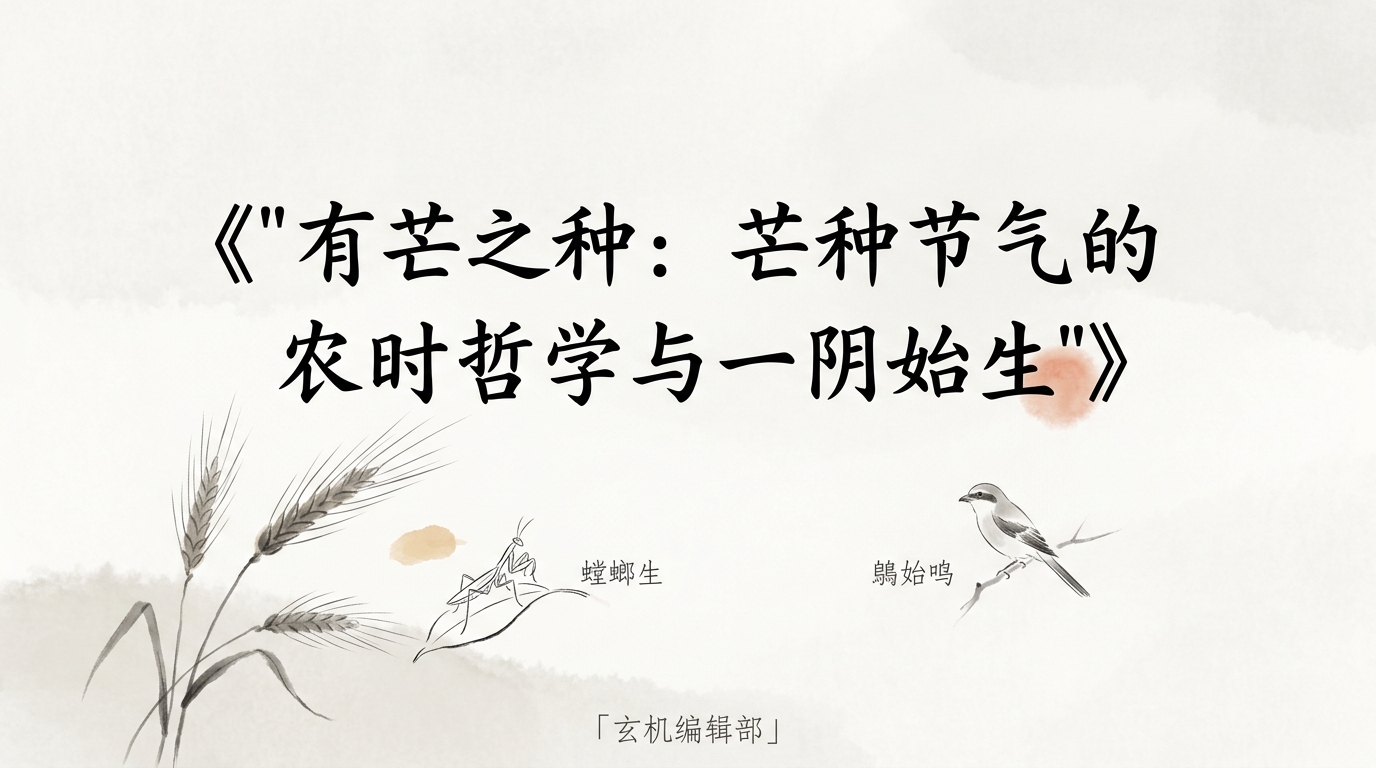
Bearded Grain and Sown Seed: The Farming-Time Philosophy of Mangzhong and the First Stirring of Yin
Drawing on pre-Qin Confucian and Daoist thought, etymology, astronomy, and phenology, this article offers an in-depth reading of Mangzhong (Grain in Ear), the ninth of the twenty-four solar terms. It reveals the farming-time philosophy behind the folk saying "Mangzhong is busy sowing," examines the phenomena of the praying mantis emerging and the shrike beginning to cry at solar longitude seventy-five degrees, and unfolds how the Gou hexagram's "first stirring of yin" marks a cosmic turning point at the very height of yang—inviting readers into the ancient wisdom of racing against time and revering the seasons as one reveres the divine.
Chapter 1: The Original Meaning of "Mang": From a Single Barb to a Flashing Edge
I. Why Does "Mang" (芒) Take the "Grass" Radical$6
To understand Mangzhong, we must first fix our gaze on the character "mang" (芒). Why was this character chosen to name the solar term$7 What, precisely, is its original meaning$8
"Mang" is written with the "grass" radical (艹) atop, and takes its sound from "wang" (亡). The Shuowen Jiezi (說文解字, Explaining Graphs and Analyzing Characters) glosses "mang" as: "The tip of a plant. From 'grass,' with 'wang' as phonetic" (草耑也。从艸亡声). "Cao duan" (草耑) means the tip or terminal end of a plant; "duan" (耑) is the archaic form of "duan" (端), meaning the pointed end of a thing. So the original meaning of "mang" is simply the sharpest, most terminal part of a plant.
Why did the ancients bother to coin a dedicated character for "the tip of a plant"$9 This may seem a trifling matter, but it in fact reveals the subtlety of the ancients' observation of the world. Among the overall forms of grasses and grains, what draws the eye most, and what is most functionally significant, is very often precisely that sharp tip. The bristles on wheat, on rice, on thorny grasses—these needle-like fibers on the husks of grain are the plant's "weapon," used to protect its seed and ward off harm. One of the most direct bodily sensations the ancients experienced while laboring in the fields was the prick of wheat awns and the sting of rice awns against the skin. The character "mang" crystallizes precisely this visceral, lived experience of farm labor.
Even more worth pondering is the phonetic component of "mang"—"wang" (亡), which carries the meanings of fleeing, vanishing, and disappearing. Why should "the tip of a plant" take "wang" as its sound$10 This may not be mere phonetic convenience. The bearded tip of a plant is fine to the point of near-vanishing—it exists, yet is so slight as to be almost invisible, almost ungraspable. As a thing, the "mang" hovers between being and non-being, a critical threshold at which matter tends toward disappearance. This subtle linguistic resonance may well touch upon the deepest secret of the Mangzhong solar term: at the very moment when yang qi is at its fullest and the myriad things are at their most "existent," that first thread of yin qi tending toward "wang" (decline, vanishing) has already quietly begun to stir.
II. The Bearded Wheat: A Mark of Ripeness
In farming, the most important significance of "mang" lies in its being a mark of the grain's ripeness.
Not every grain bears awns. Wheat and barley bear awns, and rice bears awns, whereas broomcorn millet, foxtail millet, and beans generally do not, or bear them only faintly. "Bearded grain" refers specifically to crops of the wheat and rice type. When the Yueling Qishi'er Hou Jijie says "the bearded grain may now be harvested and sown," this phrase—"bearded grain"—points precisely to the agricultural core of the Mangzhong solar term: it concerns exactly these two most important bearded crops, wheat and rice.
Why did the awn come to serve as a mark of ripeness$11 Because the awns of wheat and rice turn hard, sharp, and golden only once the grain has filled out and the ear has ripened. The awns of unripe, green wheat are soft and greenish; but once the wheat has fully ripened, the awns stand erect like needles, golden in hue, sharp enough to prick the skin. A farmer need not split open the ear to inspect the grain within—one glance at the golden glint of the awns in the sunlight is enough to know that the time for harvest has arrived. The awn is Earth's own notice of ripeness, written out for the farmer to read.
The "Chen Gong" (臣工) ode in the "Zhou Song" (周頌) section of the Book of Songs (詩經, Shijing) contains the line: "Oh, magnificent are the wheat and barley; we shall receive their brightness" (于皇来牟,将受厥明). "Lai" (来) means wheat, and "mou" (牟) means barley—this is a passage in the Book of Songs explicitly devoted to praising wheat. "Oh, magnificent are the wheat and barley" is an exclamation of admiration for the abundance of the crop. From this we can glimpse just how highly the ancients prized wheat. And the reason wheat was so precious lies in its role as the crucial crop that bridged the gap between the old harvest and the new, staving off famine—sown the previous autumn or winter, it ripened in early summer of the following year, filling precisely that lean season when the old grain stores were nearly exhausted and the new grain had not yet come in. Harvesting wheat at Mangzhong thus carried a significance verging on life and death.
III. From "Barb" to "Cutting Edge": A Character's Universe of Extended Meanings
What is most captivating about the character "mang" is that its extended meanings form a universe of significance unfolding in successive layers.
The first layer is "barb" (芒刺)—the needle-like awn of the grain, its most primal physical form. From this most direct bodily experience, the ancients derived the idiom "as if a barb pricked one's back" (芒刺在背), describing the unease of feeling as though a needle-sharp awn were pressed against one's spine. This is the tactile dimension of "mang."
The second layer is "cutting edge" (锋芒)—the sharp point of a blade or sword. "Mang" extended from the tip of a plant to the tip of a weapon, giving rise to expressions such as "sharp edge" (锋芒), "the edge of a blade" (芒刃), and "an edge none can withstand" (其锋不可当). This is the vigorous, forceful dimension of "mang." Where the edge points is where power concentrates and manifests outward—the single point at which firm, vigorous qi condenses to its utmost.
The third layer is "radiance" (光芒)—the bursting forth of light. "Mang" extended once more, from the physical tip to the ray of light, giving rise to expressions such as "radiance" (光芒), "the corona of a star" (星芒), and "ten-thousand-fathom radiance" (万丈光芒). The sharp rays cast by the stars are called "mang," and the blazing rays burst forth by the sun are likewise called "mang." This is the luminous dimension of "mang."
We might well ask: why should three seemingly quite different things—a needle-barb, a blade's edge, a ray of light—share the single character "mang"$12
The answer lies in the deep "form" and "momentum" they share: sharpness, outward projection, vigor, force. The barb pricks outward, the blade's edge cuts outward, the ray of light shoots outward—all three are forms in which some power, condensed within, bursts forth toward the outside. And this corresponds perfectly with the "qi" of the season in which Mangzhong falls. At the time of Mangzhong, yang qi is at its fullest, and Heaven and Earth are filled with an energy that bursts outward, vigorous and forceful. The gold of the wheat awns, the blaze of the sunlight, the sharpness of the farmer's swinging sickle—all of these are different manifestations of "mang." The "mang" of Mangzhong is thus not merely the single barb upon the wheat ear, but the very cosmic qi—vigorous, outward-bursting, edge fully bared—that pervades the entire season.
The "Wenyan" (文言) commentary on the Qian hexagram (乾卦) in the Zhouyi states: "Qian is firm and vigorous, centered and correct, pure and unmixed in its essence" (乾,刚健中正,纯粹精也). Qian is pure yang, and its virtue is firm vigor. The beginning of the wu month, in which Mangzhong falls, is precisely the period when yang qi is at its most firm and vigorous. The sharp vigor of "mang" and the firm, correct vigor of Qian's yang are spiritually of one piece. A single small wheat awn, it turns out, mirrors the vigorous virtue of the entire cosmos—this is precisely the wisdom of image-taking that the ancients described as "taking near at hand from one's own body, and taking far off from other things" (近取诸身,远取诸物; Zhouyi, "Great Treatise, Part Two" Xici zhuan).
IV. "Wang" Concealed Within "Mang": A Metaphor of Turning Within Vigor
Yet the deepest mystery of the character "mang" still returns to its phonetic component, "wang."
Those who bare their edge most fully are very often also the first to be broken. The ancients understood this well. The Most High (Laozi), in Chapter 9 of the Daodejing, says: "Hammer it to an ever sharper point, and it cannot long be kept" (揣而锐之,不可长保). A blade honed too sharp cannot be preserved for long. An edge bared too fully is easily snapped; a radiance too intense is easily dimmed. As a thing, the "mang" is precisely that which is both sharpest and most fragile.
This resonates precisely with the deeper philosophy of the Mangzhong solar term. At the time of Mangzhong, the yang qi bares its edge fully, vigorous to the utmost—and yet it is precisely within this utmost fullness of "mang" that the thread of "wang" (yin qi, decline) already lies concealed, deep within the character itself, deep within the season's foundation. The first stirring of yin in the Gou hexagram is precisely the hexagram-image expression of this "wang concealed within mang."
The Most High also says: "Bright, yet not dazzling" (光而不耀; Daodejing, Chapter 58)—possessing light, yet not glaring to the eye. True wisdom lies in restraining one's edge, in "blunting the sharpness and settling the dust" (和其光,同其尘; Daodejing, Chapter 4). The Mangzhong solar term takes its name from "mang," seemingly proclaiming an outward-bursting, vigorous qi—yet at the very moment of its fullest edge, it already conceals a reminder to restrain, to turn, to guard against the subtle before it grows. The character itself is an ancient parable about how fullness at its height gives way to decline, and firmness at its extremity gives way to a break.
From this we can understand why the name "Mangzhong" is so endlessly worth pondering. It is at once the plainest record of farm labor (the harvesting and sowing of bearded grain) and the most profound philosophical metaphor (a turning toward "wang" concealed within the vigor of "mang"). A single character bears within it two faces of the operation of Heaven's Way—we must see both the fullness and outward radiance of yang qi, and remain alert to the yin qi and the turning that have already begun to sprout.