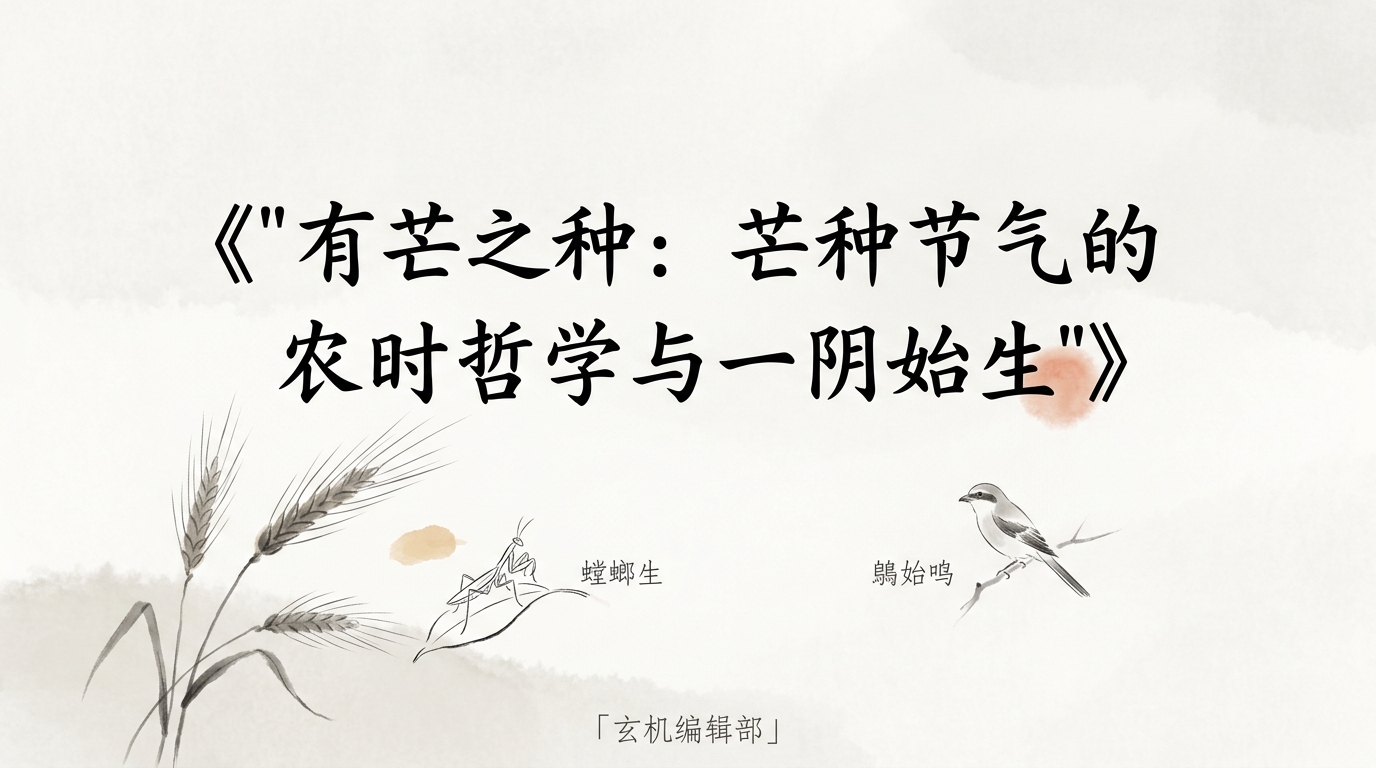
Bearded Grain and Sown Seed: The Farming-Time Philosophy of Mangzhong and the First Stirring of Yin
Drawing on pre-Qin Confucian and Daoist thought, etymology, astronomy, and phenology, this article offers an in-depth reading of Mangzhong (Grain in Ear), the ninth of the twenty-four solar terms. It reveals the farming-time philosophy behind the folk saying "Mangzhong is busy sowing," examines the phenomena of the praying mantis emerging and the shrike beginning to cry at solar longitude seventy-five degrees, and unfolds how the Gou hexagram's "first stirring of yin" marks a cosmic turning point at the very height of yang—inviting readers into the ancient wisdom of racing against time and revering the seasons as one reveres the divine.
Conclusion: The "Mang" of Mangzhong—Between Sharp Edge and Turning Point
I. Looking Back: What Kind of Mangzhong Have We Come to Understand$18
Through the layered inquiry of the seventeen chapters above, we have delved into the solar term of "Mangzhong" from multiple dimensions—etymology, astronomy, phenology, the Five Phases, the Zhouyi, Confucianism, Daoism, mythology, farming, health cultivation, ritual custom, literature, and musical pitch.
We have come to understand: the "mang" of Mangzhong is at once the row of golden needle-barbs upon the wheat ear and rice stalk (a mark of ripeness), and the sharp edge of a blade, the radiance of a star (a vigorous, outward-bursting cosmic qi); and deep within this character "mang," so fully baring its edge, lies concealed the turning and restraint metaphorically signaled by its phonetic component "wang"—firmness at its extremity gives way to a break, fullness at its height gives way to decline.
We have come to understand: the "zhong" of Mangzhong is at once a single seed sealing within it an entire future, and the devout gesture of the farmer bending to the earth, joining in the transforming and nurturing work of Heaven and Earth; and within this act of sowing is crystallized both the toil of "the hardship of sowing and reaping" and the reverence of "not violating the farming seasons."
We have come to understand: "Mangzhong means busy sowing"—this plainest of folk sayings carries within it the most profound farming-time philosophy. Mangzhong is the juncture in the year when farm labor is busiest, the farming season most pressing, least tolerant of delay; the overlap of harvesting wheat and sowing rice makes it the most severe proving ground for the idea of "revering the season." And Master Meng's "not violating the farming seasons," the Master's "employing the people according to the seasons," and Master Guan's "what is not done today will, by tomorrow, be lost wealth" together construct the farming-time wisdom of Mangzhong—racing against every moment, revering the season as one reveres the divine.
We have come to understand: Mangzhong belongs to midsummer, corresponds to the Gou hexagram, and answers to the pitch Ruibin. Within the very fullness of yang qi's virtue of Fire, that one thread of yin qi, of the utmost importance, has already quietly begun to sprout (the Gou hexagram's "first stirring of yin"). This turning point of Heaven's Way, "yang at its extremity giving birth to yin," speaks to us, again and again, of one and the same profound truth—that within the very height of fullness, the seed of the turning point already lies concealed—through the phenology of the mantis born in response to yin, the shrike beginning to cry while the mockingbird falls silent (the waxing and waning of sound corresponding to the alternation of yin and yang), through the Gou hexagram's guarding against the subtle before it grows by being "tied to the metal wheel-stop," and through the pitch-name Ruibin's "yin born, yang become guest."
II. The Twofold Teaching of Mangzhong: Sharp Edge and Turning Point
If we were to sum up, in two phrases, the teaching that Mangzhong offers us, it would be "sharp edge" (锋芒) and "turning point" (转折).
"Sharp edge"—Mangzhong teaches us that when Heaven's timing arrives, we should bare our own edge and give our utmost effort. Just as the farmer, at Mangzhong, "snatches grain from the tiger's mouth," racing against every moment to harvest and sow; just as the wheat awn stands erect like a needle in the sunlight, sharp and golden; just as the Zhouyi's teaching, "Heaven's motion is vigorous; the noble person, in accordance with this, makes himself ceaselessly strong." Mangzhong tells us: when the moment that belongs to you arrives (the wheat ripe, the season for seedlings), do not hesitate, do not slacken—meet it, achieve it, with the utmost diligence, the highest focus, the sharpest edge. Time waits for no one; only striving forward will do.
"Turning point"—Mangzhong also teaches us that at the very height of our sharpest edge, we must remain vigilant toward the turning point that has already begun to sprout. Just as the Gou hexagram, at the very height of yang qi's fullness, reveals the "first stirring of yin," reminding us to be "tied to the metal wheel-stop," to guard against the subtle before it grows; just as the Most High's admonition, "hammer it to an ever sharper point, and it cannot long be kept"; just as the mantis born in response to yin, the mockingbird's silence, proclaiming the alternation of yin and yang. Mangzhong tells us: at the very moment you are at your fullest, most self-satisfied, your edge most bared, you must all the more preserve clarity and humility—because no fullness is eternal, and the turning point very often begins quietly, precisely at the summit of flourishing. Only by dwelling in safety while contemplating danger, holding to humility within fullness, can one calmly meet the turn that is bound, inevitably, to come.
"Sharp edge" is the wisdom of "motion," the wisdom of "purposeful action," the wisdom of "racing against every moment"; "turning point" is the wisdom of "stillness," the wisdom of "guarding against the subtle," the wisdom of "contemplating decline within fullness." Mangzhong fuses these two seemingly opposite wisdoms into a single whole—it demands that we give our utmost to "busyness," while also demanding that we remain clear-eyed and vigilant in "reverence"; it demands that we accord with the fullness of the virtue of Fire and strive forward, while also demanding that we guard the newly born yin and restrain ourselves. This is precisely the deepest dialectic of Mangzhong, and also the supreme state of Chinese wisdom—firmness and yielding completing one another, motion and stillness each fitting, humility contained within fullness.
III. A Final Inquiry: What Does Mangzhong Mean for Us Today$19
As this article draws to a close, let us return to the question with which we began: in this modern age, when we no longer "live at the mercy of Heaven's weather," no longer bend low to transplant rice seedlings, what does Mangzhong still mean for us today$20
It means a renewed reverence for "time." Is the lesson of "time waits for no one," which Mangzhong teaches the farmer, not also the very lesson that Heaven's Way teaches every modern person$21 In this age, which seems to offer an abundance of time, in which we can always "wait a little longer," have we forgotten: that some opportunities, once missed, can never come again; that some matters, once delayed, can never be remedied$22 Through the plainest of farm labor, Mangzhong reminds us: recognize those moments that "cannot be delayed," and then, like the farmer "snatching grain from the tiger's mouth," seize them with your utmost effort.
It means a renewed respect for "diligence." The farmer of "busy sowing" at Mangzhong, through a diligence that leaves "no leisure even to eat," receives Heaven's timing and joins in the transforming and nurturing work. In this age that prizes ease and "lying flat," Mangzhong, through the sweat-drenched toil hidden behind that golden wheat awn, reminds us: every harvest springs from diligence; Heaven's Way rewards effort, and never fails those who race against every moment and give their utmost.
More than this, it means a clear-eyed awareness that fullness at its height gives way to decline. Through the truth of Heaven's Way that is "Fire at its extremity, with yin born," Mangzhong reminds us: at the very moment life is at its fullest, most self-satisfied, we must preserve humility and vigilance; deep within flourishing, the turning point has already begun to sprout. This wisdom—dwelling in safety while contemplating danger, holding to humility within fullness—never grows outdated in any age. It is the most profound counsel on life that Chinese civilization has left us.
The Master said: "What passes away is just like this, is it not! Never ceasing, day or night" (Analects, "Zi Han").
Time flows like water, ceaseless day and night, never to return. Mangzhong is precisely the most solemn reminder that Heaven's Way sends to us, through a field of golden wheat awns, a paddy of emerald-green seedlings—the moment is right before you, and it is fleeting; may you, like the farmer bending low to the earth, meet it with a reverent heart and diligent strength, and seize this stretch of the journey that belongs to you, never to come again.
The question is: amid this urging voice of Heaven's Way, "Mangzhong means busy sowing," are we still racing against every moment to till and sow$23 Do we still know how, at the very height of our sharpest edge, to remain vigilant toward the turning point that has already begun to sprout$24
End of article