Rain Bringing Forth the Hundred Grains: Guyu, Civilization's Spring Rain, and the Legend of Cangjie
Drawing on pre-Qin Confucian and Daoist philosophy, etymology, astronomy, phenology, and the legend of Cangjie's invention of writing, this article offers an in-depth reading of the Guyu (Grain Rain) solar term. It examines the humane grace of Heaven and Earth embodied in "rain giving birth to the hundred grains," the firm-yet-yielding way of hexagram Guai's "resolving away the last remnant of yin," and the profound meaning behind "Heaven rained down millet, and ghosts wept in the night" at the origin of writing—returning readers to the ancient world of the unity of Heaven and humanity.
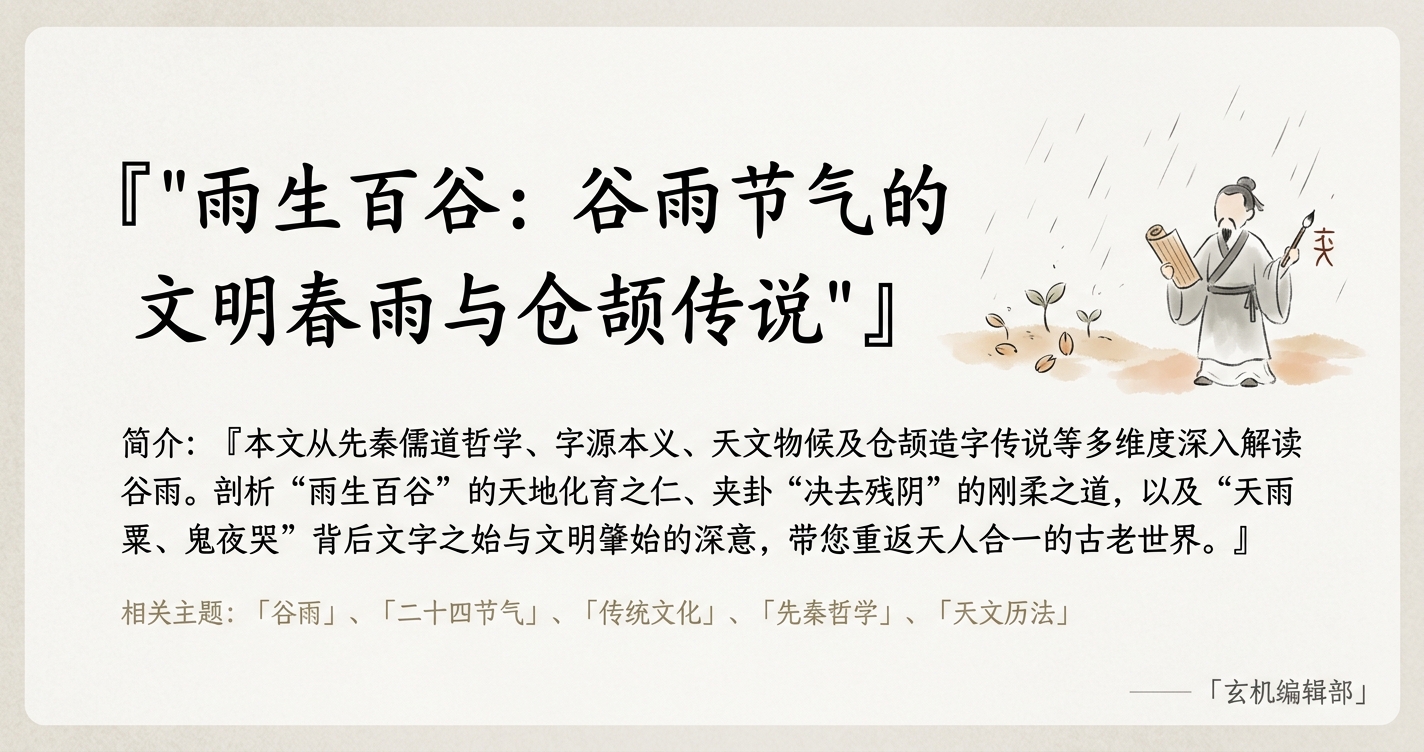
Chapter 12: A Special Chapter on the Origin of Writing — Cangjie's Invention of Writing and "Heaven Rained Down Millet, and Ghosts Wept in the Night"
Section 1: A Strange Legend — Why Does Guyu Sacrifice to Cangjie$2
Among all the cultural meanings of Guyu, one connection is the most strange, and also the most profound—the link between Guyu and Cangjie's invention of writing. Later tradition holds that on the day Cangjie invented writing, "Heaven rained down millet, and ghosts wept in the night"; and folk custom, in turn, takes Guyu as the day for sacrificing to Cangjie. The very origin of writing came to be bound together with "raining millet," with "Guyu." What a marvelous cultural affinity this is!
The core textual source for this connection is that startling record in the "Basic Warp" chapter of the Huainanzi: "Of old, when Cangjie invented writing, Heaven rained down millet, and ghosts wept in the night." (昔者仓颉作书,而天雨粟,鬼夜哭。) Long ago, when Cangjie created writing, millet rained down from the sky (as if it were rain), and spirits wept in the night.
These few characters strike with startling force. Cangjie's invention of writing was, in itself, a human cultural achievement—why should it have moved Heaven itself, causing Heaven to "rain millet"; why should it have stirred the underworld, causing ghosts to "weep in the night"$3 And why did later generations link this miracle of "Heaven raining millet" precisely to the late-spring Guyu of "rain giving birth to the hundred grains," designating it as the day for sacrificing to Cangjie$4 To unravel this chain of mysteries, we must begin with the profound meaning behind the two images of "Heaven raining millet" and "ghosts weeping in the night."
Section 2: "Heaven Rained Down Millet" — The Hidden Resonance Between the Origin of Writing and the Descent of Grain
Let us first consider "Heaven rained down millet." Why would millet (grain) rain down from the sky at Cangjie's invention of writing$5
Various explanations have been offered through the ages, and among them, the most profound touches upon the fundamental relationship between writing and civilization. Writing is one of humanity's greatest inventions—it enables experience to be recorded, knowledge to be accumulated, and civilization to be transmitted. Before the appearance of writing, human wisdom arose and vanished with each generation, unable to be carried across time and space; but once writing appeared, the farming methods, seasonal knowledge, and agricultural techniques of earlier generations could be recorded and passed on to later generations. In other words, writing greatly advanced every civilizational enterprise, agriculture included.
In this sense, the birth of writing was, like grain raining down from the sky, an immense gift to human survival—"Heaven rained down millet" celebrates, through this plainest and most precious image of "grain descending," the birth of writing's great grace to human civilization, comparable to the grace of "bestowing food."
And this forms, precisely, a striking resonance with Guyu's "rain giving birth to the hundred grains." Guyu's rain coaxes forth the "hundred grains" in the fields—the material grain that nourishes the human body; Cangjie's "Heaven rained down millet" at the invention of writing sends down the "millet" of civilization—the spiritual grain that nourishes the human mind. One rains "grain" to nourish the body; the other rains "millet" to nourish the mind; one is the humaneness of Heaven and Earth's nurturing, the other the achievement of civilization's founding.
That the ancients bound Cangjie together with Guyu was by no means an arbitrary, forced association, but arose from a profound intuition: the material "raining of grain" (Guyu) and the spiritual "raining of millet" (the invention of writing) are one and the same great grace—"Heaven descending to nourish humanity"—corresponding to each other on the material and spiritual levels respectively. That Guyu sacrifices to Cangjie is a way of celebrating, within one and the same season, one and the same image of "rained-down grain," both the grain that Heaven and Earth nurture the body with and the writing that civilization nurtures the mind with.
Section 3: "Ghosts Wept in the Night" — How Could Writing Startle Heaven and Earth and Bring Spirits to Tears$6
Now let us turn to "ghosts wept in the night." Why would the spirits of the underworld weep in the night at Cangjie's invention of writing$7
This image is more obscure still, and explanations have long varied, though all point toward the immense power of writing to "startle Heaven and Earth, bring spirits to tears." One explanation holds: once writing appeared, the secrets of Heaven and Earth, the laws of nature, could all potentially be recorded, uncovered, and mastered by humanity; the workings of creation could no longer remain entirely hidden, and so the spirits (who preside over the hidden and obscure) wept in fear on its account—humanity had, from this point on, a "sharp instrument" capable of glimpsing Heaven's secrets and recording the ten thousand phenomena.
Another explanation carries a reflection on civilization itself: though writing is civilization's sharp instrument, it may also become a source of cunning deceit, strife, and calculation—with writing came contracts, came scheming, came disputes of right and wrong, came mutual deception; humanity's simple, natural age of "namelessness" was, from that point on, gone forever, and so the spirits wept for humanity's imminent farewell to innocence and its entry into cunning artifice.
This second explanation resonates especially deeply with Daoist reflection. The Most High says: "The five colors blind the eye... goods that are hard to obtain hinder one's conduct." He also advocates "abandoning sagacity and discarding wisdom, that the people may benefit a hundredfold," and yearns for a simple age of "a small state with few people," "letting the people again use knotted cords for record-keeping." In Daoist eyes, the flourishing of writing and cunning wisdom, while certainly bringing civilization, also brought a departure from natural innocence.
"Ghosts wept in the night" may well be a deep sigh uttered by Heaven and Earth at humanity's imminent farewell to the simplicity of "governing by knotted cords" and its entry into an age of cunning artifice, of "grinding against one another through writing." Writing is both a blessing and a sorrow; it is both the beginning of civilization and the end of innocence—the joy of "Heaven rained down millet" and the sorrow of "ghosts wept in the night" are precisely the two faces of this single coin, civilization.
Section 4: Fu Xi, Cangjie, and "Writing and Tallies" — The High-Antiquity Genealogy of the Origin of Writing
Let us broaden our view further: Cangjie's invention of writing is not an isolated legend, but a crucial link in the high-antiquity genealogy of "the origin of writing." And this genealogy connects, from afar, precisely with the sovereign matched with Guyu—Great Hao Fu Xi.
The "Appended Statements, Part II" of the Book of Changes records the origin of writing (shuqi, writing and tallies): "In high antiquity, government was carried out by means of knotted cords; the sages of later ages replaced this with writing and tallies, by which the hundred officials could govern their affairs and the myriad people could examine and verify matters." (上古结绳而治,后世圣人易之以书契,百官以治,万民以察。) In high antiquity, affairs were recorded through knotted cords, and governance was conducted by this means; the sages of later ages replaced this with "writing and tallies" (written inscriptions), enabling the hundred officials to govern their affairs and the myriad people to examine and verify matters. This passage clearly sketches the civilizational leap from "knotted cords" to "writing and tallies"—and this very leap is the great moment that the legend of Cangjie's invention of writing commemorates.
And when the "Appended Statements, Part II" discusses the achievements of the high-antiquity sage kings, it traces the origin of "drawing the Eight Trigrams" and "inventing writing and tallies" back to Fu Xi (Great Hao): "In ancient times, when Baoxi (Fu Xi) ruled the world... he first drew the Eight Trigrams, in order to penetrate the virtue of the spirits and gods, and to classify the conditions of the ten thousand things." Fu Xi's drawing of the Eight Trigrams—this use of "symbols" to "penetrate the virtue of the spirits and gods, and classify the conditions of the ten thousand things"—may be regarded as the living wellspring of the spirit of "writing." The Eight Trigrams are the most ancient "system of symbols," and writing is a still more precise "system of symbols"; the two share a single lineage, both being humanity's great endeavor to grasp the world and transmit wisdom through "symbols."
And so a profound thread emerges: Guyu is matched with Great Hao Fu Xi (the sovereign of the third month of spring); Fu Xi first drew the Eight Trigrams (the source of symbols); later generations, through Cangjie, carried this forward and invented writing and tallies (the accomplishment of writing); and Cangjie's invention of writing carried the auspicious sign of "Heaven raining millet," and was bound to the solar term of "Guyu." From Fu Xi's Eight Trigrams, to Cangjie's writing, to Guyu's "rained millet"—symbol, writing, and solar term converge, marvelously, at this late-spring point of Guyu, into a single chain of "civilization's founding" running through high antiquity. Guyu, therefore, is not merely an agricultural solar term, but has become a spiritual festival by which Chinese civilization commemorates "the origin of writing."
Section 5: Writing and Heaven and Earth — Why Must the Origin of Writing Be Matched with a Rain$8
Finally, let us return to that most fundamental question: why did the ancients match "the origin of writing" with a "rain"—and precisely with this rain of Guyu, "rain giving birth to the hundred grains"$9
Concealed behind this is the ancients' deepest apprehension of the essential nature of "writing." In the ancients' view, writing was not invented by humanity out of nothing, but was distilled and traced by Cangjie from the "patterns" (wen) of Heaven and Earth and the ten thousand things—"gazing up to observe the curved and circling configurations of the Kui constellation, and looking down to examine the patterns of the tortoise shell, the tracks of birds, the mountains and rivers, and the lines of the palm and fingers."
The original meaning of the character "wen" (文) is precisely "pattern" or "vein-marking"—Heaven has its celestial patterns (the markings of sun, moon, and stars), Earth has its terrestrial patterns (the markings of mountains, rivers, grasses, and trees), birds have their tracks, tortoises have their shell-markings; what Cangjie did was to trace and distill the patterns already inherent in Heaven, Earth, and the ten thousand things into "writing" usable by the human world. In other words, writing is the projection and transcription, within the human world, of Heaven and Earth's own "pattern."
Given this, it becomes only natural that the origin of writing should be matched with a rain—for rain is precisely the most direct medium of Heaven and Earth's nurturing, of Heaven and humanity's communication. Heaven "gives birth to the hundred grains" through rain, nourishing the human body; Heaven also, through Cangjie's hand, transcribes the "pattern" of Heaven and Earth into writing (descending like "rained millet"), nourishing the human mind. Rain giving birth to the hundred grains, and writing giving birth to the hundred forms of wisdom, are the simultaneous unfolding, on the material and spiritual ends, of one and the same humaneness of Heaven and Earth's nurturing.
To bind the origin of writing to Guyu, the solar term of "rain giving birth to the hundred grains," is precisely the ancients' most poetic, most profound way of proclaiming a conviction: writing is another kind of "grain" that Heaven and Earth send down to humanity; civilization is another instance of "rain giving birth to the hundred grains," a nurturing between Heaven and humanity. A single Guyu both moistens the five grains in the fields and nourishes civilization in the human world—body and mind, grain and writing, farming and writing, are thoroughly threaded together into one, within this single rain of late spring.