Bearded Grain and Sown Seed: The Farming-Time Philosophy of Mangzhong and the First Stirring of Yin
Drawing on pre-Qin Confucian and Daoist thought, etymology, astronomy, and phenology, this article offers an in-depth reading of Mangzhong (Grain in Ear), the ninth of the twenty-four solar terms. It reveals the farming-time philosophy behind the folk saying "Mangzhong is busy sowing," examines the phenomena of the praying mantis emerging and the shrike beginning to cry at solar longitude seventy-five degrees, and unfolds how the Gou hexagram's "first stirring of yin" marks a cosmic turning point at the very height of yang—inviting readers into the ancient wisdom of racing against time and revering the seasons as one reveres the divine.
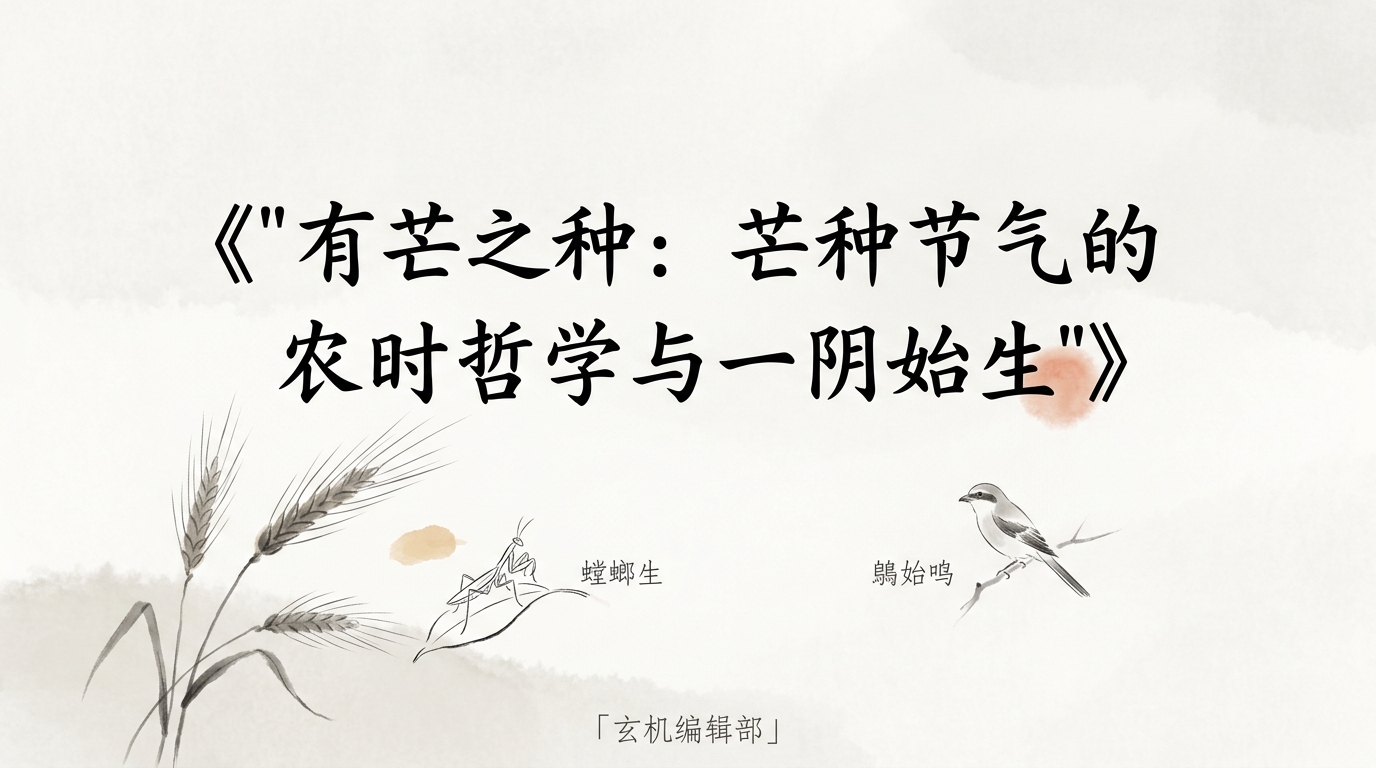
Chapter 17: A Philosophical Chapter on "Why": Yang at Its Extremity Giving Birth to Yin, and the Way of Revering the Season
I. Why, at the Very Moment Yang Qi Is Fullest, Has the First Yin Already Been Born$4
Having laid out sixteen chapters above, we may now focus at last on the most central philosophical question of Mangzhong: why, at the very moment yang qi is fullest, has the first yin already begun to sprout$5
This question touches upon the deepest wisdom of Chinese philosophy—the dialectic that a thing at its extremity must reverse, that fullness at its height gives way to decline.
Why must "a thing at its extremity reverse"$6 Let us think this through from the most fundamental level. If the operation of Heaven's Way were linear (yang qi growing ever fuller, without end), the cosmos would move toward extremity and uniformity, ultimately ending in destruction (as in the myth of the ten suns rising together, yang qi unchecked, scorching the myriad things). But Heaven's Way is not linear; it is cyclical. It is not one-directional; it recurs, again and again. And for motion to recur cyclically, a mechanism of "turning" must be set precisely at the "extreme point"—yang at its extremity gives birth to yin, allowing yang's growth to brake and turn; yin at its extremity gives birth to yang, allowing yin's growth to brake and turn. It is precisely this mechanism of "the extreme point giving birth to its reversal" that enables Heaven's Way to return upon itself, cycle after cycle, ceaselessly generating life.
The Most High says: "Reversal is the movement of the Dao" (Daodejing, Chapter 40)—"reversal" (returning, turning) is the fundamental manner in which the Dao moves. He also says: "When a thing reaches its prime, it ages" (Daodejing, Chapter 30)—when a thing grows to the height of its prime, it moves toward aging. This is precisely the philosophical foundation of "yang at its extremity giving birth to the first yin." As yang qi grows to a prime nearing its extremity (Mangzhong), the mechanism of "aging" (decline) must necessarily activate—this is that quietly sprouting first yin. The sprouting of this first yin is not an "enemy" of yang qi, but a mechanism of "self-regulation" that Heaven's Way sets in place to prevent yang qi from growing excessively unchecked. It is like the brake of "tying it to the metal wheel-stop" in the Gou hexagram, allowing yang qi, once it has reached its summit, to turn smoothly, rather than continuing to grow unchecked toward self-destruction.
So the deeper wisdom of "yang at its extremity giving birth to the first yin" is this: any force, at the very height of its fullness, inherently carries within it the seed of self-restraint, self-transformation. This is not pessimism (that fullness must inevitably decline), but the great wisdom of Heaven's Way—it is precisely this mechanism of "decline contained within fullness, reversal born at the extreme point" that guarantees the cosmos's eternal cycle and ceaseless generation of life. That Mangzhong lets us see, at the very moment yang qi is fullest, this sprouting of the first yin, is meant precisely to help us grasp: true fullness is not infinite expansion, but the wisdom of nurturing transformation within the extreme, and maintaining restraint within grandeur.
II. Why Must One "Revere the Season"$7 Why Is Time Worthy of Reverence$8
Another core question of Mangzhong is "revering the season." Why did the ancients hold such a profound reverence for "time" (season, timing, farming time)$9 Why is time worthy of reverence$10
First, because time is the manifestation of Heaven's will. We have already cited the Master's words above: "What does Heaven ever say$11 Yet the four seasons proceed through it, and the hundred things are born through it. What does Heaven ever say$12" (Analects, "Yang Huo"). Heaven does not speak; it expresses itself through the operation of the four seasons, through the growth of the myriad things. The seasons (the four seasons) are Heaven's "language"; timing (the farming season) is Heaven's "command." To revere the season is to revere Heaven; to violate the season is to defy Heaven. The farming time of Mangzhong is an inviolable command that Heaven itself has set—to miss it is to defy Heaven's will, and must inevitably bring the calamity of famine.
Second, because time is an irreversible, unstorable, scarce resource. We have already cited the words of the Guanzi: "What is not done today will, by tomorrow, be lost wealth. The days that have passed are gone and will not return." The irreversibility of time makes every moment "unique," "never to come again." The farming-time window of Mangzhong, once passed, is passed forever, with no possibility of remedy. This irreversibility grants time a weight verging on the sacred—it demands that human beings treat every moment with the utmost care and the highest focus.
Third, because revering the season is the fundamental path to the unity of Heaven and humanity. The "Wenyan" commentary on the Qian hexagram in the Zhouyi says: "Acting before Heaven, yet Heaven does not oppose him; acting after Heaven, yet he reveres Heaven's timing" (先天而天弗违,后天而奉天时). Acting before Heaven's timing arrives, without violating Heaven's Way; acting after Heaven's timing has arrived, reverently honoring Heaven's timing. "Reverently honoring Heaven's timing"—reverently complying with Heaven's timing—is precisely the core of the unity of Heaven and humanity. Only by revering the season, honoring the season, and according with the season can a person resonate with Heaven's Way at the same frequency, arriving at the state of "according one's virtue with Heaven and Earth, according one's order with the four seasons" (Zhouyi, "Wenyan" on the Qian hexagram). The "revering the season" of Mangzhong is precisely the most visceral practice of this unity of Heaven and humanity—when the farmer, at Mangzhong, reveres the farming season and races against every moment, they are, in fact, realizing, in the plainest possible way, the lofty ideal of "according one's order with the four seasons."
III. Why Must Mangzhong's "Busyness" Contain "Reverence," and Its "Busyness" Contain "Stillness"$13
The deepest dialectic of Mangzhong is the unity of "busyness" with "reverence" and "stillness." Why must this busiest of solar terms contain reverence within its busyness, and stillness within its busyness$14
Because true "busyness" is not a panicked, agitated, blind toil, but an orderly diligence grounded in "reverence" and founded upon "stillness."
"Reverence" within "busyness"—if the "busyness" of Mangzhong lacked "reverence" (devotion toward Heaven's timing, the land, the grain), it would degenerate into pure physical exhaustion, even into a squandering of grain, a desecration of the farming season. Only when threaded through with "reverence" does this "busyness" attain a spiritual height—it is not a wearying scramble, but a solemn reception of Heaven's timing, a devout participation in the transforming and nurturing work, carried out with a devout heart. The "handling affairs with reverence" cited above (Analects, "Zi Lu") is precisely the spiritual foundation of "reverence" within the "busyness" of Mangzhong.
"Stillness" within "busyness"—if the "busyness" of Mangzhong lacked "stillness" (inward settledness, a steady heart and qi), the busyness would breed disorder, and the toil would injure the body. Only when founded upon "stillness" can this "busyness" proceed with composure and efficiency—when the heart is settled, affairs do not fall into disorder; when the qi is still, the body is not injured. The teaching cited above from the Liji's "Monthly Ordinances," "settle the heart and qi," and from the Daxue, "having settledness, one is afterward able to be still... being still, one is afterward able to be at peace," are precisely the cultivational foundation of "stillness" within the "busyness" of Mangzhong.
At a deeper level, this "stillness" within "busyness" also resonates with Mangzhong's truth of Heaven's Way, "Fire at its extremity, with yin born." At Mangzhong, the virtue of Fire is at its fullest (corresponding to the blazing intensity of "busyness"), while the first yin secretly sprouts (corresponding to the inward restraint of "stillness"). The outward "busyness" answers to the fullness of yang; the inward "stillness" guards the newly born yin. One busyness, one stillness; one yang, one yin—these are precisely Mangzhong's perfect response to Heaven's Way, at the level of body and mind. So the "stillness within busyness" of Mangzhong is not merely a wisdom for conducting oneself in the world, but a state of life structurally aligned with Heaven's Way itself—answering the fullness of yang through outward diligence, guarding the sprouting of yin through inward settledness, and thereby, at the very busiest of moments, achieving a profound harmony between body and mind and Heaven's Way.
IV. Why Does Mangzhong Center on "Busyness" and "Sowing," While Xiazhi Centers on "Arrival" and "Culmination"$15
Mangzhong and Xiazhi both fall within the fifth month (the wu month), both correspond to the Gou hexagram, and both belong to the virtue of Fire. Why, then, did the ancients establish them as two distinct solar terms$16 What, precisely, distinguishes their respective emphases$17
This question touches upon the subtle wisdom of the twenty-four-solar-term system in "discerning difference within sameness."
Xiazhi centers on "arrival" (至) and "culmination" (极). "Zhi" (至) means extremity, reaching the summit. Xiazhi is the "extreme point" at which the sun reaches its northernmost position (ninety degrees of solar longitude), the day reaches its longest, and yang qi reaches its absolute summit. The focus of Xiazhi is the "extremity" in an astronomical sense—the culmination of yang, the extremity of the day. It is a "static," "landmark" astronomical moment, marking the peak of yang qi and the formal beginning of the shift between yin and yang (after Xiazhi, the days gradually shorten, and yin qi formally begins to grow). The philosophy of Xiazhi is a philosophy of "the extremity"—fullness at its height gives way to decline; the extremity reverses.
Mangzhong centers on "busyness" (忙) and "sowing" (种). "Mang" refers to the intensity of farm labor; "zhong" refers to the work of sowing and reaping. The focus of Mangzhong is not the astronomical "extremity," but the agricultural "busyness"—the intense labor of harvesting wheat, sowing rice, tending the fields. It is a "dynamic," "practical" agricultural period, marking the juncture in the year when the farming season is most urgent and human affairs busiest. The philosophy of Mangzhong is a philosophy of "timing"—not violating the farming season, racing against every moment, revering the season as one reveres the divine.
From this we can see that Xiazhi and Mangzhong form a natural complementary pair: one "Heaven," the other "humanity"; one "extremity," the other "busyness"; one "stillness," the other "motion." Xiazhi centers on the objective astronomical extreme point (yang's culmination); Mangzhong centers on the subjective human response (busy sowing). Xiazhi displays the "natural image" of Heaven's Way reaching its summit; Mangzhong displays the "human achievement" of humanity racing against every moment beneath Heaven's Way. Though the two share the same month, the same hexagram, the same virtue, they together construct the complete picture of midsummer from the two dimensions of "Heaven" and "humanity"—Heaven's Way reaches its extremity at Xiazhi (yang at its extremity, yin born); human affairs give their utmost at Mangzhong (harvesting and sowing, revering the season). This is precisely the exquisite design of the twenty-four solar terms, "discerning difference within sameness, Heaven and humanity complementing one another"—the very same midsummer, the very same cycle of the virtue of Fire, yet named separately, understood separately by the ancients from the two vantage points of astronomical "extremity" (Xiazhi) and human "busyness" (Mangzhong), so that both the Heaven's Way and the human affairs of midsummer are given their full, thorough due.
Understanding this, we can grasp the distinctive value of Mangzhong: it pulls the focus of the solar term back from a purely astronomical phenomenon (such as the "extremity" of Xiazhi) to the most visceral practice of human affairs (the "busyness" of harvesting and sowing). Among the twenty-four solar terms, Mangzhong is one of the most "down to earth"—it takes its very name directly from "busy sowing," solemnly writing the farmer's labor of bending to the earth, racing against every moment, into the very system of Heaven's Way. This is the highest tribute the ancients paid to labor, and also the plainest, most moving expression of the cosmology of "the unity of Heaven and humanity."