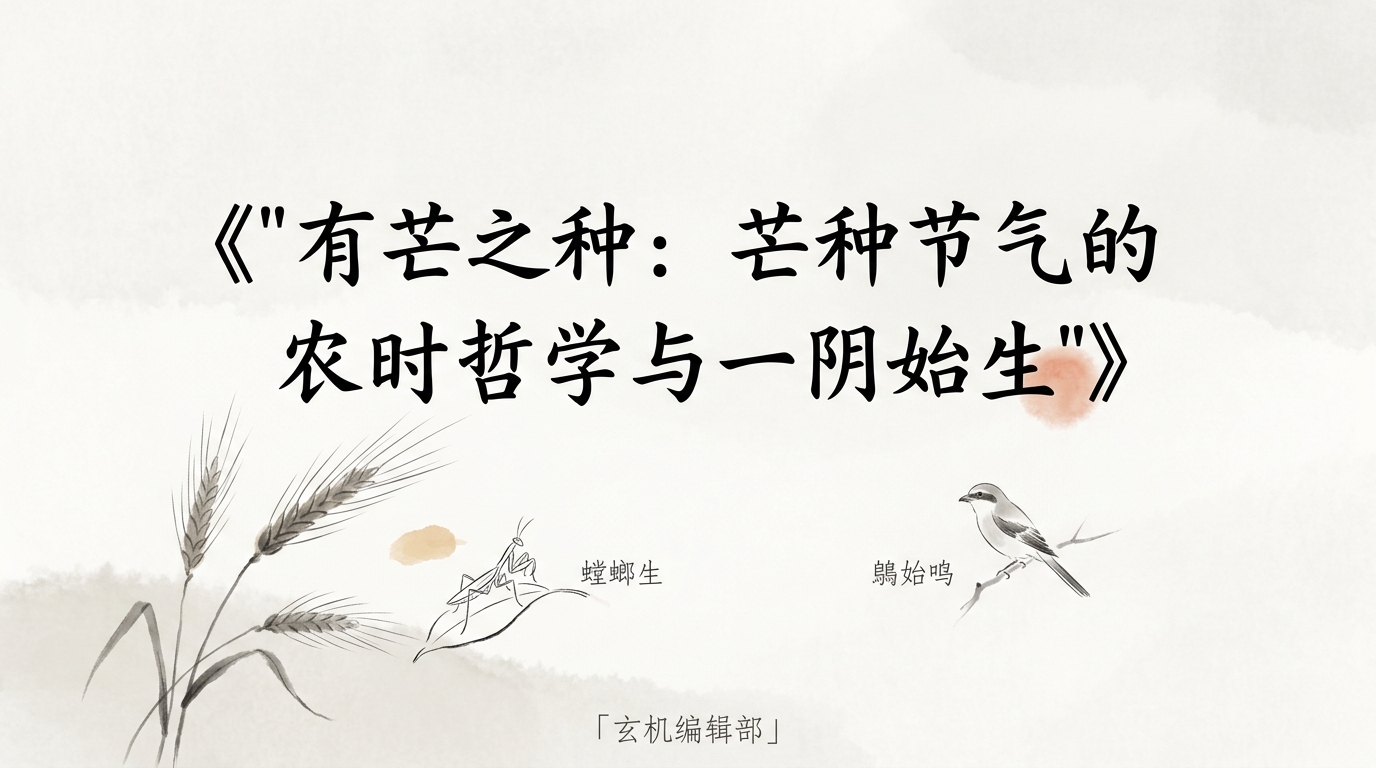
Bearded Grain and Sown Seed: The Farming-Time Philosophy of Mangzhong and the First Stirring of Yin
Drawing on pre-Qin Confucian and Daoist thought, etymology, astronomy, and phenology, this article offers an in-depth reading of Mangzhong (Grain in Ear), the ninth of the twenty-four solar terms. It reveals the farming-time philosophy behind the folk saying "Mangzhong is busy sowing," examines the phenomena of the praying mantis emerging and the shrike beginning to cry at solar longitude seventy-five degrees, and unfolds how the Gou hexagram's "first stirring of yin" marks a cosmic turning point at the very height of yang—inviting readers into the ancient wisdom of racing against time and revering the seasons as one reveres the divine.
Chapter 5: "Mangzhong Means Busy Sowing": The Farming-Time Philosophy of Not Violating the Seasons
I. Why Is Mangzhong the Busiest Farming Time of the Entire Year$29
"Mangzhong means busy sowing"—this folk saying is the very soul of the Mangzhong solar term. To truly understand Mangzhong, we must enter deeply into this word "busy."
The busyness of Mangzhong arises from the overlap of three agricultural tasks within the same narrow window of time: harvesting wheat, transplanting rice, and tending the fields.
Harvesting wheat means racing to reap the bearded wheat that has already ripened. Once the wheat is fully ripe, delay means the grains fall to the ground, or rot on the ear if caught by rain, and a year's labor comes to nothing. So when the wheat ripens, one must race against every moment, swinging the sickle to harvest it—"snatching grain from the tiger's mouth."
Transplanting rice means racing to sow the seasonal rice. The period around Mangzhong is the critical window for transplanting rice seedlings; once this window passes, the seedlings miss their proper timing, their growing period falls short, and they struggle to ripen fully. So the moment the wheat has been harvested, the field must at once be plowed, flooded, and planted with seedlings, without a moment's delay.
Tending the fields means managing the other crops that have already been sown. This is precisely midsummer, when crops grow most vigorously, and weeds, pests, drought, and flooding all require attention.
Harvesting, sowing, and tending all proceed together, and the window of time granted by Heaven is exceedingly brief—this is the root of Mangzhong's busyness. It is not ordinary busyness, but a "race" bound up with an entire year's livelihood—racing to harvest, racing to sow, racing against the farming season. In this sense, Mangzhong is the juncture at which the pressure to "not violate the farming seasons" is greatest, the most severe proving ground for the idea of "revering the season."
II. Master Meng's Solemn Proclamation of "Not Violating the Farming Seasons"
"Not violating the farming seasons" (不违农时) is the central proposition of pre-Qin farming-time philosophy, and its most solemn proclamation comes from Master Meng (Mencius).
The "King Hui of Liang, Part One" chapter of the Mencius (孟子, Mengzi) records Master Meng's famous discourse to King Hui of Liang: "If the farming seasons are not violated, there will be more grain than can be eaten. If close-meshed nets are not cast into the ponds and pools, there will be more fish and turtles than can be eaten. If axes enter the mountain forests only at the proper times, there will be more timber than can be used. When grain and fish and turtles are more than can be eaten, and timber more than can be used, this enables the people to nurture the living and mourn the dead without regret. To nurture the living and mourn the dead without regret is the beginning of the Kingly Way" (不违农时,谷不可胜食也;数罟不入洿池,鱼鳖不可胜食也;斧斤以时入山林,材木不可胜用也。谷与鱼鳖不可胜食,材木不可胜用,是使民养生丧死无憾也。养生丧死无憾,王道之始也).
The weight of this passage is immense. Master Meng places "not violating the farming seasons" at the very forefront, as "the beginning of the Kingly Way." Why$30 Because "not violating the farming seasons" directly concerns "grain more than can be eaten"—the abundance of food; and the abundance of food, in turn, concerns "nurturing the living and mourning the dead without regret"—the people having no cause for regret in nurturing life and mourning death; and this, precisely, is "the beginning of the Kingly Way"—the starting point of kingly governance.
Note the foundation of this chain of reasoning: the realization of every political ideal begins with these four words, "not violating the farming seasons." A ruler who does not understand and does not respect the farming seasons cannot even achieve the most basic goal of "enabling the people to nurture the living and mourn the dead without regret," let alone the Kingly Way. Master Meng anchors an abstract political ideal firmly in the most concrete, most unadorned reality—the farming season.
And Mangzhong is precisely the moment when "the farming season" is most urgent, least tolerant of violation. If "not violating the farming seasons" is the overarching principle governing the whole of the four seasons, then Mangzhong is the period in which this principle faces its most severe test. Miss Mangzhong, and the wheat rots, the rice is sown too late, and "more grain than can be eaten" becomes an empty phrase. Master Meng's "not violating the farming seasons" finds, in Mangzhong, its most concrete and most visceral footnote.
III. "Employing the People According to the Seasons": The Ruler's Responsibility for Farming Time
Echoing "not violating the farming seasons" is the Master's (Confucius's) teaching of "employing the people according to the seasons" (使民以时).
The "Xue Er" chapter of the Analects records the Master's essential teaching on governance: "In guiding a state of a thousand chariots, approach affairs with reverence and good faith, economize expenditure and cherish the people, and employ the people according to the seasons" (道千乘之国,敬事而信,节用而爱人,使民以时). To govern a great state possessing a thousand war chariots, one must handle affairs with seriousness and hold fast to good faith, economize expenditure and cherish the people, and conscript the people's labor only in accordance with the farming seasons.
"Employing the people according to the seasons"—conscripting the people's labor must accord with the farming season. This is a solemn demand placed upon the ruler. In an agrarian society, if a ruler conscripts labor (for corvée or military service) without avoiding the farming season, and happens to strike precisely at a busy juncture like Mangzhong, this will rob farmers of the precious time needed for harvesting and sowing, leading to fields left fallow and a disastrous harvest. So the core of "employing the people according to the seasons" is that the ruler must place the urgency of the farming season above his own needs, and must never conscript the people's labor at a juncture like Mangzhong.
The "King Hui of Liang, Part One" chapter of the Mencius also says: "Those who seize the people's farming time, preventing them from plowing and weeding to nurture their parents, cause their parents to freeze and starve, and their brothers, wives, and children to be scattered" (彼夺其民时,使不得耕耨以养其父母,父母冻饿,兄弟妻子离散). "Seizing the people's farming time" is the most severe indictment that can be leveled against a ruler. And the "people's time" that must least of all be "seized" is precisely the critical farming juncture of Mangzhong, where harvesting and sowing overlap.
From this we can see that the busyness of Mangzhong is not merely the farmer's affair, but also the ruler's political responsibility. Pre-Qin political philosophy raised "revering the farming season" and "not seizing the people's time" to the height of "the beginning of the Kingly Way." The "busyness" in the very name Mangzhong is thus not merely a description of an agricultural state, but also the vessel of a profound political ethic—it reminds every person in power: in this season, return the farming time to the farmers; let all under Heaven harvest and sow in peace.
IV. Master Guan on Timing: The Benefit of Seizing the Moment, the Harm of Missing It
Master Guan of the state of Qi offers the most pragmatic and profound discourse on the economic significance of "timing" (时).
The "Cheng Ma" (乘馬) chapter of the Guanzi (管子) says: "The place of timing in the handling of affairs is exquisite; it cannot be stored away and set aside. Hence it is said: what is not done today will, by tomorrow, be lost wealth. The days that have passed are gone and will not return" (时之处事精矣,不可藏而舍也。故曰:今日不为,明日亡货。昔之日已往而不来矣). This passage, with an almost merchant's shrewdness, spells out the economic essence of "timing"—timing is a resource that cannot be stored, that vanishes the instant it passes. "What is not done today will, by tomorrow, be lost wealth"—applied to the farm labor of Mangzhong, this means: fail to harvest the wheat today, and tomorrow it rots; fail to transplant the seedlings today, and tomorrow the season is missed. The farming-time window of Mangzhong is the finest illustration of "the days that have passed are gone and will not return"—once missed, it is missed forever, with no possibility of remedy.
The "Zhou He" (宙合) chapter of the Guanzi further says: "Gathering the newly grown in spring, gathering the gourds and melons in autumn, dwelling in the shade in summer, dwelling in the sun in winter—this describes how the sage's every movement and stillness, opening and closing, bending and stretching, taking and giving, must necessarily accord with the season" (春采生,秋采蓏,夏处阴,冬处阳,此言圣人之动静开阖,诎信浧儒,取与之必因于时也). Every choice of action or restraint made by the sage must follow the season. This wisdom of "taking and giving necessarily according with the season" finds its most extreme expression precisely in Mangzhong—both harvesting (taking) and sowing (giving) must strictly follow the farming season, with not the slightest "violation of timing" permitted.
Master Guan's discourse supplies an economic dimension to "not violating the farming seasons." The farming season must not be violated not only because it is Heaven's Way, not only because it is an ethical matter, but also because it is the scarcest, most irreversible of resources. The "busyness" of Mangzhong is, at its essence, humanity racing against "time"—completing as much harvesting and sowing as possible before that fleeting window of farming time closes. This is a race that cannot be lost, and cannot be delayed.
V. "Time Waits for No One": The Philosophy of Life That Mangzhong Teaches Us
The busyness of Mangzhong ultimately points toward a philosophy of life that transcends farming itself—time waits for no one.
The "Yang Huo" (陽貨) chapter of the Analects records a lament attributed to the Master (some say it was spoken by Yang Huo, with the Master remaining silent): "The sun and moon pass on; the years do not wait for us" (日月逝矣,岁不我与). The "Zi Han" (子罕) chapter of the Analects records the Master's sigh as he stood by a river: "What passes away is just like this, is it not! Never ceasing, day or night" (逝者如斯夫!不舍昼夜).
This profound realization of the passage of time resonates with the farming-time philosophy of Mangzhong. The farming season flows like water, never to return; a human life, too, flows like water, gone in an instant. Is the "racing" that Mangzhong teaches the farmer not also the very lesson that Heaven's Way teaches every one of us—to plow, sow, and reap with all our strength before the window of time that belongs to us swings shut$1
The "Image" commentary (象傳) on the Qian hexagram in the Zhouyi says: "Heaven's motion is vigorous; the noble person, in accordance with this, makes himself ceaselessly strong" (天行健,君子以自强不息). The operation of Heaven's Way is vigorous and unceasing, and the noble person, taking Heaven's Way as a model, must likewise make himself ceaselessly strong. The busyness of Mangzhong is precisely the expression, at the level of farm labor, of "Heaven's motion is vigorous"—Heaven's Way operates with all its force through midsummer, hastening the ripening of the myriad things, and the farmer, too, must give his utmost, resonating with Heaven's Way at the same frequency. The phrase "ceaselessly strong" carries its most visceral weight precisely within this solar term of sweat and racing against the clock.
So the "busyness" of Mangzhong is by no means a passive toil, but an active striving in step with Heaven's Way. It reminds us: the moment granted by Heaven and Earth is limited, precious, and irreversible; only by meeting and seizing it with the utmost diligence and focus can we prove worthy of the grace of Heaven and Earth's nurturing, and worthy of this brief and precious stretch of life.