Rain Bringing Forth the Hundred Grains: Guyu, Civilization's Spring Rain, and the Legend of Cangjie
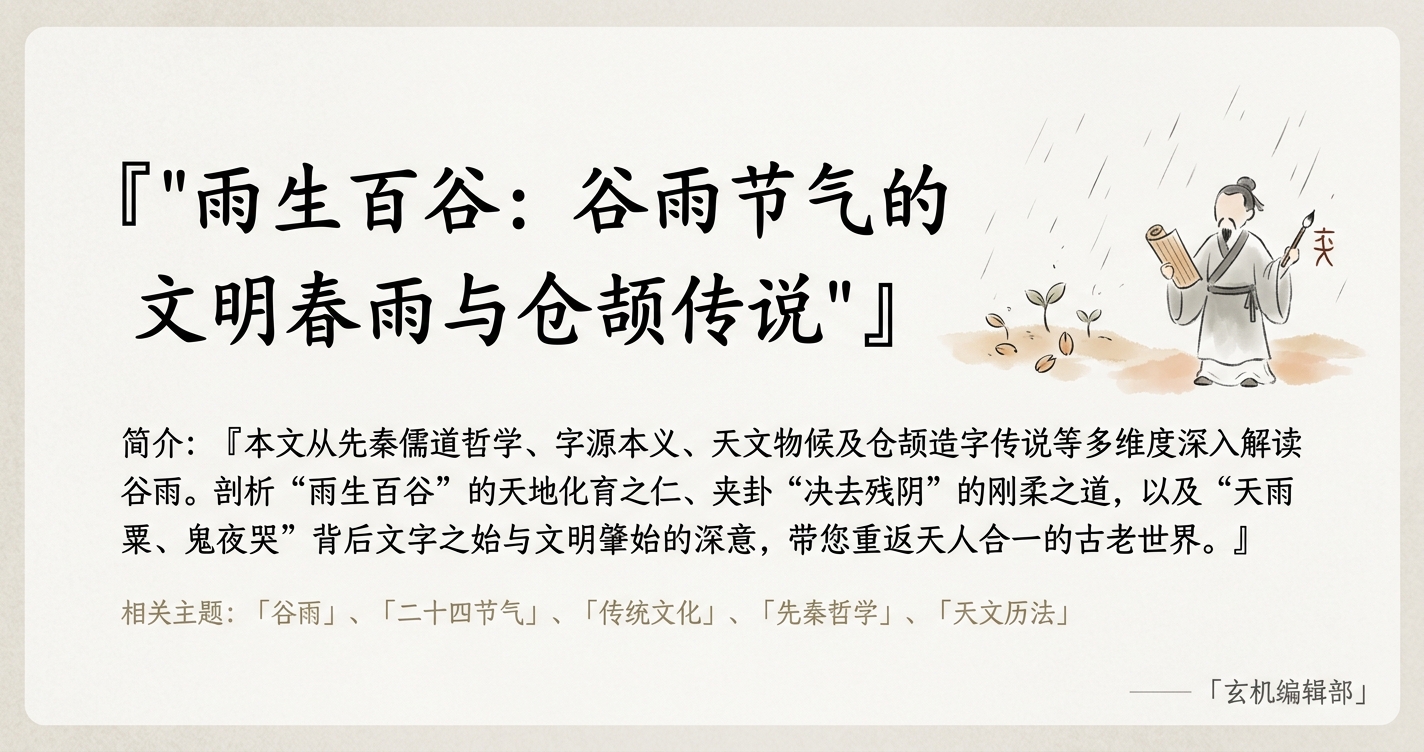
Drawing on pre-Qin Confucian and Daoist philosophy, etymology, astronomy, phenology, and the legend of Cangjie's invention of writing, this article offers an in-depth reading of the Guyu (Grain Rain) solar term. It examines the humane grace of Heaven and Earth embodied in "rain giving birth to the hundred grains," the firm-yet-yielding way of hexagram Guai's "resolving away the last remnant of yin," and the profound meaning behind "Heaven rained down millet, and ghosts wept in the night" at the origin of writing—returning readers to the ancient world of the unity of Heaven and humanity.
Introduction: Why Gaze Anew Upon "Guyu" in the Rains of Late Spring$1
Between Heaven and Earth, all things have their season. When we speak of "Guyu" (谷雨, Grain Rain) today, we tend to treat it merely as a square on the calendar—a certain day in a certain month, when the rains grow heavier and spring draws toward its close. Yet such an understanding truly does a disservice to the millennia of labor our ancestors poured into observing the heavens above and scrutinizing the earth below. Guyu is by no means a simple point in time. It is the crystallization of the ancients' profound apprehension of the workings of the Heavenly Dao; it is the solemn testimony of Heaven and Earth nourishing "grain" (谷) through "rain" (雨), covering and rearing the ten thousand things with a wordless benevolence; and it is, still more, proof of that ancient and subtle bond between humanity and nature.
Why revisit Guyu through the lens of the pre-Qin and high-antiquity worldview$2 Because that was the age in which this solar term was born—the age before its meaning had been buried beneath layer upon layer of later commentary and custom. In that age, a solar term was not knowledge but survival; not a concept but a faith; not a cultural symbol but a real and solemn intercourse between Heaven and humanity. A spell of Guyu rain, to people today, may mean no more than remembering to carry an umbrella out the door; to the ancients, it was "Heaven's grace," bound up with a whole year's livelihood and the very survival of the clan.
The Canon of Yao in the Book of Documents (Shangshu) records: "Then he commanded Xi and He, in reverent accordance with vast Heaven, to calculate and delineate the sun, moon, and stars, and respectfully to bestow the seasons upon the people." These few words say everything about why the solar terms came to be—"respectfully to bestow the seasons upon the people." The word "reverent" and the word "bestow" raise the observation of the heavens to something nearly religious in stature. One watched the sky not to satisfy curiosity but out of reverence—awe before the Way of Heaven; one bestowed the seasons not merely for convenience of living but to convey Heaven's will down into the human world.
And among all the solar terms, Guyu may be the one that most fully embodies these words "respectfully bestowing the seasons upon the people"—for its very name speaks directly of farm work: grain is about to be sown; rain is about to come. Miss the rain of Guyu, and one misses an entire year's grain.
What deep cosmology lies within this$3 Why would the ancients bind together the two characters "rain" and "grain" to coin a name like "Guyu"$4 Why not "spring rain," "late rain," or "blossom rain," but precisely "Guyu"—a name that welds the water above the sky directly to the grain upon the earth$5
This very question touches the core of pre-Qin thought: in the eyes of the ancients, Heaven was not some lofty firmament remote from human affairs—Heaven was something that "rained down grain." It sent down rain; rain became the five grains; the five grains sustained the multitude. Between Heaven and humanity ran an unbroken chain of grace, threaded through by "rain."
The Tuan commentary to the hexagram Qian in the Book of Changes (Zhouyi) says: "Clouds move and rain is bestowed, and the categories of things flow into form." Clouds move across the heavens; rain is bestowed generously upon the earth below; and so the ten thousand things each flow forth and take their shape. Guyu is precisely the fullest, most direct embodiment within the year of these eight characters, "clouds move and rain is bestowed, and the categories of things flow into form." It stands in late spring, the last solar term of spring; one step further brings Start of Summer (Lixia), the grand threshold at which the hexagram Qian—pure yang—turns the ten thousand things from "birth" to "growth." Guyu is thus a place of liminality: it is spring's end and the eve of summer's beginning; it is the juncture where the yang qi is about to fill yet has not fully filled, where the five grains are about to sprout yet have not quite sprouted.
This article proceeds from the core thought of pre-Qin Confucianism and Daoism, and reaches further back into more ancient myth and folk tradition, to offer as deep a reading as possible of the solar term "Guyu." We wish not merely to know what Guyu is, but to ask why it is so; not merely to learn what the ancients did at Guyu, but to understand why they did it.
We shall gaze upon the original meanings of the two characters "grain" and "rain," and ask after the humane grace of Heaven and Earth behind "rain giving birth to the hundred grains"; we shall enter the cosmic picture of the third month of spring in the "Monthly Ordinances" (Yueling) of the Book of Rites (Liji), and inquire into the firm-yet-yielding way of hexagram Guai's "resolving away the last remnant of yin"; above all, we shall pause before a strange and singular legend—that when Cangjie invented writing, "Heaven rained down millet, and ghosts wept in the night"—to explore why later ages bound the very origin of writing to this particular rain of Guyu, and to touch that almost mystical resonance between "raining millet" and "civilization."
In the course of these layered inquiries, perhaps we may once again touch that ancient world in which all things possessed spirit, Heaven and humanity moved each other, and even a single rain was laden with profound meaning.