A Modest Discourse on "Li" (Ritual Propriety) — Part 1
Approaching the subject from the standpoint of pre-Qin Confucianism, this article examines the origin, essence, and civilizational foundations of ritual propriety (li), seeking to understand the profound meaning it carries between human ethical order and the Way of Heaven.
I. What Is "Li"$1 — Beyond the Predicament of Translation
1.1 A Word Nearly Impossible to Translate
When a Chinese concept is rendered into a Western language, it often loses the greater part of its meaning. "Li" (礼) is no exception. Common English renderings include: ritual, propriety, etiquette, rites, ceremony, decorum. Dutch offers a similarly limited range of equivalents: ritueel, fatsoen, ceremonie. Yet any single one of these translations captures only one facet of li.
Why should this be so$2 Because in pre-Qin thought, li is not merely a code of conduct or a set of ceremonial procedures. It is an all-encompassing concept, spanning multiple dimensions at once:
- The cosmological dimension: the very order by which Heaven and Earth operate is itself an expression of li
- The dimension of social institutions: the arrangement of rank, division of labor, and allocation of authority and responsibility within a population
- The dimension of interpersonal relations: the proper way for people to conduct themselves toward one another
- The dimension of personal cultivation: how a person cultivates their own character
- The dimension of sacrificial ritual: the manner of communing with Heaven, Earth, ancestors, and spirits
- The dimension of emotional expression: expressing joy, anger, sorrow, and delight appropriately on different occasions
- The aesthetic dimension: what counts as beautiful, elegant, and cultured
To use an analogy: if li were a crystal, then translations such as ritual, propriety, and etiquette each capture only one facet of that crystal. The crystal as a whole is far richer than any single facet.
1.2 The Origins of the Character "Li"
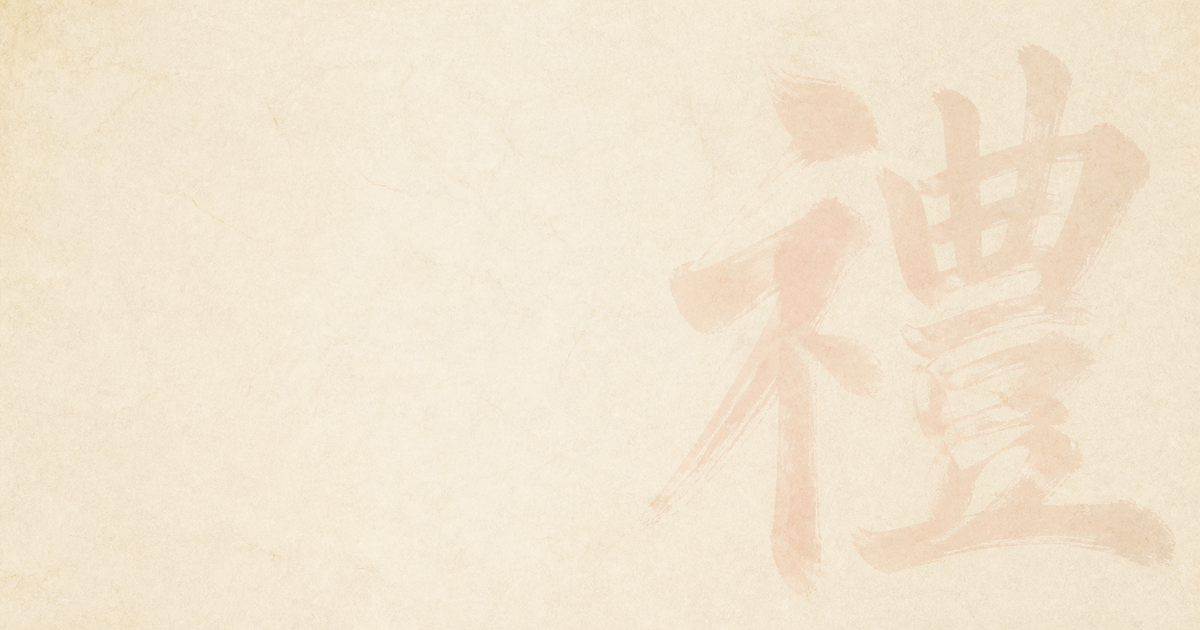
Some clues can be glimpsed in the character itself. The traditional form of li is 禮. On the left is shi (示, abbreviated 礻), the pictograph of an ancient altar or of the spirits — in ancient script, nearly every character related to sacrifice or to spirits and ghosts bears this radical. On the right is feng (豊), the pictograph of a vessel filled with sacrificial offerings — jade and grain placed within a vessel, to be presented to Heaven and Earth or to the ancestors.
Thus the original meaning of li was simply the act of presenting offerings to Heaven, Earth, and the ancestors. It was the means by which human beings established a connection with transcendent presences — Heaven, Earth, the ancestors, and the spirits.
By the pre-Qin period, however, the meaning of li had already expanded far beyond sacrifice. It grew from a religious act into the organizing principle of the whole of human civilization. This expansion is exactly what we find in Master Xun's "Discourse on Ritual Propriety."
1.3 How the Pre-Qin Thinkers Regarded "Li"
Before turning to Master Xun's "Discourse on Ritual Propriety," let us first sketch, in broad strokes, the attitudes of various pre-Qin thinkers toward li, so that the reader may have an overall map to work from.
Confucius (c. 551–479 BCE) bound li tightly together with ren (仁) — the deepest goodness and empathy within human nature. He made one especially important statement: "If a person is not ren, what has he to do with li$3 If a person is not ren, what has he to do with music$4" (Analects 3.3) — if a person lacks an inner heart of ren, then of what meaning is li to him$5 Of what meaning is music to him$6 In other words, Confucius held that the foundation of li lies in inner feeling, in ren. Li without ren is mere hollow performance.
Mencius (c. 372–289 BCE) traced the root of li still further back, to a natural inclination within human nature itself. He proposed the celebrated doctrine of the "Four Sprouts": "The heart of deference and yielding is the sprout of li." (Mencius, "Gongsun Chou I") — human beings are born with a psychological inclination toward yielding, and this inclination is the sprout of li. In Mencius's view, li is not something imposed on people from without, but the development and perfection of a seed of goodness already present within human nature.
Master Xun (Xunzi, c. 313–238 BCE) stood in sharp contrast to Mencius. He held that human nature (xing) inclines toward what is bad — "bad" here not meaning that people are born wicked, but that if the natural desires of human beings are left unchecked and unguided, they will lead to contention and disorder. Li, therefore, is a cultural institution created by the Former Kings (the sage-rulers of antiquity) to address this condition. The source of li is not human nature itself, but human wisdom and effort — what Master Xun calls wei (伪), that is, deliberate, conscious activity.
Laozi (whose dates, and even whose historicity, remain disputed, generally placed somewhere from the late Spring and Autumn period into the Warring States) took a critical stance toward li. In Chapter 38 of the Daodejing, he sets out a sequence descending step by step from the Dao: "When the Dao is lost, only then is there virtue (de); when virtue is lost, only then is there benevolence (ren); when benevolence is lost, only then is there righteousness (yi); when righteousness is lost, only then is there li. Now li is the thinning of loyalty and good faith, and the beginning of disorder." Li, in this view, is what remains once loyalty and good faith have grown thin — indeed the very onset of disorder. But it should be noted: the li that Laozi criticizes is a li that has already lost its inner substance and been hollowed into an empty shell. We shall return to this point in detail later.
Zhuangzi (c. 369–286 BCE) questioned li from yet another angle: he held that true harmony arises when people dwell together spontaneously, needing no external norms whatsoever. He offers a famous image: "When the springs dry up and the fish are stranded together on dry land, they moisten each other with their breath and slather each other with spittle — but this is not so good as forgetting one another in the rivers and lakes." (Zhuangzi, "The Great and Venerable Teacher") — when the spring dries up and the fish are trapped on land, they moisten one another's bodies with saliva; such "mutual aid," touching though it is, is far inferior to swimming freely, each forgetting the other, in the rivers and lakes. In Zhuangzi's view, a society that must be held together by li is like those fish stranded on dry land — the truly good state is one in which none of this is needed at all.
Mozi (c. 468–376 BCE) represents yet another orientation. He opposed the Confucian li of graduated distinctions (different treatment according to differences in status), advocating instead "impartial care" (jian ai) — loving all people equally, without regard to closeness or distance of relation. He held that the elaborate Confucian rites of mourning and sacrifice were a tremendous waste of social resources, and advocated "moderation in funerals" and "condemnation of music."
Such is an overview of li within the pre-Qin intellectual world. Let us now turn to Master Xun's "Discourse on Ritual Propriety" in depth.