A Comprehensive Survey of the Fengshui Principle-and-Qi School
From historical origins, theoretical foundations, and the compass as core instrument, to the doctrines of Eight Mansions, Sanhe, Xuankong Flying Star, and other major schools—along with comparative case studies and inter-school debates—a panoramic survey of the principle-and-qi (liqi) tradition for advanced readers.
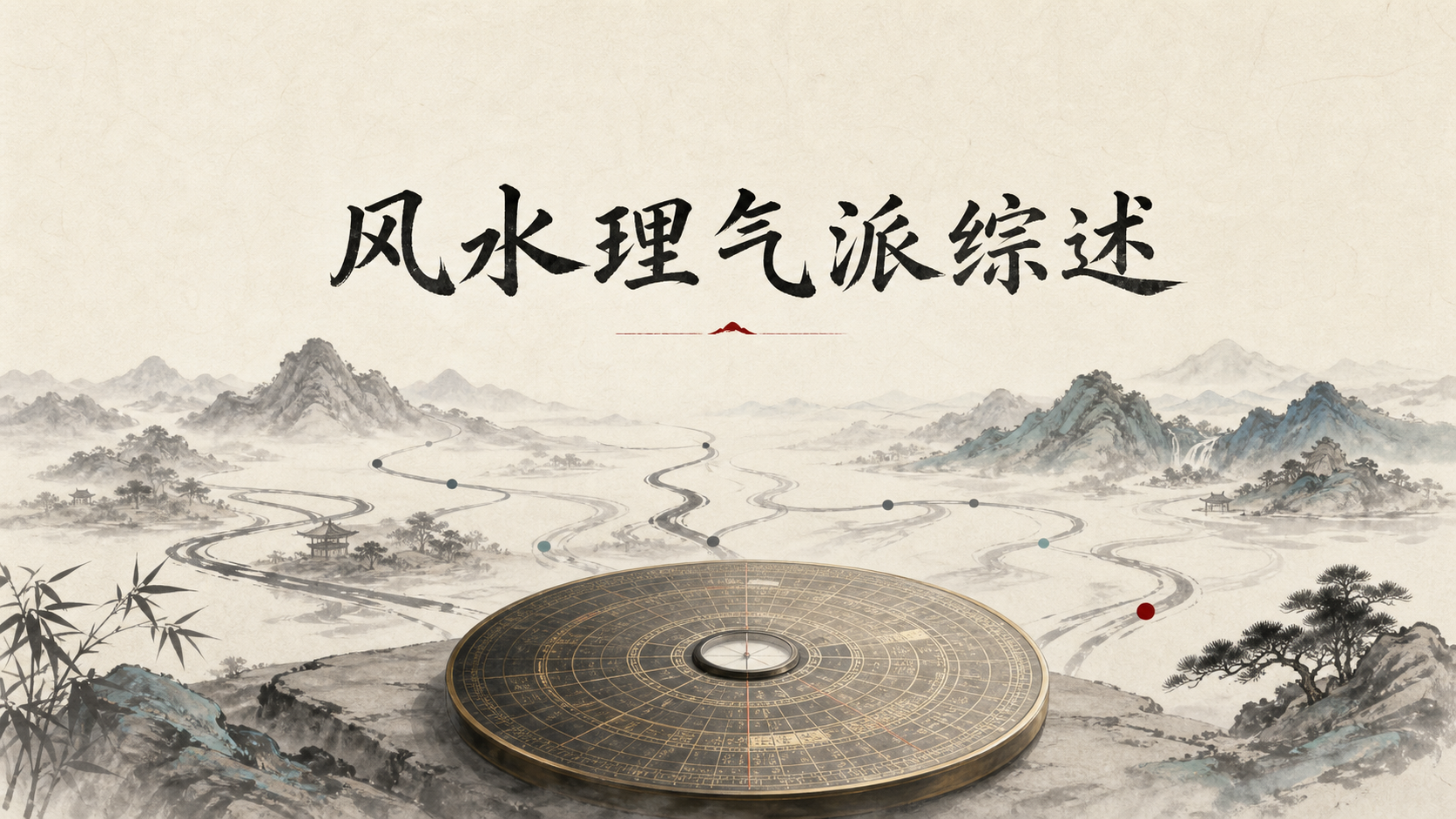
Chapter 4: The Compass — the Principle-and-Qi School's Core Instrument
If the Form School's instruments are the eye and the foot, the principle-and-qi school's instrument is the compass. The compass (luo jing, luo geng) is by no means merely a graduated magnetic needle—it is an "analog computer" that materializes the symbolic systems of Chapter Three into concentric rings: the magnetic needle supplies the reference direction, the successive rings supply lookup functions, and rotating the inner plate performs the coordinate conversion. To understand the structure of the compass is to hold a bird's-eye view of the entire operative practice of the principle-and-qi school.
4.1 The Evolution from the South-Pointer and Cosmic Board to the Compass
The compass fuses two independent technical threads. The first is magnetic-orientation technology: the Han Feizi's statement that "the former kings established the south-pointer in order to fix dawn and dusk" is regarded as the earliest record of a magnetically oriented instrument (the form and practical usability of the south-pointer remain debated within the history of science and technology); by no later than the Northern Song, artificially magnetized compass needles had already matured, and the "thread-suspension method" among the four needle-mounting methods recorded in Shen Kuo's Dream Pool Essays is, together with the later dry-pivot and water-float needles, a direct forerunner of the compass's magnetic needle. The second thread is the cosmic board's system of graduation: as described in Chapter Two, the Han-dynasty cosmic board already arrayed the stems and branches, the trigrams, and the twenty-eight lunar lodges across its face, establishing the form of "carrying a symbolic system on concentric rings." The Northern Song Yingyuan Zonglu's record of "taking the needle at Bing-Wu" shows that these two threads had already converged within the field of kanyu by no later than the eleventh century; and the Southern Song record of the "earth snail" having both a true needle and a seam needle shows that the compass's multi-needle system had already taken fixed form by that time. Across the Ming and Qing dynasties, compass manufacture became a specialized trade (the "Wan'an compass" of Wan'an town in Xiuning, Anhui, is among the most famous centers of production, and its craftsmanship is now listed as a national-level item of intangible cultural heritage); the design of the plate itself also kept adding further layers under the demands of the different schools, growing from a handful of layers in its early form to the common versions of a dozen or even thirty or forty layers seen today.
4.2 Three Plates, Three Needles: The True Needle, the Middle Needle, and the Seam Needle, and Their Respective Roles
A common compass carries three sets of Twenty-Four-Mountain rings, each offset from the others by seven and a half degrees (half a mountain-sector), known as the "three plates":
The Earth Plate's True Needle: takes the direction the magnetic needle points as zi-wu (magnetic north), and serves as the compass's reference ring. Its use: gauging the dragon and fixing the facing—measuring the direction from which the incoming dragon enters the site, and the sitting-and-facing of a house or grave. The input value for every principle-and-qi calculation (the sitting-and-facing) is taken from the Earth Plate.
The Human Plate's Middle Needle: offset from the Earth Plate as a whole by seven and a half degrees counterclockwise (a technical term describes this as "retreating half a position"). Practitioners traditionally attribute its invention to Lai Wenjun, hence the Human Plate is also called the Lai Plate. Its use: adjusting the sand—measuring the direction of the peaks (sand) surrounding the site, matched against the lodge-degree Five Phases to argue generation and overcoming (detailed in 4.4).
The Heaven Plate's Seam Needle: offset from the Earth Plate as a whole by seven and a half degrees clockwise ("advancing half a position"). Practitioners traditionally attribute its invention to Yang Yunsong. Its use: taking in the water—measuring the direction of incoming and outgoing water and the water outlet; the Sanhe water method's Twelve Stages of Life are cast starting from the Heaven Plate.
Why three offset coordinate systems$3 The practitioners' traditional explanation is that each of the "Three Powers"—Heaven, Earth, and Humanity—has its own pole: the Earth Plate rests on the magnetic pole (earthly qi), the Heaven Plate rests on the direction of the sun's shadow (heavenly qi—the seam needle's zi-wu is explained as the difference between the sun-shadow direction and the magnetic-needle direction), and the Human Plate sits between the two. Modern researchers, by contrast, mostly hold that the real source of the difference among the three needles is magnetic declination: compasses calibrated at different times and places would naturally show their own "zi-wu" deviating by several degrees from true zi-wu; Song-dynasty kanyu masters marked different reference points at different times using the true needle and the seam needle respectively, and later generations, no longer understanding the reason, ended up keeping all the needles side by side, each assigned its own function, with theoretical explanations added on afterward. Both accounts have textual support, and this article presents them side by side without adjudicating between them. On the practical level, it suffices to remember the division of labor: the true needle for gauging the dragon and fixing the facing, the middle needle for adjusting the sand, the seam needle for taking in the water—this mnemonic sums up the basic framework of traditional compass operation (later-arising schools such as Xuankong Flying Star, by contrast, use the Earth Plate's true needle for everything, and do not use the middle or seam needles at all).
4.3 A Summary of the Major Rings on the Plate
The number of rings on a compass varies from maker to maker; the following introduces, in the common order from innermost to outermost, the rings of greatest significance for principle-and-qi practice:
- The Heaven Pool: the central chamber housing the magnetic needle. The "seabed line" (the red line and two dots at the bottom of the Heaven Pool) is used to align the needle, and is the key to reading precision.
- The Earlier Heaven / Later Heaven trigram rings: reference rings for the trigrams, marking substance and function.
- The Earth Plate's true-needle Twenty-Four Mountains: the core ring. Whether the characters are marked in red or black (indicating yin or yang) follows either the pure-yin-pure-yang or the Three-Cycles-dragon convention, and varies from maker to maker—when buying a compass, checking the convention used on this ring immediately tells you which school the compass was made for (this is the basis of the distinction among Sanhe plates, Three-Cycles plates, and combined plates).
- The Piercing-Mountain Seventy-Two Dragons: each mountain on the Earth Plate is further divided into three sectors, seventy-two sectors in all, matched to the sixty-term ganzhi cycle plus the eight stems and four intercardinal trigrams (some versions add a "void and death" sector). Used for finely distinguishing the qi of the incoming dragon at the point of entry (the fine-grained tier of dragon-gauging), selecting a dragon in its flourishing phase and avoiding the seams of "solitary, empty, tortoise-shell, and void."
- The Human Plate's middle-needle Twenty-Four Mountains: used for adjusting the sand.
- The Earth-Piercing Sixty Dragons: beneath each trigram (palace), a segment of the sixty-term ganzhi cycle is laid out, sixty sectors in all, used to determine the qi that the site takes in ("earth-piercing" meaning the sense of the qi-vein piercing into the site), matched against na-yin to argue generation and overcoming.
- The Heaven Plate's seam-needle Twenty-Four Mountains: used for taking in the water.
- The One Hundred Twenty Fen Jin ("Parting the Gold"): beneath each mountain of the seam needle (or the Earth Plate), five further sectors are divided, one hundred twenty sectors in all, laid out with the sixty-term ganzhi cycle inserted at alternating stem-and-branch intervals. This is the finest tier of fixing the facing: once the sitting-and-facing has been determined down to the mountain position, it is further fine-tuned by several degrees to select a "fen jin," avoiding the seams of "solitary, empty, and void," and selecting a fen jin in the flourishing phase of bing, ding, geng, or xin, with the fen jin's na-yin then matched against the burial mountain and the immortal's fate to argue generation and overcoming. The saying "a hair's breadth's error in the parting of the gold, and wealth and honor will never meet" refers to this very ring.
- The Twenty-Eight Lunar Lodges' degree ring (the outer plate): the degrees of the twenty-eight lunar lodges are arrayed around the outermost ring, marked with the lodge-degree Five Phases, for use in looking up the Five Phases when adjusting the sand with the Human Plate.
On a large compass with thirty or more rings, the remaining rings (such as the Twelve Jupiter Stations, the waxing-and-waning Sixty Dragons, the evenly divided Sixty Dragons, the two hundred forty fen shu, and others) are mostly variants of the main rings described above, or rings dedicated to a particular school's special use, and cannot all be detailed here. It is worth noting that the Xuankong Flying Star school in fact needs only the single Earth Plate ring—the Shen lineage's method of casting a chart is entirely a matter of calculation done on paper, with the compass responsible only for supplying the sitting-and-facing reading; the elaborateness or simplicity of a compass's rings is itself a reflection of how differently each school arranges "where the calculation actually happens—on the plate, or on paper."
This has also given rise to the compass's own commercial genealogy: a plate listing only the Earth Plate and the various Sanhe rings is a Sanhe plate; one that replaces these with the various Three-Cycles trigram-and-line rings (the Yi Plate, the Jiang Plate) is a Three-Cycles plate; and one that includes both is a combined plate (usable for both Three-Cycles and Sanhe practice)—buying a compass is itself already a choice of school. The traditional protocol for using the compass likewise forms its own set procedure: leveling (the plate's face must be horizontal for the needle to move freely), aligning (matching the needle to the seabed line, with the red tip pointing north), stringing the line (pressing the Heaven-Heart's red cross-threads onto the target being measured), and reading (noting which mountain and which degree the red line falls upon); the position at which the plate is set down (the house's center point, the doorway, the point where the dragon enters) depends on what is being measured. Practitioners further observe taboos around the plate's care (avoiding magnetic interference, avoiding contamination, periodic recalibration) and rites of transmission (customs of bowing to the plate, of "opening its eyes" in consecration)—the compass carries a dual identity within the culture of the trade, as both tool and ritual implement. This is a reminder that the "calculation" performed by the principle-and-qi school has never been a purely technical act; it has always been embedded within an apparatus carrying a strong sense of ritual and authority.
4.4 Gauging the Dragon, Fixing the Facing, Adjusting the Sand, Taking In the Water: The Basic Operative Sequence
The complete traditional principle-and-qi procedure (taking the Sanhe system as the paradigm case) proceeds in four steps:
Gauging the dragon: setting the compass down at the point where the incoming dragon enters behind the site, and using the Earth Plate's true needle (or, for finer work, the Piercing-Mountain Seventy-Two Dragons) to determine from which direction the incoming dragon enters, fixing the dragon's Five-Phase attribute and its nobility or baseness. For a yang dwelling within a city, where there is no mountain dragon to gauge, the road, the incoming water, or the configuration of the surrounding buildings is substituted instead (this is called "taking the road as the dragon").
Fixing the facing: setting the plate down at the center of the site (or the house's foundation), and measuring and selecting the sitting-and-facing. This is the pivot of the entire procedure: the Sanhe school requires that the facing be matched to both the dragon and the water (the "three pearls" of dragon, water, and facing in alignment); the Xuankong school requires that the facing's star-shifting form a coherent configuration; the Eight Mansions school requires that the facing be matched to the occupant's life-gua—each school has its own standard of a "good facing," but "the facing is fixed by the compass" is a rule shared by all. Fine-grained work further descends to the level of the fen jin.
Adjusting the sand: using the Human Plate's middle needle to measure the direction of the surrounding sand-peaks, looking up their lodge-degree Five Phases, and matching them against the burial mountain's Five Phase to argue generation and overcoming. The traditional mnemonic runs: that which generates me is life-qi sand (auspicious); that which is the same phase as me is flourishing-qi sand (auspicious); that which I overcome is servant sand (wealth, auspicious); that which overcomes me is baleful sand (inauspicious); that which I generate is qi-draining sand (inauspicious). The very same peak may be auspicious for one sitting mountain and inauspicious for another; in this way, the auspiciousness of "sand" is extended from a judgment of form (pointed, round, and upright peaks are auspicious) to a judgment of principle-and-qi (Five-Phase generation and overcoming).
Taking in the water: using the Heaven Plate's seam needle to measure the direction of incoming water, outgoing water, and the water outlet, and substituting these into the school's own water method (the Sanhe school's Stage-of-Life water method, the auxiliary-star gua-flipping water method, and so on) to argue fortune and misfortune. Water holds an extremely weighty position within the principle-and-qi school—"the mountain governs descendants, the water governs wealth"—and the water method is very nearly the entire core of the Sanhe school.
In yang-dwelling practice, this sequence is simplified to "fixing the facing plus layout": once the sitting-and-facing has been measured, the school's own model is used to compute the fortune or misfortune of each direction, which is then translated into the arrangement of the gate, the rooms, the stove, the bed, and the stairs.
4.5 Magnetic Declination, True North, and the Modern Problems of Compass Use
Finally, several technical controversies within the modern context must be addressed, as they pose genuine challenges to the principle-and-qi school:
Magnetic north or true north$4 The compass points to magnetic north, and the magnetic declination between magnetic north and true north (the direction of the geographic North Pole) varies by location and by year (within China today it is generally several degrees to the west, varying by region, and drifts slowly year by year). Should principle-and-qi calculation use the magnetic direction or the true direction$5 The traditional mainstream position uses the magnetic direction (taking the compass's actual reading as authoritative); within the Xuankong school there are those who advocate converting to true north; and there are also those who hold that "since the needle has no fixed rule, the underlying principle has no fixed rule either, and each should simply follow their own lineage." A house whose facing lies near the boundary between two mountain sectors can, depending on how magnetic declination is handled, shift from the Zi mountain to the Ren mountain, changing its entire star chart—this is not pedantry, but a genuinely common point of disagreement in actual house judgments.
Reinforced concrete and electromagnetic interference. The steel structures, elevators, and electrical equipment of modern buildings interfere severely with the magnetic needle, and readings taken indoors can be off by a dozen degrees or more. The common practical countermeasure is to take multiple readings from open ground around the exterior of the building and cross-check them against architectural drawings and satellite imagery; smartphone electronic compasses (magnetometers) are likewise subject to interference and have limited precision, so professional practice still relies chiefly on a physical compass cross-checked against maps.
The dispute over the pole point. Before direction is even measured, there is a further, less frequently articulated question of convention: where should the "center" of a dwelling (the pole point, li ji dian, from which the auspiciousness of all eight directions is measured) be located$6 For a regularly shaped floor plan, taking the geometric center as the pole poses no great difficulty; but for floor plans with a missing corner, an L-shape, or a hollow-square shape, the geometric centroid may fall outside the building altogether, giving rise to competing proposals—taking the center of the bounding rectangle, taking the functional centroid, taking the central palace of the living room. Shift the pole point by a meter or two, and the palace assignment of the boundary rooms changes with it. Traditional courtyard dwellings took the courtyard's central point as the pole, and so this problem never arose for them; the irregularization of modern floor plans has turned it into the most common hidden source of disagreement in present-day principle-and-qi practice.
The determination of "sitting-and-facing" itself. An even more fundamental trouble than measurement itself is this: for a modern high-rise residence, what should the sitting-and-facing be taken from$7 The orientation of the building as a whole, the individual unit's front door, or the balcony's light-facing side$8 Schools and individual masters differ (even within the Xuankong school itself, there are three competing positions—by building, by unit, by balcony). This seemingly technical, minor question in fact exposes the fundamental difficulty the principle-and-qi model faces in migrating from the traditional freestanding courtyard house to the modern multi-unit residential building—the model's core input variable has lost any uncontested definition. Chapters Seven and Thirteen will return to this point.
With the instruments accounted for, the next five chapters move into the inner workings of the individual schools, beginning with the Eight Mansions school, the one with the lowest threshold of entry and the widest circulation.