Dwelling, One Observes the Images; Acting, One Observes the Changes -- Reading the Chapter "The Sage Established the Hexagrams and Observed the Images" from the Upper Xici
A line-by-line reading of the second chapter of the Upper Xici. The sage's four acts -- establishing the hexagrams, observing the images, appending the statements, clarifying fortune and misfortune -- run in exact reverse order to the noble person's four acts -- observing the images, savoring the statements, observing the changes, savoring the divination. The four clauses "is the image of..." form a chain tracing effect back to cause; "the repose in which he dwells" echoes the Doctrine of the Mean's "dwelling in ease, awaiting the Mandate"; and the chapter closes by quoting the top line of hexagram Da You, "From Heaven comes its aid," gathering the whole into the two words compliance and good faith. Grounded in Confucian and Daoist thought, and drawing on the Analects, Mencius, Laozi, Zhuangzi, Xunzi, and the Zuo Tradition, it explores how the noble person finds repose between Heaven and Earth and acts amid change.
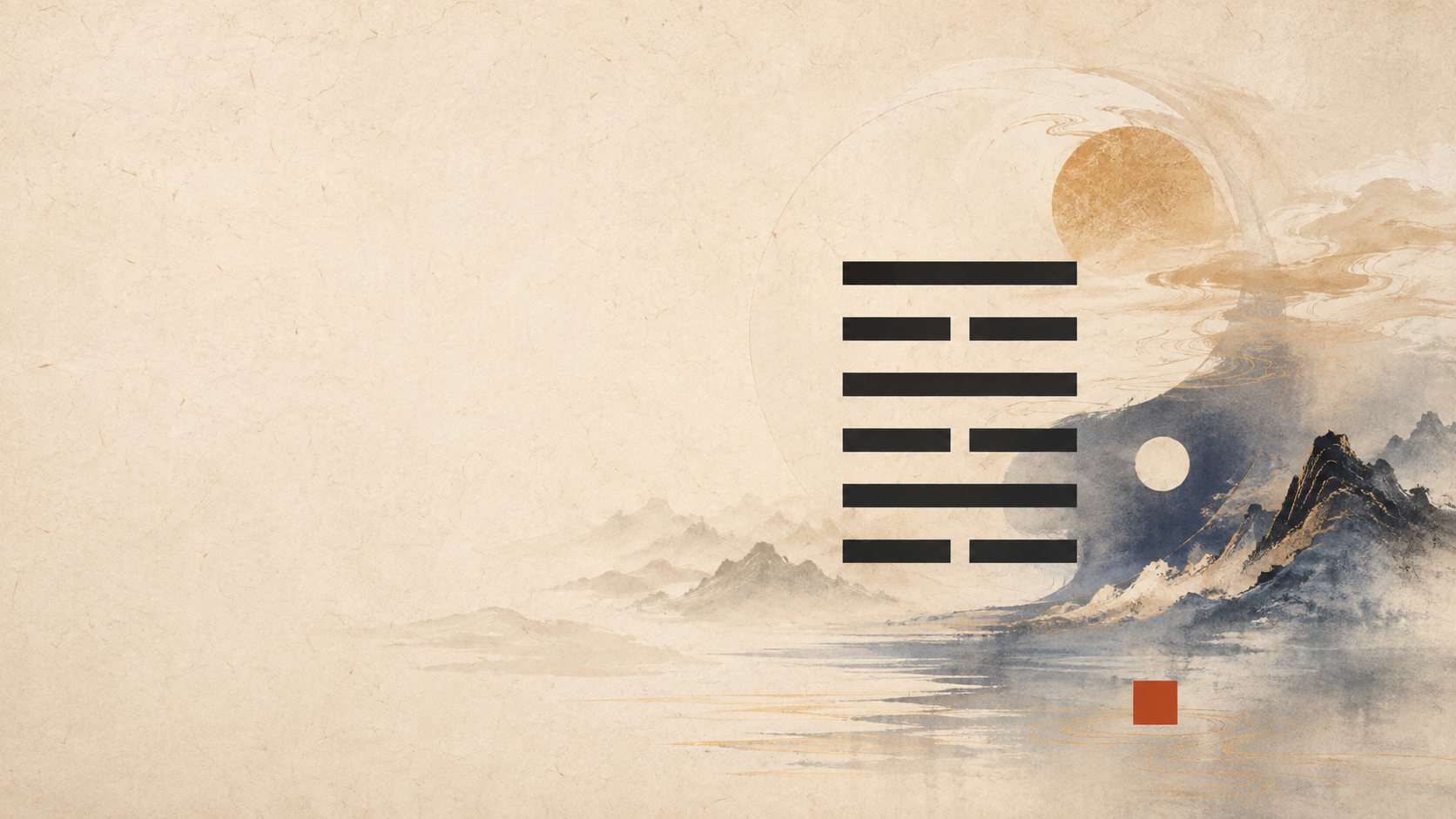
2 The Four Clauses "Is the Image of...": A Chain Tracing Effect Back to Cause
2.1 The Sequence of the Four Images
2.1.1 Loss and Gain, Anxious Care, Advance and Withdrawal, Day and Night
"Fortune and misfortune are the images of loss and gain. Regret and remorse are the images of anxious care. Change and transformation are the images of advance and withdrawal. The firm and the yielding are the images of day and night." The order in which these four clauses are arranged deserves close examination.
Fortune and misfortune correspond to loss and gain. Loss and gain are the result of an affair -- what one obtains or loses once a matter has run its course. Regret and remorse correspond to anxious care: anxiety (you) is apprehension, care (yu) is wariness and precaution. Anxious care is a state of mind, the caution and unease a person feels while a matter is still under way. Change and transformation correspond to advance and withdrawal: advance and withdrawal are action, the choice a person makes, within a given situation, to move forward or draw back. The firm and the yielding correspond to day and night: day and night are the timing of Heaven, a rhythm that a person cannot control but can only comply with.
The four clauses run, in order: result, state of mind, action, the timing of Heaven. The first three lie on the human side; the fourth lies on Heaven's side. The first three can be further distinguished: loss and gain are the outward result, anxious care is the inward feeling, and advance and withdrawal are the motion between inward and outward. Each layer runs deeper than the last. The four clauses move, step by step, from the most superficial -- loss and gain -- to the most fundamental -- day and night.
Arranged this way, one can see that the author of the Xici did not simply list four terms at random. There is a sequence running through the four clauses, from the surface inward and from Man to Heaven. What one sees on the surface is fortune and misfortune; tracing inward, one finds regret and remorse; tracing further inward, change and transformation; tracing to the very bottom, the firm and the yielding. And the firm and the yielding are precisely day and night, the operation of Heaven itself.
2.1.2 Reading Forward and Reading in Reverse
Reading these four clauses forward moves from the surface to the depths, forming a path of understanding: one first sees the result of fortune and misfortune, then apprehends the feeling of anxious care, then perceives the pivot of advance and withdrawal, and finally understands that everything is rooted in the timing of Heaven -- day and night. Reading these four clauses in reverse forms a path of practice: one first understands the timing of Heaven -- day and night -- and on this basis decides one's own advance and withdrawal, maintains a mind of anxious care throughout that advance and withdrawal, and only then arrives at the result of loss and gain.
This reverse path is precisely the order in which the noble person conducts his affairs. The noble person does not fix his eyes on fortune and misfortune and pursue them directly; he looks first to the timing of Heaven. Once the timing of Heaven is clear, advance and withdrawal have a basis. Once advance and withdrawal have a basis, one must still hold fast to a mind of anxious care, not daring to grow careless. Proceeding this way, the resulting loss or gain is no matter of luck, but the natural outcome of following the proper course. Master Meng (Mencius) said, "There is no calamity or blessing that one does not bring upon oneself" -- precisely this meaning: fortune and misfortune are not something pursued directly, but something derived, step by step, from the timing of Heaven, from advance and withdrawal, from anxious care.
A line in the Lower Xici corroborates this way of reading: "The firm and the yielding are what establish the root; change and adaptation are what pursue the moment." The firm and the yielding are the root; change and adaptation pursue the moment. This corresponds exactly to this chapter's pairing of the firm and the yielding with day and night, and change and transformation with advance and withdrawal. Day and night are the root, the rhythm fixed by Heaven; advance and withdrawal pursue the moment, the human response within that rhythm. Only once the root is established can one pursue the moment -- this is the first step of reading the four clauses in reverse.
The Lower Xici also says: "Fortune, misfortune, regret, and remorse are generated by movement." Fortune, misfortune, regret, and remorse are all generated by movement, and movement is advance and withdrawal. This line strings together the first three of the four images: the movement of advance and withdrawal generates the regret and remorse of anxious care, which generates the fortune and misfortune of loss and gain. And the basis of that movement is the root of the firm and the yielding, of day and night. In this way, the four clauses "is the image of..." become a single, complete chain.
2.2 "The Firm and the Yielding Are the Images of Day and Night": The Firm and the Yielding Are Time
2.2.1 To Push Against Each Other Is to Succeed One Another
Of the four clauses, the most crucial is the last: "the firm and the yielding are the images of day and night." The firm is the yang line, the yielding is the yin line -- the two most basic elements in the drawing of the hexagrams. That the author of the Xici calls them the images of day and night is a statement of the greatest weight.
Day and night are not two separate things; they are two successive phases within a single stretch of time. Day is not a thing, nor is night. Day is the interval from dawn to dusk; night is the interval from dusk to dawn. Day and night speak of the rhythm of time, not the nature of any object. To call the firm and the yielding the images of day and night is to say that the firm and the yielding, too, are not two kinds of material nature, but two positions in time. The firm is time having arrived at this phase; the yielding is time having arrived at that phase. The firm is not hardness, and the yielding is not softness; the firm and the yielding are the two phases within a single day, the two aspects within a single cycle.
Understood this way, the words "push against each other" in this chapter's opening line -- "the firm and the yielding push against each other and generate change and transformation" -- come alive. To push against each other is not two objects crowding against one another, but day pushing against night and night pushing against day, time moving ever forward. The Lower Xici puts it most plainly: "The sun departs and the moon arrives; the moon departs and the sun arrives; sun and moon push against each other, and brightness is generated thereby. Cold departs and heat arrives; heat departs and cold arrives; cold and heat push against each other, and the year is completed thereby." The pushing of sun against moon, of cold against heat -- both are the passage of time. Brightness and the year are both generated in the course of time's passage. That the firm and the yielding push against each other and generate change and transformation is exactly the same principle: change and transformation are nothing other than time itself.
The Xici says the Changes "changes and moves without staying fixed, circulating through the six empty positions, rising and falling without constancy, the firm and the yielding exchanging places, admitting no fixed rule, following only where change leads." That the firm and the yielding exchange places means the firm can become the yielding, and the yielding can become the firm. If the firm and the yielding were a material nature, how could a hard object soften of itself$2 But if the firm and the yielding are positions in time, then day becoming night and night becoming day is the most natural thing in the world. That the firm and the yielding can exchange places is possible precisely because the firm and the yielding were, all along, the images of day and night.
2.2.2 Master Zhuang's "Day and Night Succeed Each Other"
Master Zhuang (Zhuangzi), in the "Discussion on Making All Things Equal," said: "Day and night succeed one another before us, yet no one knows whence they sprout." Day and night alternate before people's eyes, yet no one knows where this alternation springs from. This is precisely what this chapter's "the firm and the yielding push against each other" describes. To succeed one another is to push against each other. In the succession of day and night, people see only the succession, not its sprouting; in the pushing of the firm against the yielding, people see only the pushing, not what causes it.
Master Zhuang also said: "Just as there is life there is death; just as there is death there is life. Just as there is the admissible there is the inadmissible; just as there is the inadmissible there is the admissible." Life and death, the admissible and the inadmissible, are not two separate states, but mutually contain one another at the very same moment. What is now living already contains death; what is now dying already contains life. This accords with the Changes' view of the firm and the yielding: a yang line already contains within it the tendency toward yin; a yin line already contains within it the tendency toward yang. Within the firm is the presage of the yielding to come; within the yielding is the presage of the firm to come. This is why the Changes says "the firm and the yielding push against each other," not "the firm and the yielding stand opposed." To stand opposed is for two things each to occupy one side; to push against each other is for two phases each to contain the other within itself.
These words of Master Zhuang come from the Daoist tradition, while this chapter comes from the Changes as transmitted by the Confucian tradition; yet on this single point -- that change and transformation are time itself -- the two schools see entirely alike. This is no coincidence. Both Confucianism and Daoism draw their principles from the operation of Heaven and Earth, and the most conspicuous expression of that operation is precisely the succession of day and night, cold and heat.
2.2.3 The True Meaning of the Most High's Esteem for the Yielding
The Most High esteemed the yielding, saying "the soft and weak overcome the hard and strong," and "the hard and strong belong to the company of death; the soft and weak belong to the company of life." This appears to differ from the Changes' attitude of giving equal weight to the firm and the yielding. The Changes places Qian first among the hexagrams, and Qian is pure firmness -- the Changes does not disparage firmness. But once the firm and the yielding are understood as the images of day and night, the Most High's esteem for the yielding admits of another reading.
The Most High said, "Reversal is the movement of the Way." The movement of the Way turns toward its opposite. When the firm reaches its height, it must turn toward the yielding; when the yielding reaches its height, it must turn toward the firm. This is precisely the firm and the yielding pushing against each other. Within this pushing tendency, what is the wise course$3 To hold fast to what is about to come, not to what has already reached its height. Since the firm has already reached its height, the yielding must necessarily come next -- hence one holds to the yielding. This does not mean the yielding is inherently better than the firm; it means that holding to the yielding while the firm is at its height is to move along the very direction in which the Way is moving. The Most High also said, "The Way that advances seems to retreat" -- likewise meaning that, within a given situation, following the pushing tendency often requires choosing the opposite of what the present situation would suggest.
Read this way, the Most High's esteem for the yielding does not conflict with the Changes' notion of the firm and the yielding pushing against each other; rather, it is an application of the Changes' principle to a particular moment in time. The top line of hexagram Qian, "the arrogant dragon has cause for regret" -- when the firm reaches its utmost, regret follows -- is precisely the fate of firmness at its height that fails to know how to hold to the yielding. The Wenyan commentary on Qian says, "Is it not only the sage who knows advance and withdrawal, survival and ruin, and does not lose the correct course$4" To know advance and withdrawal, survival and ruin, and yet never lose the correct course -- this is the sage. The Most High's holding to the yielding is the way of knowing when to withdraw and survive; the Changes' "the arrogant dragon has cause for regret" is a warning against the fault of firm advance. What the two say is one and the same principle of the firm and the yielding pushing against each other.
2.3 "Change and Transformation Are the Images of Advance and Withdrawal": Change Lies with Man
2.3.1 Knowing Advance and Withdrawal, Survival and Ruin
The third of the four clauses, "change and transformation are the images of advance and withdrawal," traces the change and transformation of the hexagrams and lines back to human advance and withdrawal. This clause likewise deserves attention. Change and transformation belong to Heaven; advance and withdrawal belong to Man. Heaven's change and transformation are day and night, cold and heat; within this change, all a person can do is advance or withdraw. Advance and withdrawal are the only two basic postures a person can take in the face of change.
The Wenyan commentary on Qian says: "Is it not only the sage who knows advance and withdrawal, survival and ruin, and does not lose the correct course$5" Advance and withdrawal are paired here with survival and ruin: advance and withdrawal are action, survival and ruin are result. To know advance and withdrawal is to be able to attain survival. But knowing advance and withdrawal is not enough; one must also "not lose the correct course." What is the correct course$6 It is what accords with the moment. To advance when advance is called for, to withdraw when withdrawal is called for -- this is correct. To advance when withdrawal is called for, to withdraw when advance is called for -- this is incorrect. So advance and withdrawal are not an arbitrary choice, but something determined by the moment. And the moment is day and night, is the firm and the yielding. This returns us again to the reverse reading of the four clauses: first understand the moment of the firm and the yielding, and only then determine the movement of advance and withdrawal.
The Tuan commentary on hexagram Gen (Restraint) says: "When it is time to stop, stop; when it is time to move, move. When movement and stillness never lose their proper moment, the Way is bright and clear." To stop is to withdraw; to move is to advance. Both stopping and moving take the moment as their standard; when the moment is never lost, the Way is bright and clear. This "bright and clear" echoes this chapter's opening phrase, "clarifying fortune and misfortune." When movement and stillness never lose their proper moment, fortune and misfortune naturally become clear.
2.3.2 Establishing the Root and Pursuing the Moment
The Lower Xici's line "the firm and the yielding are what establish the root; change and adaptation are what pursue the moment" has already been quoted above. These two clauses serve as exact commentary on the third and fourth clauses of this chapter. "The firm and the yielding establish the root" corresponds to "the firm and the yielding are the images of day and night." "Change and adaptation pursue the moment" corresponds to "change and transformation are the images of advance and withdrawal." The root is fixed by Heaven; the moment is what Man pursues. Man cannot fix the root; he can only pursue the moment.
This same idea appears in other Confucian texts as well. The Doctrine of the Mean says, "the noble person, being a noble person, holds to the mean according to the moment" -- holding to the mean according to the moment is precisely pursuing the moment. Master Meng called the Master (Confucius) "the sage of timeliness," meaning that the Master was supremely capable of pursuing the moment. To pursue the moment is not to drift with the current, but to make the appropriate advance or withdrawal upon a root already fixed. The root does not depend on Man; the moment is what Man pursues -- this is the space for action that the Changes leaves to human beings.
What a person does within this space is precisely advance and withdrawal. Whether advance and withdrawal is done rightly depends on whether it accords with the moment. If it accords with the moment, anxious care can turn into fortune; if it does not accord with the moment, anxious care will fall into misfortune. So the four clauses "is the image of..." lead, from advance and withdrawal, upward to anxious care and to fortune and misfortune. The next chapter will address these two layers.