Dwelling, One Observes the Images; Acting, One Observes the Changes -- Reading the Chapter "The Sage Established the Hexagrams and Observed the Images" from the Upper Xici
A line-by-line reading of the second chapter of the Upper Xici. The sage's four acts -- establishing the hexagrams, observing the images, appending the statements, clarifying fortune and misfortune -- run in exact reverse order to the noble person's four acts -- observing the images, savoring the statements, observing the changes, savoring the divination. The four clauses "is the image of..." form a chain tracing effect back to cause; "the repose in which he dwells" echoes the Doctrine of the Mean's "dwelling in ease, awaiting the Mandate"; and the chapter closes by quoting the top line of hexagram Da You, "From Heaven comes its aid," gathering the whole into the two words compliance and good faith. Grounded in Confucian and Daoist thought, and drawing on the Analects, Mencius, Laozi, Zhuangzi, Xunzi, and the Zuo Tradition, it explores how the noble person finds repose between Heaven and Earth and acts amid change.
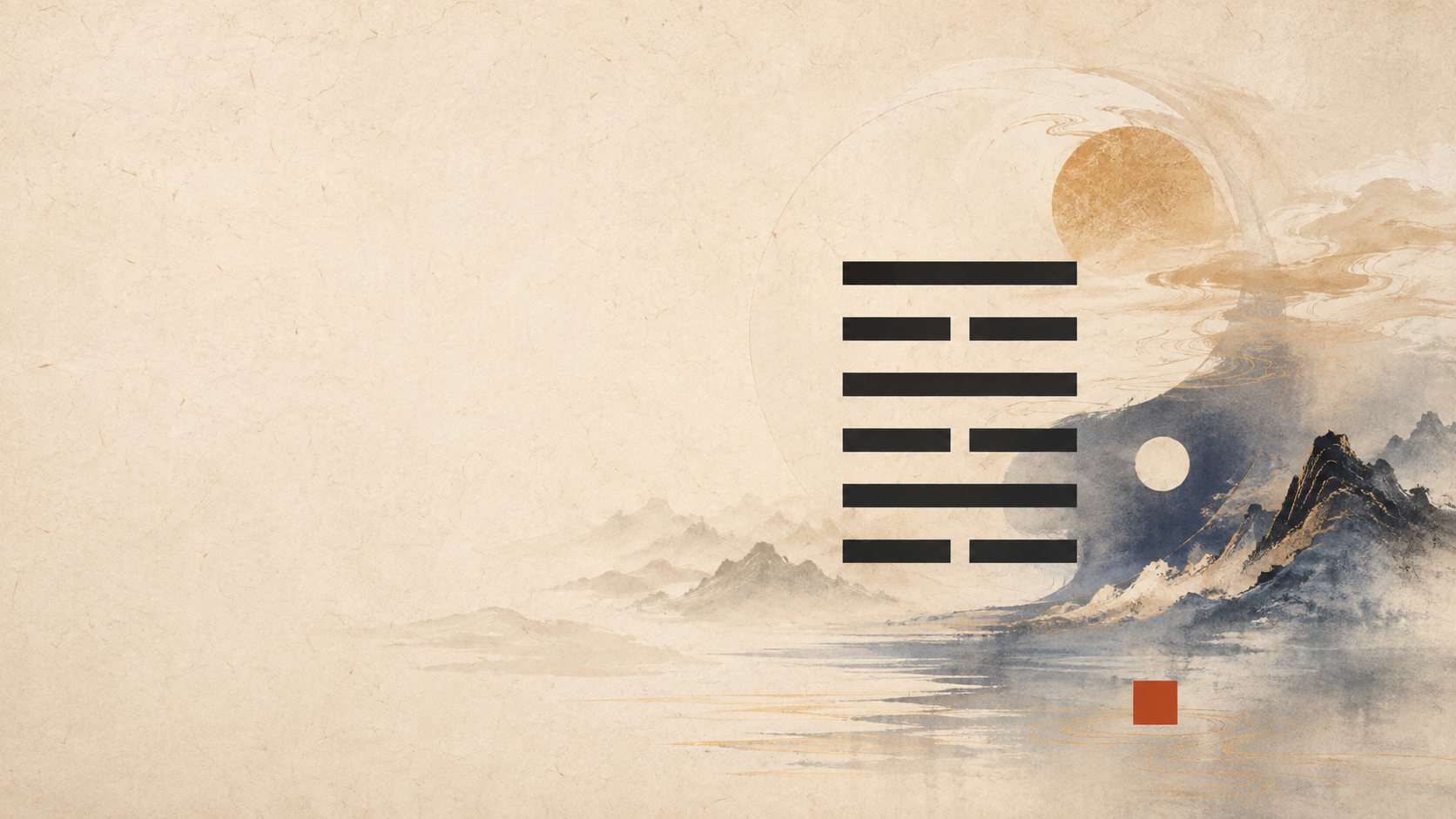
4 The Motion of the Six Lines, the Way of the Three Ultimates
4.1 The Three Powers and the Six Positions
4.1.1 "Combining the Three Powers and Doubling Them"
"The motion of the six lines is the Way of the Three Ultimates." The three ultimates are the Three Powers: Heaven, Earth, and Man. The Shuogua (Discussion of the Trigrams) says: "In ancient times, when the sages made the Changes, it was in order to comply with the principle of nature and destiny. Thus they established the Way of Heaven, calling it yin and yang; they established the Way of Earth, calling it the yielding and the firm; they established the Way of Man, calling it benevolence and righteousness. They combined the Three Powers and doubled them, and so the Changes forms its hexagrams from six lines." The reason the lines number six is that Heaven, Earth, and Man each occupy two lines. The six lines of a single hexagram are precisely the Three Powers of Heaven, Earth, and Man, each divided into yin and yang.
The Lower Xici states it more directly: "As a book, the Changes is vast and complete, embracing all things. Within it are the Way of Heaven, the Way of Man, and the Way of Earth. It combines the Three Powers and doubles them, hence six. The six are nothing other than the Way of the Three Powers." The six lines are nothing other than the Way of the Three Powers. These two passages serve as commentary on this chapter's "the motion of the six lines is the Way of the Three Ultimates." The motion of the six lines is the very motion of the Way of the Three Ultimates.
That this clause is placed after the four clauses "is the image of..." is deliberate. The first four clauses translate the hexagram and line statements into human affairs and the timing of Heaven; this clause then explains the underlying structure on which the hexagrams and lines as a whole depend. Fortune and misfortune, regret and remorse, change and transformation, the firm and the yielding -- all are contained within the six lines; and the six lines are able to contain all of this because they combine within themselves the Three Ultimates of Heaven, Earth, and Man.
4.1.2 Among the Three Ultimates, Man Occupies the Middle
In the arrangement of the Three Ultimates within the six lines, Earth lies below, Man in the middle, and Heaven above. Man occupies the middle position. This arrangement is itself significant. Man does not stand outside Heaven and Earth, looking upon them; Man stands between Heaven and Earth, a part of the whole that Heaven and Earth together constitute. Man's advance and withdrawal, anxious care, loss and gain, all occur within Heaven and Earth, all are bounded by the firm and the yielding, the day and night, of Heaven and Earth.
Yet Man is not merely passive. The Shuogua says, "they established the Way of Man, calling it benevolence and righteousness." The Way of Heaven is yin and yang; the Way of Earth is the yielding and the firm; the Way of Man is benevolence and righteousness. Yin and yang, the yielding and the firm, are natural; benevolence and righteousness are what Man himself must establish. Among the Three Ultimates, Man alone must "establish" his own Way. Heaven has no need to establish its Way; Earth has no need to establish its Way; only Man must do so. This is what is distinctive about Man's place among the Three Ultimates: Man stands within Heaven and Earth, and yet must also establish his own Way within Heaven and Earth.
4.2 Man as One of the Ultimates: Able to Form a Triad
4.2.1 Master Xun's "Forming a Triad"
Master Xun (Xunzi) said: "Heaven has its seasons, Earth has its resources, Man has his governance -- this is called being able to form a triad." Heaven has Heaven's seasons, Earth has Earth's resources, Man has Man's governance; the three together are called forming a triad. To form a triad means to become three, that is, for Man to stand alongside Heaven and Earth as their equal, a third. This line of Master Xun's states Man's place among the Three Ultimates as plainly as possible. Man is not an appendage of Heaven and Earth; Man is a third party standing alongside Heaven and Earth.
Master Xun continues: "To abandon the means by which one forms the triad, and instead to long for what the triad accomplishes, is confusion." To abandon one's responsibility as the third party, and instead look to Heaven and Earth to provide, is folly. Man's responsibility is "governance," seeing to his own affairs properly. Heaven's seasons and Earth's resources do not depend on Man; Man's governance depends on Man. This carries the same meaning as what was said earlier: "the root does not depend on Man; the moment is what Man pursues." Although Master Xun belongs to the branch of Confucianism that places greater emphasis on human effort, on this point -- that Man stands alongside Heaven and Earth as their equal, a third -- he accords entirely with the Changes' doctrine of the Three Ultimates.
This chapter says, "the motion of the six lines is the Way of the Three Ultimates" -- the motion of the six lines is the Way of the Three Ultimates. Since Man is one of the Three Ultimates, the motion of the six lines includes Man's own share. The change and transformation of the hexagrams and lines is not something Man stands by and watches; Man himself moves within it. This is the premise for understanding what follows -- "dwelling, the noble person observes the images; acting, he observes the changes": the noble person's observing of images and observing of changes is not the observing of another's images and another's changes, but the observing of the very images and changes in which he himself takes part.
4.2.2 The Doctrine of the Mean's "Positions" and "Nurturing"
The Doctrine of the Mean says: "When centrality and harmony are attained to the utmost, Heaven and Earth take their proper positions, and the myriad things are nurtured." When a person attains centrality and harmony, Heaven and Earth each rest secure in their proper position, and the myriad things receive nurture. This line carries the role of Man among the Three Ultimates to its furthest point. That the positions of Heaven and Earth and the nurturing of the myriad things should depend on a person's centrality and harmony does not mean that Man creates Heaven and Earth; it means that if a person loses centrality and harmony, Heaven and Earth fall out of their proper positions so far as that person is concerned; and if a person can attain centrality and harmony, Heaven and Earth each attain their proper positions so far as that person is concerned.
The word "position" here connects with the word "order" in this chapter's later line, "the repose in which the noble person dwells is the order of the Changes." That "Heaven and Earth take their proper positions" means Heaven and Earth each rest secure in their own order. That the noble person dwells in repose means the noble person rests secure in his own order among the Three Ultimates. When Man rests secure in his position, Heaven and Earth also rest secure in theirs. The Doctrine of the Mean also says: "Only the utmost sincerity under Heaven can fully realize its own nature; able to fully realize its own nature, it can fully realize the nature of other people; able to fully realize the nature of other people, it can fully realize the nature of things; able to fully realize the nature of things, it can assist in the transforming and nurturing work of Heaven and Earth; able to assist in the transforming and nurturing work of Heaven and Earth, it can form a triad with Heaven and Earth." Here too the word "triad" is used, the same as in Master Xun's saying. When Man fully realizes his own nature, he can, in the end, form a triad with Heaven and Earth.
This whole line of Confucian thought -- from the Shuogua's "they established the Way of Man, calling it benevolence and righteousness," to Master Xun's "able to form a triad," to the Doctrine of the Mean's "form a triad with Heaven and Earth" -- is speaking, throughout, of Man's place as one of the Three Ultimates. Man is one of the three, neither more nor less. To claim more is to usurp Heaven; to claim less is to abandon Man's own place. This chapter's line, "the motion of the six lines is the Way of the Three Ultimates," is precisely the root, within the Changes, from which this entire body of doctrine springs.
4.3 The Word "Motion": Not Six Positions, but a Single Way
4.3.1 "The Motion of the Six Lines" and "the Way of the Three Ultimates"
This clause speaks of "the motion of the six lines," not "the positions of the six lines." The word "motion" is crucial. The six lines are not six static compartments; they are a process in motion. The first line moves to the second, the second moves to the third, and so on upward, until the top line, where it must change once again. The motion of the six lines is a temporal process running from bottom to top, from beginning to end. This accords with what was said earlier -- "the firm and the yielding are the images of day and night": the six positions of the six lines are likewise six phases of time.
The Way of the Three Ultimates is likewise a way, not three compartments. A way is a road, something walked. Heaven, Earth, and Man, the Three Ultimates, are not three fixed positions, but the operation of three roads. The Way of Heaven operates, the Way of Earth operates, the Way of Man operates, and the three together become the motion of the six lines. So when this chapter says, "the motion of the six lines is the Way of the Three Ultimates," it matches one word of motion with another word of motion. The lines are in motion, and the Way is in motion.
This point helps in understanding "dwelling" and "acting" as they appear later in the chapter. Since the six lines are themselves in motion, the noble person's "dwelling" is not a state of static immobility, but a finding of repose within motion. While dwelling, the noble person observes the images and savors the statements -- the images he observes are images already in motion, and the statements he savors are statements that speak of change. While acting, the noble person observes the changes and savors the divination, which is all the more a matter of observing motion from within motion. Both dwelling and acting occur within the motion of the six lines. There is no standpoint outside that motion from which to observe it.
4.3.2 Time and Position Cannot Be Separated
When the Changes speaks of the lines, it often speaks of time and position together. Position belongs to space; time belongs to time. But within the six lines, position is time. The first line is the initial moment; the top line is the final moment. The position a line occupies is precisely the moment at which it stands. This accords with this chapter's "the firm and the yielding are the images of day and night": the firm and the yielding are position, day and night are time, and position is time.
In this light, the "order" in which the noble person dwells is likewise, at once, both position and time. To rest secure in this order is at once to rest secure in one's own position and to rest secure in one's own moment. The Da Xiang (Great Image) commentary on hexagram Gen says, "the noble person, in accordance with this, does not let his thoughts stray beyond his position." Position is order. Not letting one's thoughts stray beyond one's position is resting secure in order. But position is itself in motion, changing with time, and so not letting one's thoughts stray beyond one's position is not a matter of clinging rigidly to a single compartment, but of always resting secure in one's present position as time moves forward. This is the subject to be treated in detail in the next chapter.