Dwelling, One Observes the Images; Acting, One Observes the Changes -- Reading the Chapter "The Sage Established the Hexagrams and Observed the Images" from the Upper Xici
A line-by-line reading of the second chapter of the Upper Xici. The sage's four acts -- establishing the hexagrams, observing the images, appending the statements, clarifying fortune and misfortune -- run in exact reverse order to the noble person's four acts -- observing the images, savoring the statements, observing the changes, savoring the divination. The four clauses "is the image of..." form a chain tracing effect back to cause; "the repose in which he dwells" echoes the Doctrine of the Mean's "dwelling in ease, awaiting the Mandate"; and the chapter closes by quoting the top line of hexagram Da You, "From Heaven comes its aid," gathering the whole into the two words compliance and good faith. Grounded in Confucian and Daoist thought, and drawing on the Analects, Mencius, Laozi, Zhuangzi, Xunzi, and the Zuo Tradition, it explores how the noble person finds repose between Heaven and Earth and acts amid change.
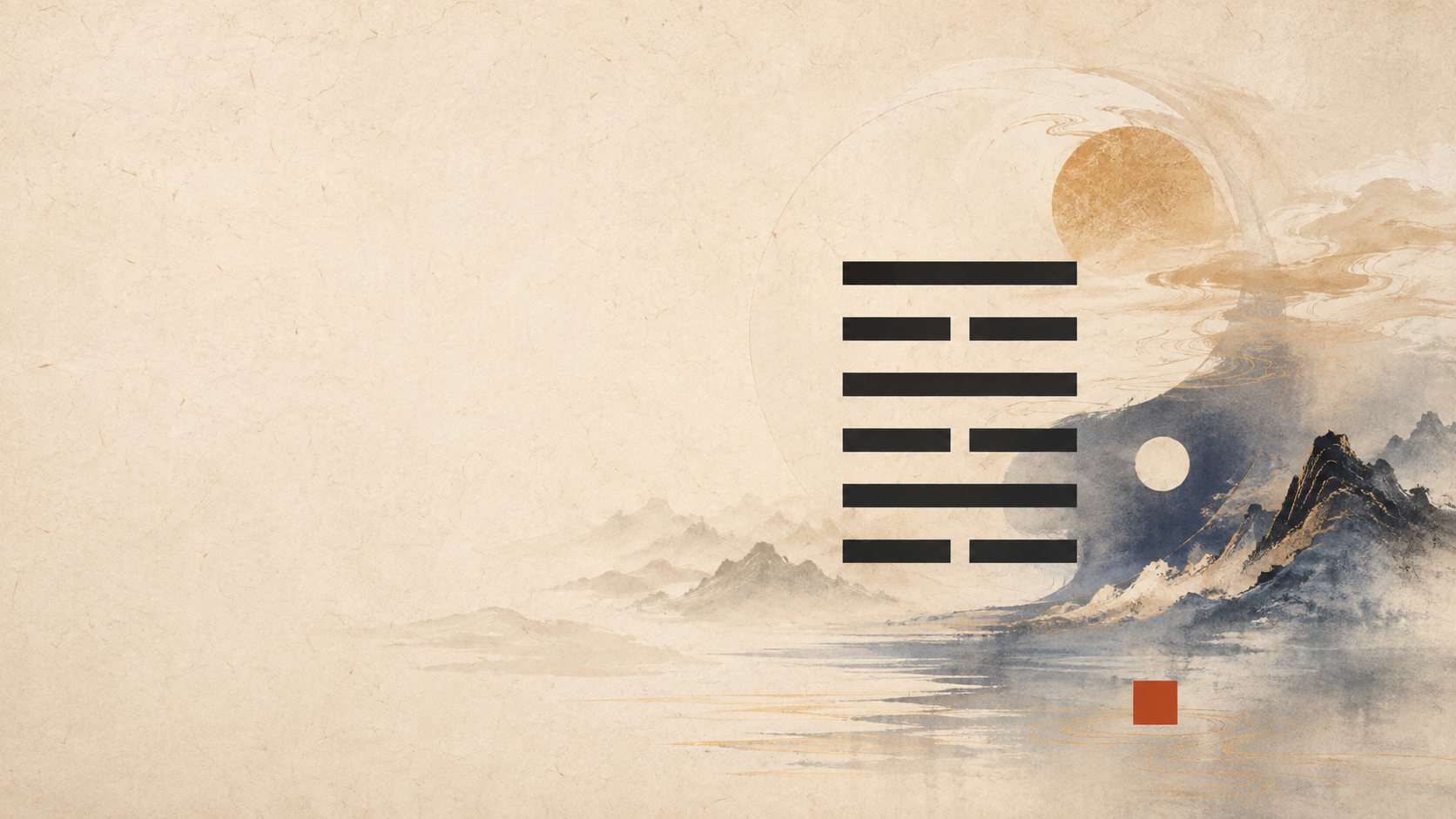
7 Dwelling and Acting: Still and Unmoving, Yet When Stirred It Penetrates
7.1 The Ontological Account of Dwelling and Acting
7.1.1 "The Changes Has No Thought and No Deliberate Action"
"Dwelling, the noble person observes the images and savors their statements; acting, he observes the changes and savors the divination." Dwelling and acting are the two pillars of this clause. What one does while dwelling, and what one does while acting, are laid out with great clarity. But where do dwelling and acting themselves originate$15 Why should the noble person's use of the Changes divide into these two halves, dwelling and acting$16
The tenth chapter of the Upper Xici says: "The Changes has no thought and no deliberate action; it is still and unmoving, and when stirred it penetrates all the affairs of the world. Were it not the most spiritually potent thing under Heaven, what could accomplish this$17" The Changes itself is without thought, without deliberate action, still and unmoving. Yet the moment it is stirred, it penetrates the affairs of the whole world. Stillness and unmoving is one state; being stirred and penetrating is another. The former is stillness; the latter is motion. The very substance of the Changes consists of these two aspects, stillness and motion.
This chapter's dwelling and acting of the noble person are precisely these two aspects of the Changes, expressed in a human being. Dwelling is stillness and unmoving; acting is being stirred and penetrating. While dwelling, the noble person observes the images and savors the statements -- he is cultivating himself within stillness and unmoving. While acting, the noble person observes the changes and savors the divination -- he is responding to the occasion at the moment of being stirred and penetrating. The substance of the Changes is thus, and the noble person who employs the Changes is thus as well. Substance and function correspond to one another.
7.1.2 Dwelling Is the Root of Acting
Dwelling and acting are not two acts standing side by side; dwelling is the root of acting. Without the cultivation of dwelling, there is nothing to draw upon at the moment of acting. If the noble person has thoroughly savored the images and statements while dwelling, then when he acts he can respond the instant he is stirred. If he has not applied himself while dwelling, and only looks things up hastily when the moment for acting arrives, he will find nothing of substance there.
The Lower Xici says: "The noble person settles his person and only then acts; puts his mind at ease and only then speaks; fixes his relations firmly and only then makes requests. By cultivating these three, the noble person achieves completeness." To settle one's person and only then act is precisely to dwell first and act afterward. Settling one's person is dwelling, is this chapter's "dwelling and resting secure." Only once the person is settled can one act. This line states, as plainly as possible, the relationship between this chapter's "dwelling in repose" and "acting, he observes the changes": repose while dwelling is the precondition for acting.
The Lower Xici continues: "To act while in peril, and the people will not join with you; to speak while in fear, and the people will not respond to you; to make requests without established relations, and the people will not join with you. When no one joins with you, those who would harm you will arrive." To act while one's person is unsettled is to act while in peril, and no one will follow. This is precisely the consequence of acting without first dwelling. So dwelling is not the opposite of acting; dwelling is the preparation for acting. The very reason the noble person can "act, observing the changes and savoring the divination," and attain fortune with nothing but advantage, is that he has already laid the groundwork of "dwelling, observing the images and savoring the statements."
7.2 Daoist Stillness and Motion
7.2.1 "Attain the Utmost Emptiness, Hold Fast to Stillness, and by This Observe the Return"
The Most High said: "Attain the utmost emptiness; hold fast to stillness with all sincerity. The myriad things arise together, and by this I observe their return." The structure of this line is identical to this chapter's structure of dwelling and acting. Attaining emptiness and holding to stillness is dwelling. The myriad things arising together is acting. Observing their return is observing from within that acting. The Most High does not mean that holding to stillness precludes watching the myriad things; rather, having held to stillness, one goes on to observe the coming and going of the myriad things. Stillness exists for the sake of observing.
This chapter's "dwelling, he observes the images" -- dwelling is stillness, and observing takes place within that stillness. The Most High's "holding to stillness with all sincerity" and then "observing the return" is likewise observing from within stillness. What the two observe is also similar: what this chapter observes is the image, that is, the configuration formed by the firm and the yielding pushing against each other; what the Most High observes is the return, that is, the pattern by which the myriad things come and go. Image and return are both patterns of change. To dwell and observe the image, to be still and observe the return -- this is one and the same discipline.
The Most High also said: "Who can, through stillness, gradually clarify what is turbid$18 Who can, through motion, gradually bring the settled to life$19" Turbid water, once stilled, gradually clarifies; a settled thing, once set in motion, gradually comes to life. Gradual clarification through stillness is dwelling; gradual coming to life through motion is acting. Stillness first, motion after; clarity first, life after. This again accords with this chapter's order of dwelling first and acting after. On this point, Confucianism and Daoism are not divided: both hold that stillness comes first and motion follows, that repose comes first and action follows.
7.2.2 "In Motion It Is Like Heaven; in Stillness It Is Like Earth"
Master Zhuang said: "In motion it is like Heaven; in stillness it is like Earth; when the single mind is settled, one may rule the world." In motion it resembles Heaven, in stillness it resembles Earth; once the mind is settled, one can rule over the whole world. This line assigns motion and stillness to Heaven and Earth respectively. Heaven is in motion; Earth is still. A person who possesses both motion and stillness thereby possesses both Heaven and Earth.
This chapter says, "the motion of the six lines is the Way of the Three Ultimates" -- the six lines combine Heaven, Earth, and Man. Man occupies the middle position, Heaven above, Earth below. Man's motion resembles Heaven; Man's stillness resembles Earth. This chapter's dwelling and acting of the noble person: dwelling takes its model from the stillness of Earth, acting takes its model from the motion of Heaven. The noble person dwelling in repose is the stillness of Earth; the noble person acting and observing the changes is the motion of Heaven. Standing between Heaven and Earth, Man possesses both.
Master Zhuang's saying, "when the single mind is settled, one may rule the world," places its emphasis on "settled." Both motion and stillness must be rooted in settledness. Settledness is this chapter's "repose." Once at repose, motion is at repose, and stillness is at repose. Without repose, motion becomes chaotic movement, and stillness becomes dead stillness. This line of Master Zhuang's likewise speaks first of settledness, and only then of motion and stillness each finding their proper place -- the very same sequence as the Great Learning's "having stability, one can be still; being still, one can be at repose," and as this chapter's "the repose in which he dwells."
7.3 "In Ordinary Dwelling, Reverent; in the Conduct of Affairs, Respectful"
Fan Chi asked about benevolence, and the Master said: "In ordinary dwelling, be reverent; in the conduct of affairs, be respectful; in dealings with others, be loyal. Even if you go among the barbarian tribes, these must not be cast aside." "Ordinary dwelling" and "the conduct of affairs" are precisely this chapter's "dwelling" and "acting."
To be reverent in ordinary dwelling is the discipline of dwelling. Reverence is a gathering-in, a refusal to be careless. When the noble person dwells, observing the images and savoring the statements, his heart is reverent, not idly leafing through pages. To be respectful in the conduct of affairs is the discipline of acting. Respect is concentration, a refusal to treat things lightly. When the noble person acts, observing the changes and savoring the divination, his heart is respectful, not simply taking the result and walking away. Reverence belongs to dwelling, respect to acting; together they form the noble person's state of mind across the two halves of dwelling and acting in this chapter.
"Even if you go among the barbarian tribes, these must not be cast aside" -- these two dispositions cannot be discarded even in a foreign land among barbarian peoples. This means that being reverent in ordinary dwelling and respectful in the conduct of affairs know no bounds of time or place. This chapter's account of the noble person dwelling thus and acting thus is likewise without bounds of time or place. Whatever the moment, whatever the position, dwelling means observing the images and savoring the statements, and acting means observing the changes and savoring the divination. This is precisely the Doctrine of the Mean's "acting according to one's present station," finding, wherever one is, nothing that does not suit oneself. The two halves of dwelling and acting, the two states of mind of reverence and respect, remain the same in any position whatsoever. This is the noble person's everyday life.