Dwelling, One Observes the Images; Acting, One Observes the Changes -- Reading the Chapter "The Sage Established the Hexagrams and Observed the Images" from the Upper Xici
A line-by-line reading of the second chapter of the Upper Xici. The sage's four acts -- establishing the hexagrams, observing the images, appending the statements, clarifying fortune and misfortune -- run in exact reverse order to the noble person's four acts -- observing the images, savoring the statements, observing the changes, savoring the divination. The four clauses "is the image of..." form a chain tracing effect back to cause; "the repose in which he dwells" echoes the Doctrine of the Mean's "dwelling in ease, awaiting the Mandate"; and the chapter closes by quoting the top line of hexagram Da You, "From Heaven comes its aid," gathering the whole into the two words compliance and good faith. Grounded in Confucian and Daoist thought, and drawing on the Analects, Mencius, Laozi, Zhuangzi, Xunzi, and the Zuo Tradition, it explores how the noble person finds repose between Heaven and Earth and acts amid change.
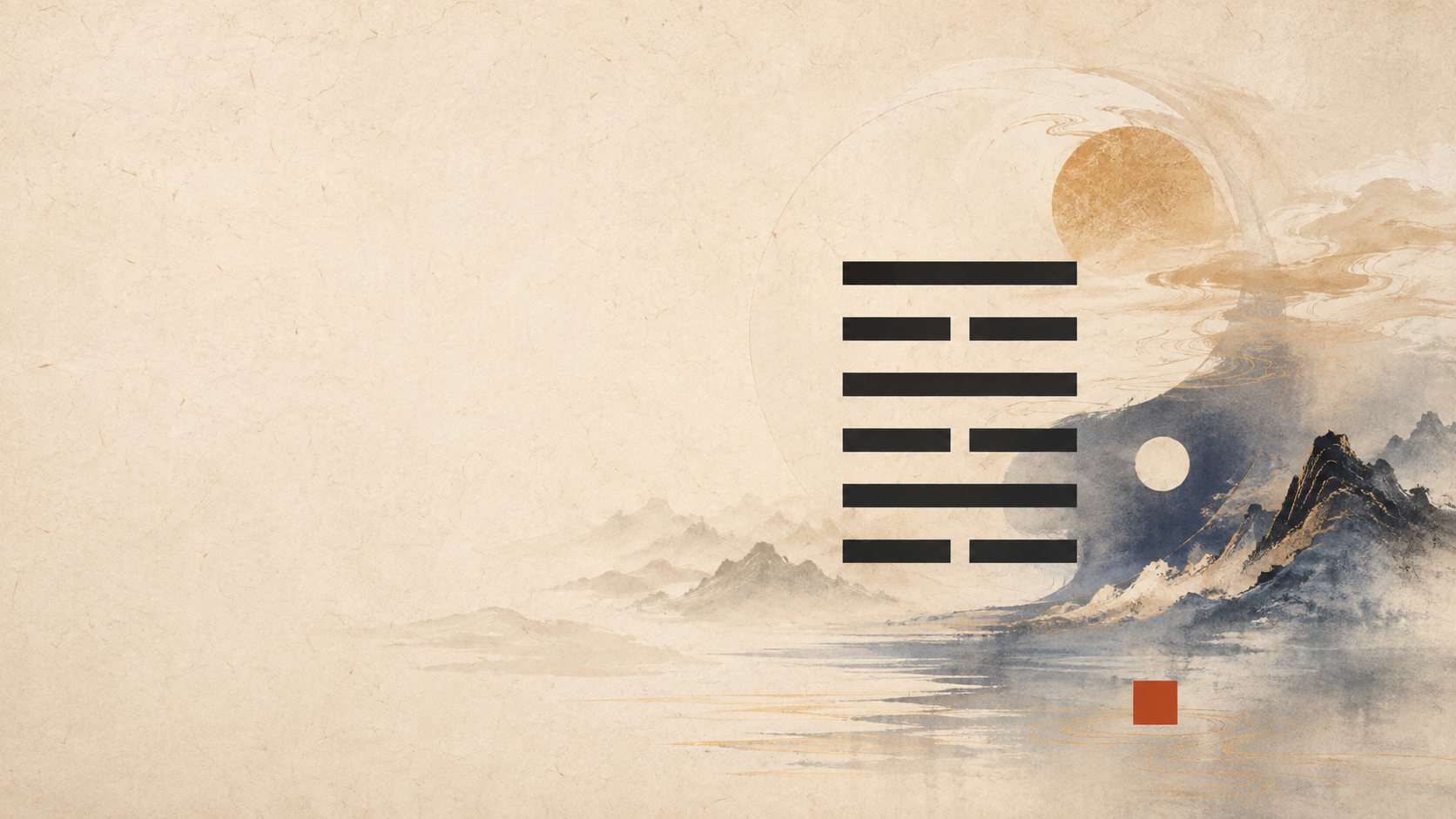
9 "From Heaven Comes Its Aid -- Fortune, and Nothing but Advantage"
9.1 The Top Line of Hexagram Da You
The final line of this chapter is: "Thus: from Heaven comes its aid -- fortune, and nothing but advantage." This is not the author's own line, but a quotation of the line statement of the top line of hexagram Da You (Great Possession). The top line of Da You reads: "From Heaven comes its aid -- fortune, and nothing but advantage." The Xiang commentary says: "The supreme fortune of Da You's top line comes from Heaven's aid."
Why does this chapter close by gathering itself into this line statement$28 The common reading takes it simply as an auspicious closing remark: act as the noble person has been described, and Heaven will grant its aid, and all will be fortunate. This reading is not wrong, but it is far too shallow. The author of the Xici would not casually quote an auspicious phrase merely to close out a chapter. This line carries a precise and deliberate resonance.
Of hexagram Da You, the Tuan commentary says: "Da You: the yielding attains the position of honor and great centrality, and those above and below respond to it -- this is called Great Possession. Its virtue is firm and vigorous, cultivated and illuminating; it responds to Heaven and acts according to the moment, and so it is sublimely prevailing." The fifth line, yielding, occupies the position of honor and holds the center, and both those above and those below respond to it. Firm and vigorous, cultivated and illuminating, it responds to Heaven and acts according to the moment. What this hexagram describes is a situation of great possession, and the very core of that situation is "responding to Heaven and acting according to the moment." The two words "according to the moment" are precisely what this chapter has been describing all along in "change and transformation are the images of advance and withdrawal" and "the firm and the yielding are the images of day and night" -- acting in compliance with the moment.
The top line is the topmost of Da You's six lines. Generally speaking, the top line marks the extremity of a position, and a position at its extremity carries the danger of arrogant excess. The top line of hexagram Qian, "the arrogant dragon has cause for regret," is precisely this principle. Yet the top line of Da You, "from Heaven comes its aid -- fortune, and nothing but advantage," carries no danger of arrogance whatsoever. Why is this$29 For the answer, we must turn to the Xici's own explanation of this line.
9.2 Compliance and Good Faith
9.2.1 The Master's Own Gloss
Later in the Upper Xici there is a passage devoted specifically to explaining this line statement: "The Changes says: 'From Heaven comes its aid -- fortune, and nothing but advantage.' The Master said: 'Aid means to assist. What Heaven assists is compliance; what people assist is good faith. Treading in good faith and thinking of compliance, and moreover esteeming the worthy -- this is why from Heaven comes its aid, fortune, and nothing but advantage.'"
This is the Master's own explanation of "from Heaven comes its aid." Aid means assistance. What Heaven assists is compliance; what people assist is good faith. Treading in good faith while thinking of compliance, and, moreover, esteeming those who are worthy -- for this reason Heaven comes to assist him, and he is fortunate with nothing but advantage. This passage is precisely the Xici's own gloss on the closing line of this chapter. Within the very same Xici, this line statement is first quoted to close Chapter Two, and later explained through the Master's own words. The author surely intended for the reader to set the two passages side by side.
Read together, the meaning of this chapter's final line comes fully into view. "From Heaven comes its aid" is not aid arriving for no reason; it is conditional -- conditional upon compliance and good faith. Compliance brings Heaven's aid; good faith brings people's aid. With Heaven's aid and people's aid together, one attains fortune with nothing but advantage. So this chapter's final line gathers everything said before it into these two words: compliance and good faith.
9.2.2 Compliance Is Resting Secure in Order; Good Faith Is Savoring the Statements
What, then, in the earlier part of this chapter, corresponds to compliance, and what corresponds to good faith$30
Compliance is "the repose in which the noble person dwells is the order of the Changes." To rest secure in order is compliance. Order is the order of Heaven and Earth, and to rest secure in order is to comply with Heaven and Earth. The Master said, "what Heaven assists is compliance" -- what Heaven assists is precisely this kind of person, one who rests secure in order. The first half of this chapter, in speaking of the firm and the yielding, day and night, change and transformation, advance and withdrawal, is throughout urging people to move in compliance with the moment. To dwell and rest secure in order, to act without ever losing the proper moment -- all of this is compliance. Compliance is what runs through the first half of the chapter, up through "that in which he dwells and rests secure."
Good faith is "that in which he delights and which he savors is the statements on the lines," together with "dwelling, he observes the images and savors their statements; acting, he observes the changes and savors the divination." Savoring the statements and savoring the divination must be rooted in good faith. Good faith is sincerity, a refusal to deceive oneself. When savoring the statements, one apprehends, in true earnest, the principle within them, not seeking some pretext; when savoring the divination, one examines, in true earnest, one's own circumstances, not seeking a lucky windfall. Lady Mu Jiang's self-examination against the four virtues, and Zifu Huibo's saying, "where the matter is one of loyalty and good faith, it may hold" -- both are good faith. The Master said, "what people assist is good faith" -- what people assist is precisely this kind of person, one who savors the statements and the divination in sincerity. Good faith is what the second half of this chapter describes.
"And moreover esteeming the worthy" -- what does esteeming the worthy mean$31 Speaking in terms of hexagram Da You, the fifth line holds the position of honor, and the top line stands above the fifth; that the fifth line can esteem this worthy top line is why the top line, though at the very extremity of the hexagram, is not arrogant. Speaking in terms of this chapter, the noble person observes the images and savors the statements; the statements were appended by the sage, and to savor the statements is to esteem the sage. The sage is the worthy one, and the noble person's learning from the sage is esteeming the worthy. This chapter opens by saying, "the sages established the hexagrams and observed the images; they appended statements to them and thereby clarified fortune and misfortune," and closes by saying that the noble person, savoring the statements, attains "from Heaven comes its aid" -- and the very reason the noble person can attain Heaven's aid is that he has esteemed the statements appended by the sage.
In this way, the relationship between this chapter's final line and the chapter as a whole becomes entirely clear. Compliance is the first half, good faith the second half, esteeming the worthy runs from beginning to end. The three together make up "from Heaven comes its aid -- fortune, and nothing but advantage." This is no casual auspicious phrase; it is the summation of the entire chapter.
9.3 The Word "From"
9.3.1 "Seeking Many Blessings for Oneself"
The word "from" in "from Heaven comes its aid" deserves separate discussion. Read literally, "from Heaven comes its aid" means an aid that comes from Heaven. But this word "from" carries a further layer of meaning: Heaven's aid is something one brings upon oneself. It is not that Heaven takes the initiative to aid someone; it is that once a person achieves compliance and good faith, Heaven's aid naturally arrives.
Master Meng said: "There is no calamity or blessing that one does not bring upon oneself." Neither calamity nor blessing is anything but something one brings upon oneself. He then quotes the Songs: "Forever matching oneself to the Mandate, seeking many blessings for oneself." To match oneself forever to the Mandate of Heaven, seeking many blessings for oneself. He also quotes the Tai Jia: "The disasters Heaven sends may still be escaped; the disasters one brings on oneself, one cannot survive." Disasters made by Heaven can still be avoided; disasters one brings upon oneself leave no way to live. In these lines, the "self" of "seeking many blessings for oneself" and the "from" of "from Heaven comes its aid" are of one and the same kind. Blessing is sought by oneself; Heaven's aid, too, is brought about by oneself.
This point echoes, from beginning to end, the word "clarify" at the opening of this chapter. The chapter opens by saying the sage "clarifies" fortune and misfortune, not creates it -- fortune and misfortune already reside within things themselves. The chapter closes with "from Heaven comes its aid" -- Heaven's aid, too, is not created by Heaven, but brought about by a person's own compliance and good faith. From beginning to end, the author of the Xici has been emphasizing one single thing: the root of fortune, misfortune, aid, and harm lies within the person himself. Heaven merely responds according to what the person does. This is the Changes' understanding of Heaven and Man: Heaven is not some external ruler, but the answer to the Way that a person walks.
9.3.2 Above, Yet Never Arrogant
Let us return to the top line of Da You. As noted earlier, the top line marks the extremity of a position, and generally carries the worry of arrogant excess. Yet the top line of Da You is fortunate with nothing but advantage. Reading through the Master's explanation, this is because the top line "treads in good faith and thinks of compliance, and moreover esteems the worthy." Though the top line occupies the very highest position, it does not consider itself exalted; instead it complies with the fifth line below it and responds to it. The fifth line esteems it as worthy, and it does not, in turn, take its own worthiness as grounds for lording it over others. This is being above, yet never arrogant.
For this chapter, the significance is this: the noble person who "dwells and rests secure" may reach even the very highest position without ever becoming arrogant. Why$1 Because what he rests secure in is order, not position. Position can rise to the very highest point, but order never changes. In the very highest position, still resting secure in order, still complying, still holding good faith, still esteeming the worthy -- then however high the position, arrogance never follows. The top line of Qian, "the arrogant dragon has cause for regret," arises because being above brings a loss of order; the top line of Da You, "from Heaven comes its aid," arises because being above brings a resting secure in order. Both are top lines, yet one has cause for regret and the other is fortunate with nothing but advantage -- the difference lies entirely in resting secure in order or not.
The Most High said, "what is high takes the low as its foundation," and also, "the reason rivers and seas are able to be kings of the hundred valleys is that they are skilled at lying below them." To occupy a high place while being able to lie low is Daoist wisdom. That the top line of Da You occupies the highest position and yet responds downward to the fifth line is precisely occupying a high place while being able to lie low. On this point, too, Confucianism and Daoism are in accord. This chapter closes with "from Heaven comes its aid -- fortune, and nothing but advantage," telling the student of the Changes: one who rests secure in order need not fear a high position. Height is not the danger; failing to rest secure in order is the danger. This, too, is the final layer of meaning within "dwelling in ease and awaiting the Mandate": one who dwells in ease is at ease in any position whatsoever, even in the very highest position.