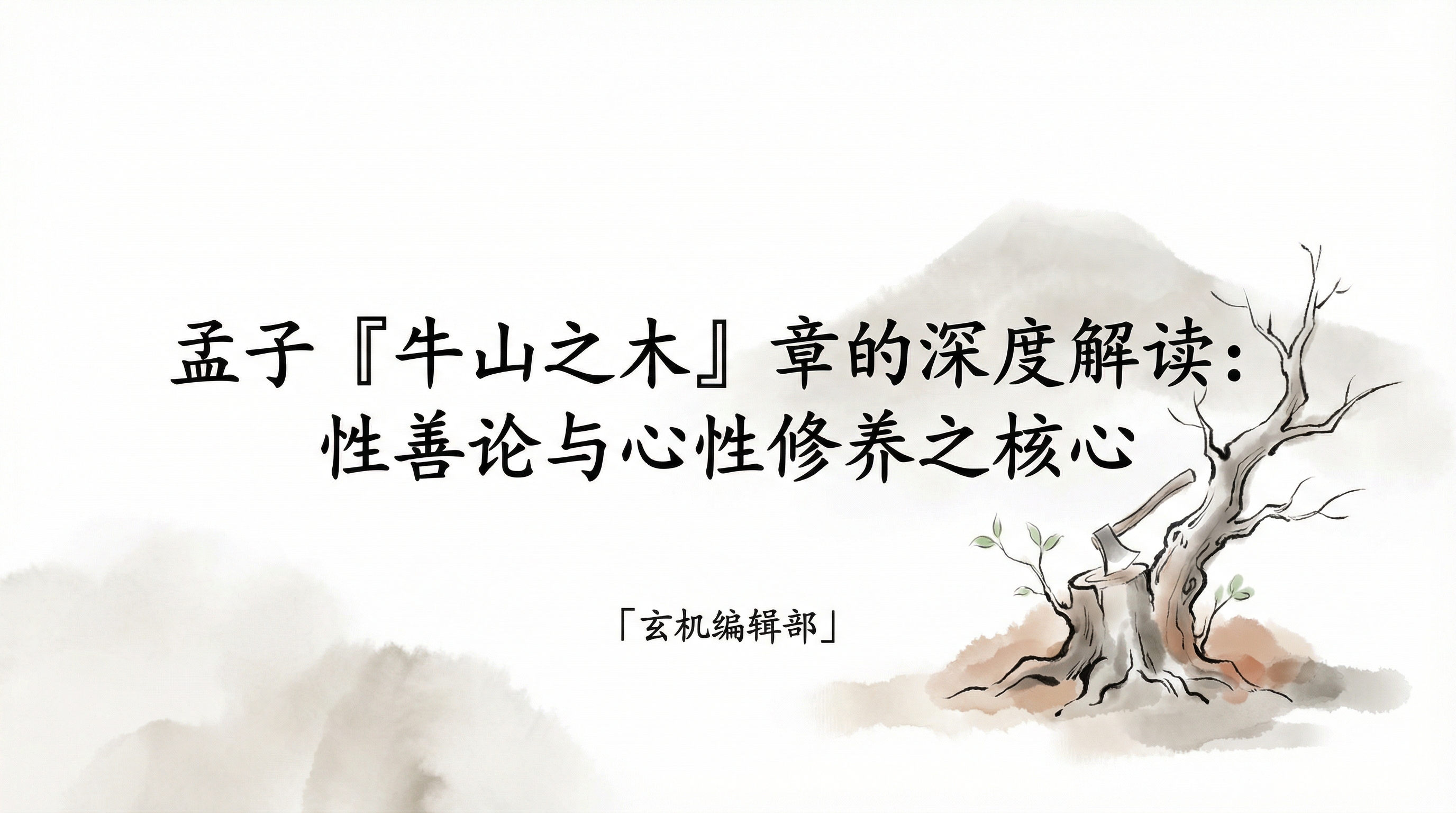
An In-depth Interpretation of Mencius' 'The Trees of Ox Mountain' Chapter: The Core of Innate Goodness and Cultivation of Mind and Nature
This paper takes the "The Trees of Ox Mountain" chapter from Mencius' "Gaozi" as its core text, integrating it with pre-Qin philosophical literature to deeply analyze the argumentative structure of innate human goodness, the mechanisms by which external environments harm the mind and nature, and the philosophical foundations and cultivation practices of the theory of innate goodness.
Chapter 12: "Thus, if they obtain nurture, nothing will fail to grow; if they lose nurture, nothing will fail to diminish" — General Discussion on Nurturing and Not Nurturing
Section 12.1 "If they obtain nurture, nothing will fail to grow" — The Power of Nurture
These two sentences are the summarizing proposition of the entire chapter, elevating the "Wood of Ox Mountain analogy" and the "discourse on the human heart" to a universal philosophical level.
"If they obtain nurture, nothing will fail to grow" (Gou de qi yang, wu wu bu zhang)—As long as appropriate nurturing is obtained, nothing fails to grow. This proposition applies to all living things: plants grow if they obtain nurture (soil, dew, sunlight); animals grow if they obtain nurture (food, water, habitat); and human goodness sprouts grow if they obtain nurture (cultivation, favorable environment, rest day and night).
"If they lose nurture, nothing will fail to diminish" (Gou shi qi yang, wu wu bu xiao)—As long as nurturing is lost, nothing fails to diminish. This proposition is the inverse of the former: plants diminish if they lose nurture, animals diminish if they lose nurture, and human sprouts of goodness diminish if they lose nurture.
The philosophical significance of these two lines is profound:
First, they establish the centrality of "Nurture" (Yang). In Mencius’s system, "Yang" is a more fundamental concept than "Xing" (Nature). Inherent goodness of nature is important, but if that goodness is not nurtured, it will also perish. Therefore, merely knowing that "nature is good" is insufficient; one must also know how to "nurture" that nature.
Second, they shift the problem of good and evil from the level of "original nature" to the level of "nurturing." The key to good and evil lies not in whether the nature is good or evil (Mencius has already argued that nature is good), but whether the nature has been nurtured. The same person, if nurtured, will be good; if un-nurtured, will be evil—the difference lies not in nature, but in nurture.
Third, they contain an optimistic conviction: as long as one "obtains nurture," goodness can be restored. Even a person whose conscience has been so eroded as to be "not far from beasts" can cause their sprouts of goodness to regrow if they begin to nurture them ("If they obtain nurture"). This provides eternal hope for moral cultivation.
Section 12.2 The Concept of "Nurture" (Yang) in Pre-Qin Literature
The concept of "Yang" has rich meanings in pre-Qin literature:
(A) Nurture for Survival (Yang Sheng)
The Book of Documents (Wuyi):
The Duke of Zhou said: "Alas! The superior man should never be idle. If he first knows the hardship of planting and reaping, he will not be idle. Only then will he know how common people depend on him. When the common people toil in planting and reaping for the parents of the ruler, their children do not know the hardship and become idle and insolent. When they become spoiled, they insult their parents, saying: 'The people of old had no knowledge.'"
The Duke of Zhou warned King Cheng not to be complacent. Complacency is the greatest threat to virtue—once a person is complacent, he ceases diligent cultivation, and the sprouts of goodness will wither. This is analogous to the Ox Mountain wood, which can grow when no one is cutting it, but if the people on the mountain stop tending the forest and allow cattle and sheep to graze, the wood will still be destroyed. "Yang" is not just "not destroying," but also "actively tending."
(B) Nurture for Life (Yang Sheng)
The I Ching (Daxu Hexagram, Image): "Heaven is above the mountain, Great Accumulation (Daxu). The superior man, by knowing the words and actions of the past, accumulates (chu) his virtue."
"Chu qi de" means to nurture one's virtue. The superior man accumulates (nurtures) his virtue by learning the words and deeds of those who came before.
The I Ching (Meng Hexagram, Judgment): "To nurture what is upright from the beginning (meng yi yang zheng), this is the achievement of the Sage."
"Yang zheng"—To establish correct conduct at the very beginning of ignorance is the achievement of the Sage. This aligns with Mencius’s idea that the sprouts of goodness must be nurtured from an early stage.
(C) Nurture of the Heart (Yang Xin)
The Mencius (Jinxin II) states:
"Cultivating the heart/mind (yang xin) is best achieved by reducing desires (gua yu). If a person has few desires, even if some things are not preserved, they will be few; if a person has many desires, even if some things are preserved, they will be few."
Reducing desires is the best way to nurture the heart/mind (nurture the conscience). The fewer the desires, the less the mountain wood (conscience) is cut, and the easier it is for it to recover and grow. This is entirely consistent with the logic of the "Wood of Ox Mountain" chapter: reduce the "axes and adzes" (material desires), and the mountain wood (conscience) can naturally recover and grow.
(D) Nurture of Qi (Yang Qi)
The Mencius (Gongsun Chou I) records:
"I am skilled at cultivating my vast, flowing energy (haoran zhi qi)."
Nurturing qi is closely related to nurturing the heart/mind. "Qi" is the intermediary between heart and body, so nurturing the heart requires achieving the nurturing of qi. The haoran zhi qi is the state of spirit when goodness is fully realized—"supremely great and supremely firm, if nourished straightforwardly and without harm, it fills the space between Heaven and Earth."
Section 12.3 Systematic Examination of the Doctrine of "Nurture" in Pre-Qin Texts
The doctrine of "Yang" (nurture) is richly and diversely explored among the pre-Qin schools:
The Book of Documents (Pan Geng):
"O you multitude of people! You do not cherish life (bu sheng sheng). If you and I, the solitary ruler, share one mind, then calamity will not descend upon you. The virtue of the Xia dynasty was like this, now I must go to destroy it."
"Bu sheng sheng" means "not taking life as life"—not cherishing life. Here, "life" (sheng) is used as a verb and a noun, meaning "cherishing life"—valuing life and caring for it.
The Book of Documents (Taishi):
"Heaven blesses the common people, and establishes rulers and teachers for them, so that they may assist the Supreme Emperor and graciously protect the Four Quarters."
Heaven blesses the people and establishes rulers and teachers to nurture them—this is the manifestation of the Heavenly Way's "life-giving virtue" (sheng de) in the political realm. Heaven does not directly govern the people but nurtures them through rulers and teachers—just as Heaven does not directly cause mountain wood to grow but nurtures it through the dew and rain and the rhythm of day and night.
The Book of Songs (Daya, Zheng Min):
"How joyous is this gentleman, whose virtue is bright and excellent. He benefits the people and benefits others, receiving his emolument from Heaven. Heaven preserves and supports his life, and continues it for him."
"Heaven preserves and supports his life, and continues it for him" (Bao you ming zhi, zi tian shen zhi)—Heaven nurtures the fate and virtue of the good man. This resonates with Mencius’s "moistened by dew and rain"—the nurturing of the Heavenly Way is a constant grace.
The Zuo Zhuan (1st year of Duke Zhao), words of Zichan:
"I have heard that the superior man has four seasons for activity: in the morning he hears official matters, during the day he makes inquiries, in the evening he corrects orders, and at night he rests his body. Thus, he regulates and loosens his qi, preventing it from becoming blocked or stagnant, which would expose his body. In this way, his heart does not falter, and the hundred matters of the state are managed. Now, if you concentrate on only one thing, illness will arise."
Zichan discusses the gentleman’s cultivation of life, emphasizing the rhythm of four phases in a day—morning, day, evening, and night, each with its function. "Rests his body at night" (ye yi an shen)—night is the time to rest and nourish the body. This is completely consistent with Mencius’s idea of "rest between day and night." Zichan also mentions "regulating and loosening the qi" (jie xuan qi), preventing it from becoming blocked. This can be cross-referenced with Mencius’s discussion of the "energy of the clear dawn."
The Guanzi (Xin Shu Shang):
"When a person is born, it is with joy. Worry disrupts the order; anger disrupts the sprouts. Worry, sorrow, joy, and anger, the Dao has no place to reside. Desire and pleasure must be quieted; disorder must be corrected. Do not pull or push; fortune will naturally return. That Dao comes on its own; it can be borrowed and consulted. If one is placid and content, the Dao remains; if one is rash and careless, the Dao perishes."
"Desire and pleasure must be quieted; disorder must be corrected" (Ai yu jing zhi, yu luan zheng zhi). If desires are excessive, use stillness to adjust; if the heart is chaotic, use uprightness to correct it. "If one is placid and content, the Dao remains; if one is rash and careless, the Dao perishes" (Tian yu, dao cun; zao hu, dao wang). This completely aligns with Mencius's statement, "If they obtain nurture, nothing will fail to grow; if they lose nurture, nothing will fail to diminish"—obtaining nurture (placid and content) preserves the Dao, losing nurture (rash and careless, sorrowful and angry) causes the Dao to perish.