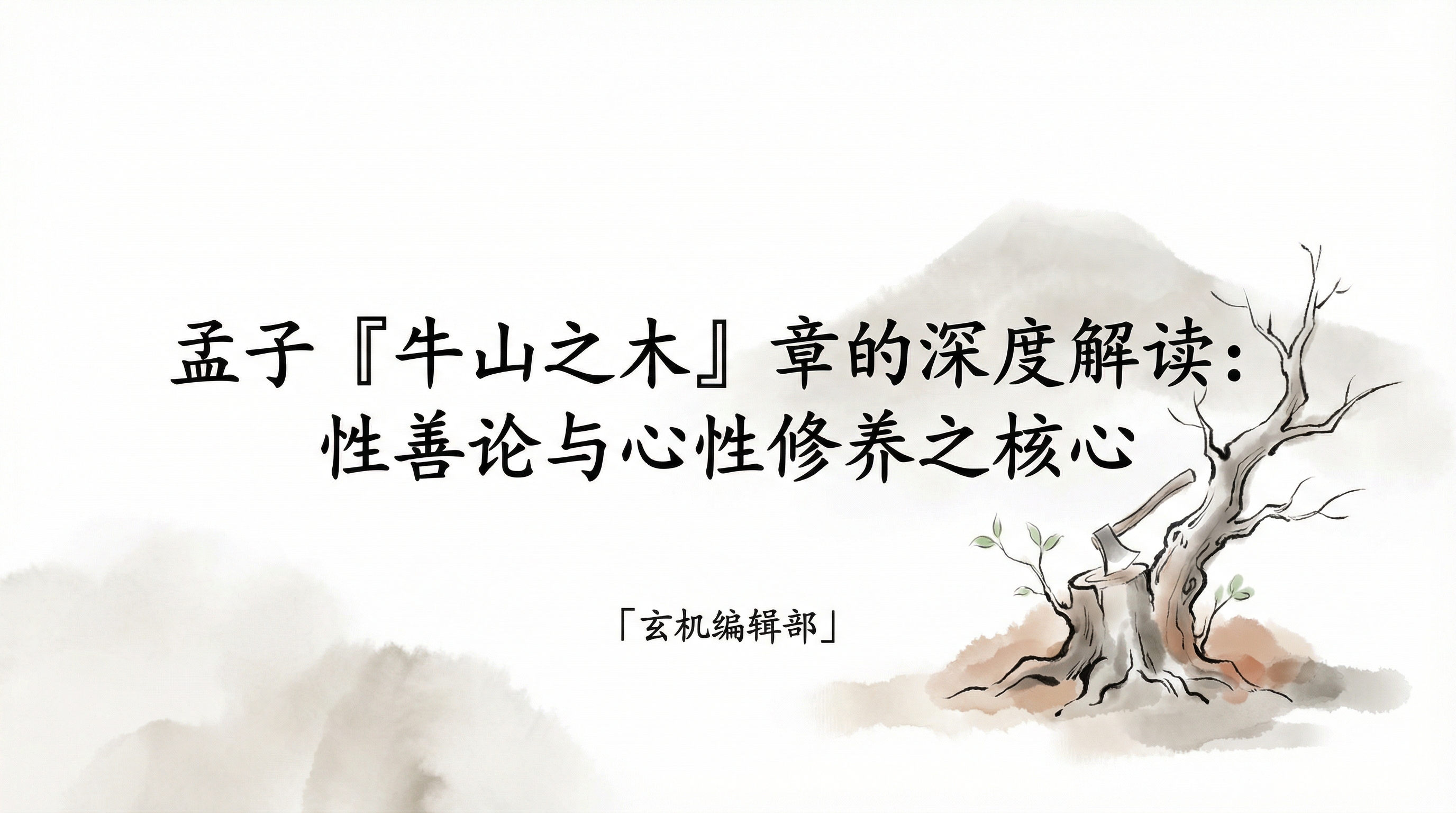
An In-depth Interpretation of Mencius' 'The Trees of Ox Mountain' Chapter: The Core of Innate Goodness and Cultivation of Mind and Nature
This paper takes the "The Trees of Ox Mountain" chapter from Mencius' "Gaozi" as its core text, integrating it with pre-Qin philosophical literature to deeply analyze the argumentative structure of innate human goodness, the mechanisms by which external environments harm the mind and nature, and the philosophical foundations and cultivation practices of the theory of innate goodness.

Part II: Thematic Inquiries into Core Ideas
Chapter 20: The Fundamental Difficulty of the Doctrine of Inherent Goodness and Mencius’s Response
Section 20.1 The Most Fundamental Question: If Nature is Good, Where Does Evil Come From$1
The greatest theoretical challenge facing the doctrine of inherent goodness is: "If human nature is inherently good, why is there so much evil in the world$2"
This question can be more precisely stated: If goodness is the original nature of man, then evil is a non-original, external phenomenon. But where does the "external" come from$3 If the external environment (society, material desire) is the source of evil, where does the evil in that external environment come from—is it not also created by man$4 If the men who create the evil environment are also inherently good, why do they create an evil environment$5
This is the circular dilemma of the "Origin of Evil": Good Nature → Man ought to do good → But man actually creates an evil environment → The evil environment causes man to lose his goodness → Man becomes ungood → The ungood man creates an even more evil environment... In this cycle, where did the initial "evil" begin$6
Section 20.2 Mencius’s Response: "Slightness" (Ji Xi) and the "Organs of Sight and Hearing"
Mencius does not directly answer the question of the "Origin of Evil" (which may be a limitation of pre-Qin thought), but his ideas contain an implicit response.
First, "The difference between man and beast is slight" (Ren zhi suo yi yi yu qin shou zhe ji xi)—The difference between man and beast is originally small. This "slightness" implies: although man has an innate nature of goodness, this goodness constitutes only a small proportion of man's total endowment. The majority of human endowments—appetites for food, sexual desire, instincts for self-preservation—are shared with beasts. Although these shared endowments are not "evil," if unchecked, they will erode that "slight" spark of goodness.
In other words, the origin of evil is not that human nature contains an element of "evil," but that the element of "good" within human nature is too weak—the sprouts of goodness are like newly sprouted shoots, while desires are like fully grown cattle and sheep. New shoots naturally cannot withstand the grazing of cattle and sheep.
Second, "The organs of sight and hearing do not think, but are obscured by things" (Er mu zhi guan bu si, er bi yu wu). The sense organs are passive—when external things arrive, the senses are attracted. This passivity causes people to pursue external things without consciously directing their inner conscience. Evil does not "arise" from some source of evil; rather, it is "formed" in the process of goodness being obscured—analogous to darkness not being a substance, but the state resulting from the obscuring of light.
Third, the chapter itself is a response—evil is the product of a "process," not "original nature." The barrenness of the mountain is not because the mountain’s nature is ugly, but because it was cut down and grazed. Likewise, human un-goodness is not because nature is ungood, but because of the process of erosion by material desires. Evil does not require a metaphysical origin (like an "evil nature"); it only requires an experiential process (external temptation → sensory pursuit → obscuring of conscience → arising of unrighteous action).
Section 20.3 Responses from Other Pre-Qin Thinkers to the "Origin of Evil"
(A) Xunzi’s Response
Xunzi (Xing E): "Now, human nature, being born, has a propensity for seeking gain; if one follows this, contention and usurpation arise, and yielding and propriety vanish."
Xunzi’s response is direct: Evil comes from natural human desires (fondness for gain, malice, lust). If one follows these natural desires (without the restraint of rites and righteousness), contention and disorder are inevitable.
However, Xunzi's response faces another difficulty: If nature is inherently evil, where does goodness come from$7 Xunzi says, "Its goodness is artificiality" (Qi shan zhe wei ye)—goodness comes from subsequent artificial construction (rites and education). But who created the rites and education$8 Xunzi says the Sages created them. But if the Sages are also inherently evil, how could they create good rites and righteousness$9 Xunzi’s answer is: "The Sages transform nature and establish artificiality; when artificiality is established, rites and righteousness arise." But "transforming nature" itself requires a power that transcends nature—where does this power come from$10 Xunzi failed to fully answer this question.
(B) Laozi’s Response
Laozi, Chapter 18: "When the Great Dao is abandoned, there arise benevolence and righteousness."
Laozi’s response is: Evil arises from the deviation from the Dao. When the world aligns with the Dao, there is no distinction between good and evil; when the world deviates from the Dao, the distinction between good and evil appears. The reason for deviating from the Dao is the growth of human cleverness and desire.
However, if the "Dao" is perfect and self-sufficient, why would it be deviated from$11 If the deviation comes from human cleverness and desire, where do cleverness and desire come from—are they not also products of the Dao$12 Laozi also failed to fully answer this question.
(C) Comparative Analysis
These three responses have their strengths and weaknesses:
Mencius’s response (Evil is the processual product of goodness being obscured) best preserves the primordial status of goodness but cannot fully explain how the "process of obscuring" initially began.
Xunzi’s response (Evil comes from natural desire) best conforms to common sense experience, but he cannot explain the ultimate source of "Goodness" (rites and righteousness).
Laozi’s response (Evil comes from the deviation of the Dao) possesses the deepest metaphysical insight, but he fails to explain why deviation occurs.
From the perspective of the "Wood of Ox Mountain" chapter, Mencius’s response, though imperfect, has the most practical guidance: Regardless of how evil originated, the key is how to "obtain nurture"—to restore the nature of goodness and nurture the conscience. Just as a doctor does not need to know how disease originated in human history, they only need to know how to treat the patient at hand. Mencius's concern is practical, immediate, and focused on the effort of cultivation.
Chapter 21: The Relationship Between Individual Cultivation and Social Environment
Section 21.1 Can Individual Cultivation Transcend Environmental Limitations$13
The "Wood of Ox Mountain" chapter raises a profound question: If a person exists in a harsh social environment ("near the suburb of a great capital"), can they preserve their conscience purely through individual cultivation$14
Mencius’s answer seems to be yes—"If held, it exists," as long as one "holds" the conscience, it remains. However, the entire chapter suggests that in a harsh environment ("cut down day after day," "repeatedly restrained"), "holding" is extremely difficult, perhaps nearly impossible—"night energy is insufficient to be preserved."
How can this contradiction be understood$15
Mencius (Teng Wen Gong II) records:
"To dwell in the greatest dwelling in the world, to stand in the most correct position in the world, and to walk the greatest Dao in the world. If successful, follow it with the people; if unsuccessful, walk the Dao alone. Riches and honor cannot corrupt him; poverty and humility cannot move him; military might cannot bow him. This is what is called the Great Man."
"Riches and honor cannot corrupt him, poverty and humility cannot move him, military might cannot bow him"—this is the "Great Man" who can uphold his conscience in any circumstance. However, very few people can achieve this level. For the majority of "common people," the influence of the environment is decisive—"The common people cast it away, but the superior man preserves it" (the "slight" difference between man and beast is lost by the common people, preserved by the superior man).
Therefore, Mencius’s answer is layered:
For the individual: The effort of cultivation can, in theory, transcend environmental limitations ("If held, it exists"), but it is extremely difficult in practice—requiring immense willpower and wisdom.
For society: Individual cultivation is insufficient; a benevolent social environment is required to nurture the sprouts of goodness in the people. This is why Mencius is not just a moral philosopher but also a political thinker—he knew well that without a social environment of benevolent governance, the sprouts of goodness in most people cannot be nurtured.
Section 21.2 Mencius’s Confrontation with Environmental Determinism
Although Mencius acknowledges the immense influence of the environment, he is by no means an environmental determinist. He insists that man possesses the capacity for active choice—the choice to "hold" or "release" the conscience.
Mencius (Gongsun Chou I) records:
"Is an arrow-maker less benevolent than a sheath-maker$16 The arrow-maker hopes his arrows wound people, while the sheath-maker hopes his sheaths protect people. The same is true for carpenters. Thus, the craft one chooses must be taken seriously. Confucius said: 'To live in a benevolent neighborhood is praiseworthy. If one chooses not to dwell where benevolence is, how can one be considered wise$17'"
This passage discusses how the nature of one's profession influences morality: the arrow-maker hopes his arrows injure people, while the sheath-maker hopes his sheaths protect people—it is not that the arrow-maker is inherently more wicked than the sheath-maker, but the nature of the craft dictates it. Thus, "the craft one chooses must be taken seriously"—one must be cautious in choosing one's profession.
The key word here is "choose" (ze): people can choose to live in a benevolent neighborhood (li ren wei mei) and choose professions that benefit others. This capacity for choice itself demonstrates that man is not completely determined by his environment—man has agency and can, to a certain extent, choose his own environment.
However, the prerequisite for this capacity to choose is that the conscience still exists—if the conscience is completely lost ("night energy insufficient to be preserved"), man loses the ability to make correct choices and truly becomes a slave to his environment. This critical threshold makes "early cultivation" paramount—one must "hold" the conscience while it still exists, and not wait until the "night energy is insufficient to be preserved" to regret it. This parallels the I Ching, Kun Hexagram (Wenyan): "The family that accumulates goodness will surely have overflowing blessings; the family that accumulates non-goodness will surely have overflowing calamities. ... A minister murdering his ruler, or a son murdering his father—this is not the result of a single day or a single night; the origin has been gradual, resulting from not distinguishing it early." If one fails to distinguish and stop it early, by the time evil actions accumulate to the tipping point, it is too late.
Chapter 22: The Cosmological Context of the Ox Mountain Chapter
Section 22.1 The Homomorphism of the Heavenly Way and the Human Heart
The "Wood of Ox Mountain" chapter is not just a treatise on moral philosophy but also contains profound cosmological implications. Mencius uses natural phenomena (the growth and destruction of mountain wood) to analogize the existence and loss of the human conscience. What is the basis for this analogy$18 It is the homomorphism—the shared structure—between the Way of Heaven and the Way of the Human Heart.
The I Ching (Xici Zhuan) states:
"The greatest virtue of Heaven and Earth is Life (sheng)."
The greatest virtue of Heaven and Earth is "Life"—the creation and nurturing of all things. When embodied in the natural world, this "Life" virtue results in the growth of all things (the beauty of mountain wood); when embodied in the human heart, it results in the sprouting of goodness (the heart of benevolence and righteousness). The growth of mountain wood and the sprouts of the human heart are both manifestations of the Heavenly Way's virtue of "Life" at different levels—they share the same metaphysical source.
Therefore, when Mencius says, "That which rested day and night, moistened by dew and rain, was not without the sprouting of new shoots," he is not merely making a comparison, but revealing a cosmological fact: the sprouting of mountain wood and the recovery of the sprouts of goodness are both manifestations of the Heavenly Way’s virtue of "Life-giving." The Heavenly Way ceaselessly creates and nurtures all things; this power is everywhere—even in the most devastated place (the barren Ox Mountain, the conscience-less human heart), the Heavenly Way's power of "Life" is silently at work.
This cosmological context gives Mencius’s doctrine of inherent goodness a firm metaphysical grounding: Goodness is not just a human value judgment; it is a fundamental property of the cosmos itself. The Heavenly Way has "Life" as its virtue, thus the Heavenly Way is good; human nature issues from Heaven's decree, thus human nature is also good. This is the ultimate meaning of "What Heaven imparts is called Nature."
Section 22.2 Yin-Yang Fluctuation and the Alternation of Good and Evil
The argumentative structure of the "Wood of Ox Mountain" chapter—the alternation between daytime evil (destruction) and nighttime rest (good)—corresponds perfectly with the cosmological rhythm of Yin and Yang fluctuation.
Day is Yang; Night is Yin. Motion is Yang; Stillness is Yin. Felling is Yang (active destructive force); Rest is Yin (passive restorative force). Erosion by material desire belongs to Yang (active outward force); Recovery of conscience belongs to Yin (passive inward force).
In the normal cosmic rhythm, Yin and Yang are balanced—day and night are equal, motion and stillness are balanced. However, in the case of the "Wood of Ox Mountain," the Yang (destructive force) overwhelms the Yin (restorative force)—daytime felling exceeds nighttime recovery, resulting in a net negative effect. This is a state of Yin-Yang imbalance.
The goal of cultivation is to restore the balance of Yin and Yang—to reduce the excess of Yang (material desire) and enhance the nurturing of Yin (night energy), allowing the sprouts of goodness to recover and grow. This resembles the image of the Tai Hexagram (☷ above ☰ below, Heaven over Earth), symbolizing the ideal state where Heaven and Earth intermingle and all things communicate, where superiors and inferiors are in harmony and unified in purpose. The goal of cultivation is to realize this state of "Peace/Harmony" (Tai) within the human heart—goodness fully grows, material desires are appropriately restrained, and Yin and Yang are harmoniously balanced.
Conversely, if Yin and Yang are severely imbalanced—Yang (material desire) expands excessively while Yin (sprouts of goodness) shrinks excessively—the situation resembles the Pi Hexagram (☰ above ☷ below, Heaven over Earth). The Pi Hexagram symbolizes a state of blockage where Heaven and Earth do not connect and all things stagnate. When the human heart is in this state—goodness completely obscured, conscience entirely lost—it is when "night energy is insufficient to be preserved, then one will not be far from birds and beasts."
Section 22.3 The Fu Hexagram and "Night Energy" — Returning from the Lowest Point
We have already noted the correspondence between the I Ching's Fu Hexagram and Mencius’s doctrine of "Night Energy." Let us explore this further.
The Fu Hexagram (☷ above ☳ below, Earth over Thunder): Five Yin lines above, one Yang line below. After the Yang energy has been completely covered by Yin (Kun, pure Yin), it begins to return from the very bottom.
This image perfectly corresponds to the process of the conscience beginning its faint recovery, as described by Mencius:
- Kun Hexagram (Pure Yin) = The state where conscience is completely lost (analogous to "as barren as that").
- Fu Hexagram (One Yang returning) = The state where conscience begins to faintly recover (analogous to "the energy of the clear dawn, how close their likes and dislikes are to those of other people, is but slight").
Although the single Yang in the Fu Hexagram is weak, it represents a turning point—the Yang energy has begun to rise. Similarly, the "Energy of the Clear Dawn," though possessing only a "slight" sense of goodness, represents the beginning of the conscience’s recovery. As long as this small recovery is protected and nurtured (not extinguished by "daytime actions"), it will gradually grow stronger, eventually leading to full restoration.
The I Ching (Fu Hexagram, Judgment): "Reversing its path, it returns after seven days; this is the movement of Heaven."
"Returns after seven days" (Qi ri lai fu)—After seven days (a complete cycle), the Yang energy returns. This implies: Recovery takes time. One cannot rush it. The recovery of the sprouts of goodness also requires a process—it cannot be accomplished overnight, but requires continuous, patient nurturing.
"This is the movement of Heaven" (Tian xing ye)—The return of Yang energy is not something man forces, but the natural rhythm of the Heavenly Way. Man's responsibility is to "hold" (maintain awareness, prevent the sprouts of goodness from being eroded again); Heaven's responsibility is to provide the grace of "rest between day and night" and "moisture of dew and rain."
Chapter 23: "If they obtain nurture" — A Comprehensive Development of the Philosophy of Nurturing
Section 23.1 The Way of "Nurture" — From Survival to Life to Lived Experience
"Thus, if they obtain nurture, nothing will fail to grow; if they lose nurture, nothing will fail to diminish." These two sentences elevate the theme of the chapter from the level of the "heart/mind" to the level of the "myriad things," possessing universal philosophical significance.
The concept of "Yang" (nurture) can be understood on three levels:
First, Nurture for Survival (Yang Sheng)—This is the most basic level. All things require appropriate material conditions to survive—plants need water, soil, and sunlight; animals need food and shelter; humans need food, clothing, shelter, and transport. Nurturing at this level is the foundation for all other levels of nurturing.
The material aspects of Benevolent Governance discussed in Mencius (Liang Hui Wang I)—five-acre dwellings, hundred-acre fields, raising fowl and swine—belong to this level.
Second, Nurture for Life (Yang Sheng)—This level transcends mere survival, focusing on the quality and health of life.
The Laozi, Chapter 76, states:
"Man is born soft and weak; when he dies, he is stiff and hard. Grass and trees are born tender and frail; when they die, they are dry and withered. Therefore, the stiff and hard are followers of death; the soft and weak are followers of life. Thus, whoever is skilled at preserving life..."
Here, Laozi uses the contrast between the soft, weak state of birth and the hard, withered state of death in plants and humans to discuss the way of nurturing life: softness is the state of life; rigidity is the state of death. The way to nurture life is to maintain softness—not to over-use or over-consume.
Third, Nurture of Lived Experience (Yang Sheng)—This is the highest level. Nurturing at this level concerns not only physical health but also spiritual perfection—the cultivation of virtue, the purity of the heart, and the fullness of character.
Mencius's discussion of "Yang" primarily focuses on this level: "Cultivating the heart is best achieved by reducing desires" (nurturing the heart); "I am skilled at cultivating my vast, flowing energy" (nurturing qi); "To preserve one's heart and nurture one's nature" (nurturing nature).
These three levels are progressive: nurturing the body is the foundation (without the body, the heart and nature have no place to reside), nurturing life is the intermediary (cultivation effort is only possible with a healthy life), and nurturing virtue is the goal (the perfection of morality is the ultimate purpose of life).
Section 23.2 Conditions and Methods of "Nurture"
"If they obtain nurture, nothing will fail to grow"—So, what are the specific conditions for "Yang"$19
First, Time — Continuity. Nurturing requires time; one cannot seek immediate results. Intermittent nurturing like "sunning for a day, chilling for ten" is ineffective. Just as the recovery of a forest requires many years, the recovery of the sprouts of goodness requires long-term, continuous cultivation effort.
Second, Environment — Suitability. Different plants require different growing environments, but all require a suitable environment. The growth of human goodness also requires a suitable environment—distance from excessive temptation of material desire ("To live in a benevolent neighborhood is praiseworthy") and good instruction and guidance ("attending to education in the schools").
Third, Method — Correctness. Nurturing is not arbitrary; it requires the correct method.
Mencius (Gongsun Chou I) records the analogy of "pulling up seedlings to help them grow":
"There was a man in Song who was anxious that his seedlings were not growing tall, so he pulled them up. He rushed home, telling his servant: 'I am exhausted today! I helped the seedlings grow!' His son ran out to look, and the seedlings were already withered. Few people in the world do not help seedlings grow. Those who think it is useless and abandon them are those who fail to weed the seedlings. Those who help them grow are those who pull them up—not only is it useless, but it is harmful."
This parable reveals two wrong ways of "nurturing":
One is "failing to weed the seedlings"—ceasing cultivation and letting things drift. This is equivalent to "if released, it perishes." The other is "pulling up the seedlings"—over-cultivating and seeking instant results. This is not only useless but harmful.
The correct way of "nurturing" is "to nourish straightforwardly and without harm" (yi zhi yang er wu hai)—nurturing the sprouts of goodness according to their own rhythm, naturally, without forcing, distorting, or rushing. This is like a park ranger managing a forest—not cutting (not destroying), not interfering excessively (not pulling up seedlings to help them grow), but providing basic protection (preventing cattle and sheep from grazing)—and then allowing the forest to grow on its own.
Fourth, Agency — Self-awareness. Ultimately, the agent of "nurturing" must be oneself. Others can provide help (education, guidance, a good social environment), but the one who "holds" the heart can only be oneself. "Benevolence comes from oneself; does it come from others$20" (Wei ren you ji, er you ren hu zai$21 Analects, Yan Yuan)—Practicing benevolence depends on oneself, not on others.
Chapter 24: The Mystery of the Heart — "It Appears and Disappears Without Fixed Timing, No One Knows Its Whereabouts"
Section 24.1 The Ungraspable Nature of the Heart
"It appears and disappears without fixed timing, and no one knows its whereabouts" (Chu ru wu shi, mo zhi qi xiang) describes the most perplexing characteristic of the heart: it is ungraspable and unpredictable.
Why does the heart have this characteristic$22
From the perspective of pre-Qin philosophy, the heart lies between the metaphysical and the physical—it is not purely material (like the body), nor is it purely an idea (like the Heavenly Dao). It is the specific manifestation of the Heavenly Dao within man, yet it is constrained and influenced by material conditions. This "in-between" position grants the heart transcendence (it can grasp the Heavenly Dao and discern good and evil), but also limitation (it is easily obscured by external objects and influenced by passions and desires).
Because of this, the heart's behavior is not entirely predictable—you cannot be certain when it will "disappear" (be lost) or when it will "appear" (exist). Sometimes you think you have cultivated yourself to a high level, but suddenly a temptation arises, and the conscience wavers; other times, you think you have completely fallen, but a certain event touches your heart of compassion, and the conscience revives.
This unpredictability is both a difficulty and a hope in cultivation. The difficulty is: you can never relax your vigilance ("No one knows its whereabouts"—you don't know when the conscience might "run away" from what place). The hope is: even in the most desperate moments, the conscience might suddenly return ("It appears and disappears without fixed timing"—the return of conscience also follows no fixed schedule).
Section 24.2 Pre-Qin Discourse on the Unknowable Heart
The Zhuangzi, Chapter on "The Emperor of the South Sea" (Ying Di Wang), records:
"The Emperor of the South Sea was called Shù; the Emperor of the North Sea was called Hū; the Emperor of the Center was called Hùndùn (Chaos). Shù and Hū occasionally met in Hùndùn’s domain, and Hùndùn treated them extremely well. Shù and Hū planned to repay Hùndùn’s kindness, saying: 'Everyone has seven orifices to see, hear, eat, and breathe; this one alone has none. Let us try to carve them for him!' They carved one orifice a day; after seven days, Hùndùn died."
Hùndùn (Chaos) had no seven orifices—his heart was not "opened" by the senses, thus he was complete and pure. Shù and Hū carved seven orifices for him, and Hùndùn died. This allegory explains: once the heart is opened to the senses (contact with external things), it loses its original purity. This aligns with Mencius’s view that "the organs of sight and hearing do not think, but are obscured by things"—the senses introduce external things into the heart, obscuring its original clarity. "It appears and disappears without fixed timing, no one knows its whereabouts"—the heart is ungraspable precisely because it is constantly being influenced and changed by external information flowing in through the senses.
The Guanzi (Xin Shu Shang):
"The position of the heart in the body is that of a ruler. The functions of the nine orifices are like those of officials. When the heart abides in its Way, the nine orifices follow the principles. If lust and desire are fully indulged, the eye cannot see colors, and the ear cannot hear sounds. Therefore, it is said: if the ruler strays from the Way, the subordinates lose their functions."
The heart is like a ruler, the nine orifices like officials. When the ruler follows the Way, the officials follow the principles; when the ruler is filled with lust and desire, the ears and eyes lose their proper function. This reiterates that the state of the heart depends on whether it is obscured by lust and desire.
Chapter 25: Conclusion — The Enduring Significance of the Ox Mountain Chapter
Section 25.1 The Chapter’s Position in the Entire Mencius
The "Wood of Ox Mountain" chapter can be considered the "General Analogy" for the entire Mencius—it integrates Mencius’s entire thought on human nature, heart/disposition, cultivation, and politics into one complete, vivid, and layered metaphor.
Structurally, this chapter contains the following layers:
- The Goodness of Original Nature ("The wood of Ox Mountain was once luxuriant") → The basic assertion of inherent goodness.
- External Harm ("Cut down with axes and adzes," "Cattle and sheep then come to graze") → The cause of the erosion of goodness.
- The Faintness of the Sprouts of Goodness ("Not without the sprouting of new shoots," "but slight") → The goodness is eroded but not completely extinguished.
- The Path to Recovery ("Rest between day and night," "the energy of the clear dawn") → The conditions for the recovery of goodness.
- The Danger of Loss ("Restrained and extinguished," "not far from birds and beasts") → The peril of complete loss of goodness.
- Errors in Cognition ("Assuming there was never any timber/talent") → The fallacy of deducing nature from phenomena.
- The Essential Need for Nurturing ("If they obtain nurture, nothing will fail to grow") → The necessity and possibility of cultivation.
- The Effort of Holding the Heart ("If held, it exists; if released, it perishes," "the mystery of the heart") → The core of the cultivation practice.
These eight layers are tightly linked, proceeding logically and deeply, forming a coherent argumentative chain.
Section 25.2 Profound Enlightenment from this Chapter
Enlightenment 1: Goodness is man’s original face; un-goodness is acquired distortion.
The practical implication of this enlightenment is: when facing human evil, one should not despair, because evil is not human nature; when facing one's own faults, one should not abandon oneself, because the conscience can still recover.
Enlightenment 2: The faintness of the sprouts of goodness does not equal the non-existence of the sprouts of goodness.
"Slight" (ji xi) does not mean "none." Even in the darkest moments, a sliver of light remains; even in the most degenerate person, a little sprout of goodness remains. This conviction is the starting point for all moral cultivation and all social progress.
Enlightenment 3: Cultivation is a lifelong endeavor that cannot be relaxed for a single day.
"If held, it exists; if released, it perishes"—maintaining conscience requires constant vigilance. There is no final, effortless state of cultivation—if you cultivate well today but relax tomorrow, the conscience will still be lost.
Enlightenment 4: Environment is extremely important, but not decisive.
The unfavorable environment of being "near the suburb of a great capital" certainly exacerbates the erosion of goodness, but the individual's agency in "holding" provides the possibility of transcending environmental limitations. Personal cultivation efforts and the social environment of benevolent governance must complement each other.
Enlightenment 5: Nurturing is more fundamental than Teaching.
"If they obtain nurture, nothing will fail to grow"—the key is not how much moral knowledge is taught, but providing suitable conditions for the sprouts of goodness to grow (i.e., "Yang"). Excessive lecturing (like "pulling up seedlings to help them grow") is actually harmful; truly effective education is creating an environment where sprouts of goodness can naturally flourish.
Section 25.3 Returning to the Text Itself — Re-appreciating the Beauty of the Entire Passage
Let us finally read this immortal passage in its entirety once more:
Mencius said: "The wood of Ox Mountain was once luxuriant. Because it was near the suburb of a great capital, it was cut down with axes and adzes. Could it remain beautiful$23 What rested day and night, moistened by dew and rain, was not without the sprouting of new shoots, but cattle and sheep then came to graze upon it, and thus it became as barren as that. When people see it barren and assume there was never any timber, is this the nature of the mountain$24 Even those existing in men, how could they lack the heart of Benevolence and Righteousness$25 That which caused the abandonment of the good heart is just like the axe and adze to the wood; if cut down day after day, could it remain beautiful$26 That which rested day and night, the energy of the clear dawn, how close their likes and dislikes are to those of other people, is but slight. Then what they do during the day is to restrain and extinguish it. If restrained repeatedly, then the night energy is insufficient to be preserved; if the night energy is insufficient to be preserved, then one will not be far from birds and beasts. When people see him as a beast and assume there was never any talent, is this the true disposition of man$27 Thus, if they obtain nurture, nothing will fail to grow; if they lose nurture, nothing will fail to diminish. Confucius said: ‘If held, it exists; if released, it perishes; it appears and disappears without fixed timing, and no one knows its whereabouts.’ Is this not what refers to the Heart$28"
This passage, in less than three hundred characters, encapsulates the essence of Mencius’s entire philosophy on human nature, cultivation, epistemology, and politics. Its literary conciseness, apt analogies, rigorous logic, and profound emotion make it a masterpiece of pre-Qin prose and a treasure of Chinese philosophy.
The beauty of this chapter lies not only in the depth of its thought but also in its method of expression. Mencius does not discuss abstract principles using abstract concepts; rather, he uses concrete, perceptible imagery drawn from daily life (mountain wood, axes, cattle and sheep, sprouts, dew and rain, night energy, clear dawn) to present the deepest philosophical truths. This method makes profound principles experiential and tangible—the reader does not merely "understand" the doctrine of inherent goodness but "feels" the existence and loss of conscience.